
ARM’s growth has moved from the phone in your pocket to the car and the data centre
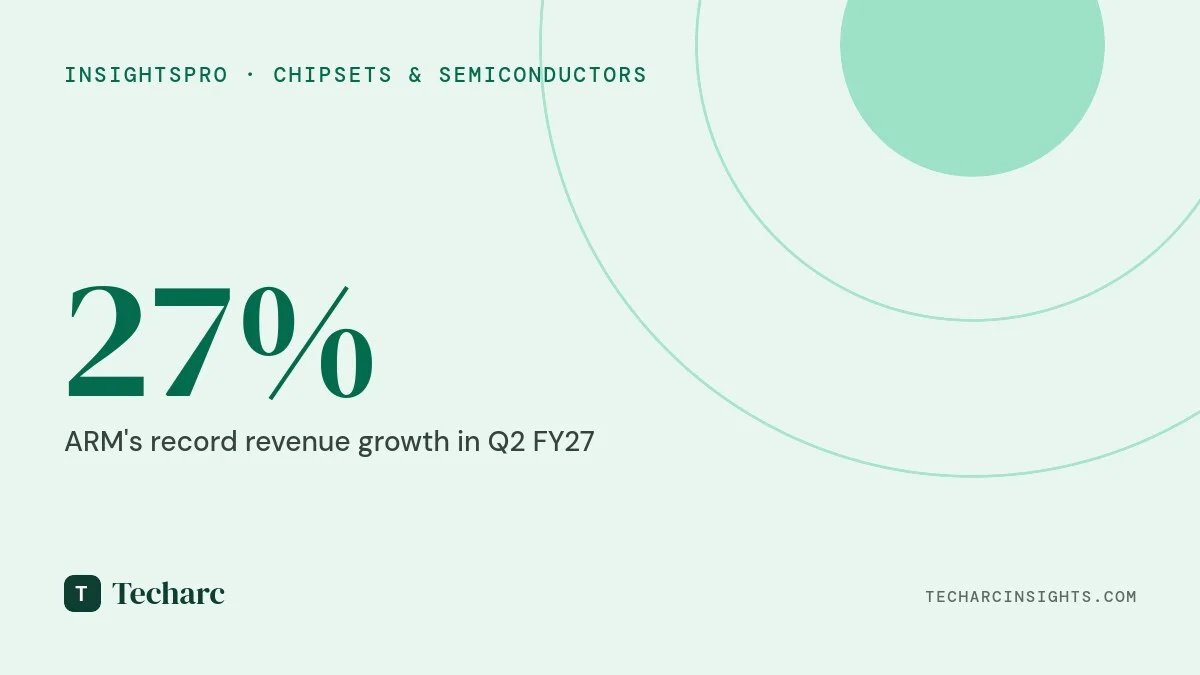
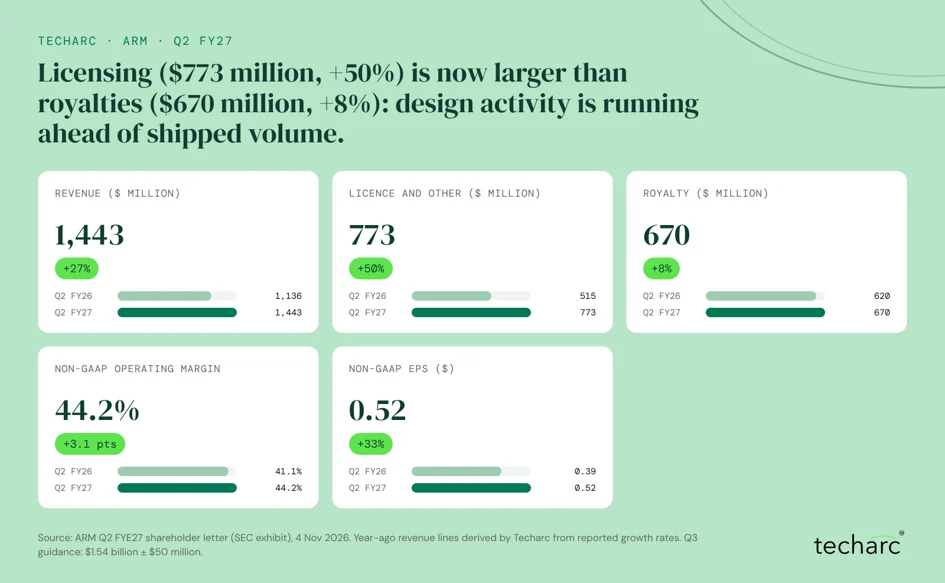
ARM posted record revenue of $1.44 billion in Q2 FY27 (Jul–Sep 2026), up 27%, but the split tells the story. Licensing, which reflects chips being designed, jumped 50%. Royalties, which reflect chips being shipped, grew only 8%, held back by smartphone royalties that suffered from high memory prices. Data centre royalties doubled and automotive royalties rose 50%. ARM still powers almost every smartphone, but the phone is no longer where its growth comes from.
Key takeaways
- Licensing ($773 million, +50%) is now larger than royalties ($670 million, +8%): design activity is running ahead of shipped volume.
- ARM says memory pricing weighed on smartphone royalties, the same pressure that SK hynix and TSMC described.
- “Physical AI” royalties (driver assistance and infotainment) grew 50%; ARM-based PCs reached about 20% of global shipments.
- ARM now sells its own data-centre chip, the AGI CPU, with up to $2 billion in revenue expected over FY27–28.
The quarter in brief
Designs are outpacing shipments
Licensing revenue comes when a chipmaker signs up to design with ARM’s technology; royalties come years later when those chips ship. A 50% licensing jump against 8% royalty growth says the industry is designing many new ARM-based chips, mainly for AI, data centres and cars, while today’s shipments, led by phones, are flat. Read alongside Qualcomm’s quarter, where handset revenue fell 26% and automotive nearly doubled, the pattern is consistent: the chip value pool is moving away from the phone.
Phones: more value per chip, fewer chips
ARM is still extracting more from each phone. Its newer Armv9 architecture and Compute Subsystems (CSS) carry higher royalty rates per chip, and CSS for Mobile 2, which ARM says boosts on-device agentic AI by 70%, has been adopted by OPPO and vivo, two brands with large Indian businesses. But memory prices are suppressing phone volumes, so higher rates are only offsetting weaker shipments.
Cars and data centres: where the growth is
- Data centre: royalties doubled. ARM says its share of servers at the top hyperscalers passed 50% in 2025 and expects over 60% by end-2026.
- Physical AI: driver assistance and infotainment royalties grew 50%, the clearest link between ARM and the connected car.
- PCs: ARM-based PCs reached about 20% of global shipments.
ARM now sells chips, not just designs
The biggest strategic change is ARM’s own data-centre processor, the AGI CPU, with purchase orders through 2027 and first deliveries due in fiscal Q4. Selling silicon makes ARM a competitor to some of its own licensees. For now that is confined to data centres; if it ever reaches phones or cars, the relationship with Qualcomm, MediaTek and others would change fundamentally.
Implications
Techarc view
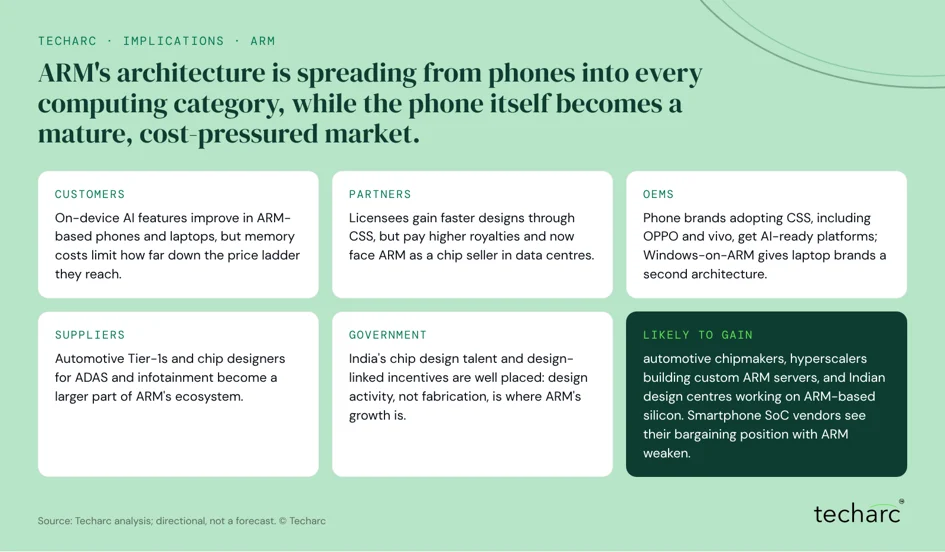
ARM’s quarter, read with Qualcomm’s, marks a turning point: the companies that grew rich on the smartphone are now growing through the car and the data centre. For India, the more relevant signal is licensing. A boom in new chip designs plays to India’s strength in semiconductor design engineering, even as its device market feels the squeeze of memory costs.
What to watch
- Smartphone royalty trend once memory prices stabilise.
- First AGI CPU deliveries and customer reaction among licensees.
- ARM’s share of automotive compute as connected-car launches increase in India.
Sources
Company filings
- ARM Q2 FYE27 shareholder letter (SEC exhibit 99.2) (4 Nov 2026)
- Techarc data: Techarc Viewpoint: Qualcomm Q4 FY26
