
Qualcomm Q4 FY26: The chip money moves from phones to cars
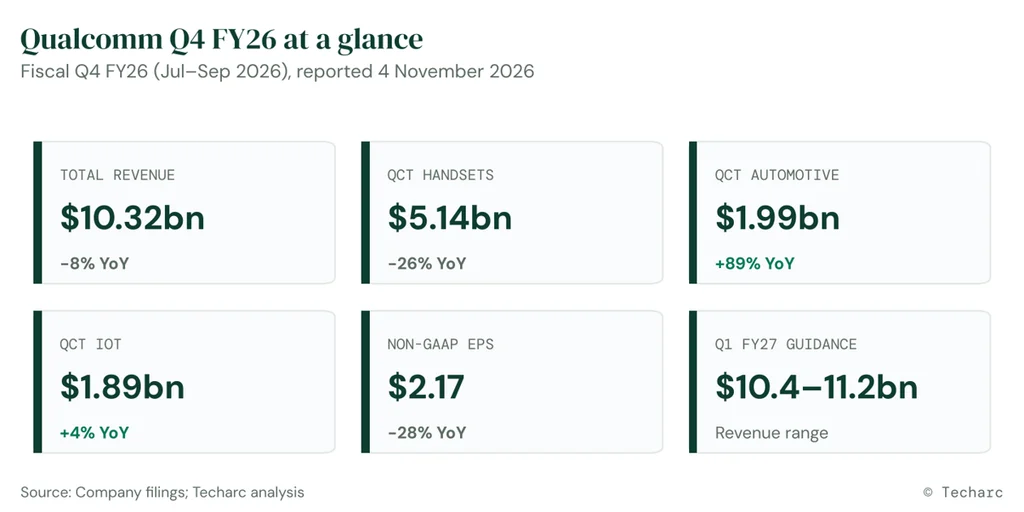
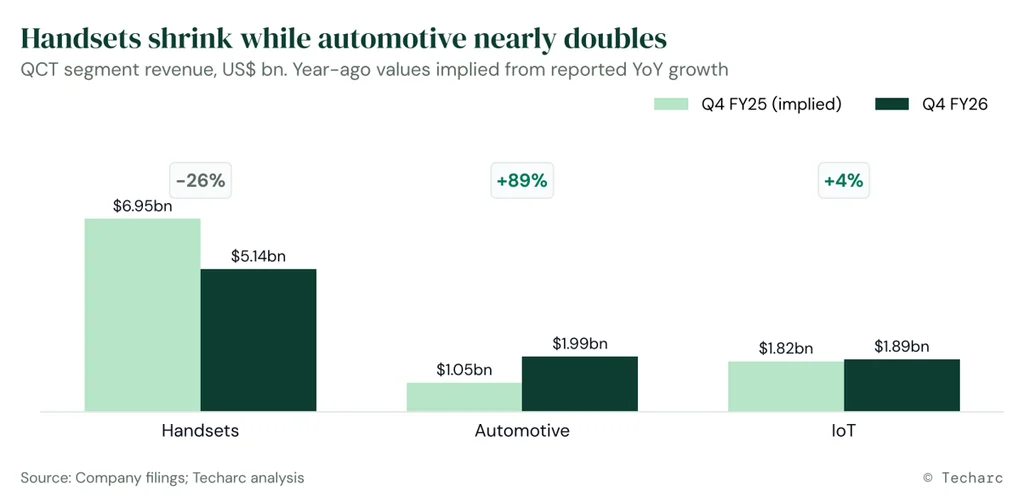
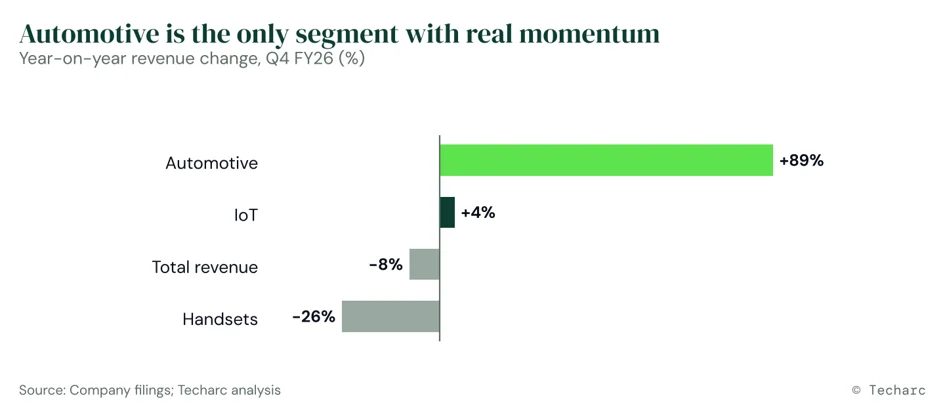
Qualcomm’s fiscal Q4 FY26 is the clearest sign yet that the smartphone is no longer the company’s only growth story. Total revenue fell 8%. Handset revenue fell 26%. Automotive revenue nearly doubled.
Headline numbers
What the numbers say
The handset decline has two causes, and only one of them is temporary. The first is memory. DRAM and NAND prices have risen sharply as AI data centres absorb supply. That raises the bill of materials for every Android phone, and OEMs respond by building fewer units or delaying launches. The second is Apple. Apple is moving iPhones to its own modem, and Qualcomm will not win that business back.
Automotive is moving the other way. At $1.99bn, automotive revenue is now close to 40% of the handset business. Two years ago it was about a seventh. Digital cockpits, connectivity and driver-assistance compute are moving into mass-market cars, and Qualcomm is the default platform for many OEMs.
The guidance also changes how the business is reported: from Q1 FY27, QCT includes Data Center. Qualcomm wants to be valued as a compute company across phones, PCs, cars and servers, not as a smartphone supplier.
The India angle
India is where both halves of this result meet. Most Android phones sold in India are in the sub-₹20,000 bands, which are the most sensitive to memory costs. When component prices rise, OEMs face two bad choices: raise prices in a market that resists them, or cut specs. Either way, unit demand for Snapdragon in India’s mass market comes under pressure in the next two quarters.
The car is the opportunity. Connected-car penetration in new Indian passenger vehicles is rising fast. SUVs from Mahindra, Tata and Hyundai now ship with large screens, embedded connectivity and over-the-air updates as standard. Each of those vehicles carries far more Qualcomm content than a budget phone.
Qualcomm also runs one of its largest engineering bases outside the US in Hyderabad and Bengaluru. India is part of how Qualcomm builds the products behind this shift, not only a market for them.
Techarc view
Qualcomm’s fiscal Q4 shows that the value in mobile chips is moving away from the handset. For Indian smartphone brands, a key supplier is now putting its growth effort into cars and data centres. Expect sharper Snapdragon pricing in the mass market as Qualcomm defends volume, and more room for MediaTek and in-house silicon.
For India’s auto industry, it is good news. A chip supplier with Qualcomm’s scale competing for the car means faster feature rollouts in mass-market SUVs and lower costs for connected-car platforms.
What to watch
- Whether Android launches in India for early 2027 come with higher prices or lower memory configurations
- Snapdragon content in upcoming Indian SUV and EV launches
- The size of Data Center revenue once it is reported inside QCT from Q1 FY27
- ARM’s licensing momentum (+50% in the same week), which points the same way: design wins are moving to AI and automotive
Sources
- Qualcomm Q4 and fiscal 2026 earnings release: https://s204.q4cdn.com/645488518/files/content_files/FY2026-4th-Quarter-Earnings-Release.pdf
- Reuters via WSAU: Qualcomm’s smartphone chip sales miss estimates: https://wsau.com/2026/11/04/qualcomms-smartphone-chip-sales-miss-estimates-shares-fall/
Techarc is an independent technology market research, analytics, and consulting firm based in India, covering consumer devices, telecom, auto-tech, and the e-commerce/D2C ecosystem across three pillars — Analytics, Research, and Consulting. techarcinsights.com
