
Why MacBooks Are Winning India’s Premium Laptop Tier
MacBooks are gaining in India’s premium laptop tier because Apple brought a premium product down to Windows price points, and buyers report almost no regret afterwards. The specs are not the reason. Techarc InfiSights tracked 116 laptop variants and 2,843 verified customer reviews between March and September 2026. The data shows three things: Apple will […]

MacBooks are gaining in India’s premium laptop tier because Apple brought a premium product down to Windows price points, and buyers report almost no regret afterwards. The specs are not the reason. Techarc InfiSights tracked 116 laptop variants and 2,843 verified customer reviews between March and September 2026. The data shows three things:
- Price. In May–June 2026, the MacBook Air M5 sold online for about ₹1.10 lakh. That was cheaper than 71% of the Windows thin-and-light laptops it competes with. The MacBook Neo was cheaper than 73% of its rivals.
- Low regret. The Air M5 averages 4.70★ across 1,552 marketplace ratings. Only 4.6% of those are 1–2★, against 14.1% for Windows rivals at the same price.
- Momentum. The Air M5 gains about 222 marketplace ratings a month. All 15 of its Windows rivals combined gain about 12. The Neo gains six times as many as the average Windows model in its tier.
Apple will hold its “Pro and Tell” event on October 28. It is expected to launch a touchscreen OLED MacBook Pro and a 14-inch MacBook Pro with an M6 chip. The question for Apple is whether it can keep this price position: tracked MacBook prices rose 12–26% between June and September.
Who each MacBook competes with
Each MacBook falls into its own price tier, so each has its own set of Windows rivals. Tiers are based on the median online street price across all months tracked. A model’s competitive set is the non-gaming Windows laptops priced around it. Gaming laptops are left out because Apple does not compete for that buyer.
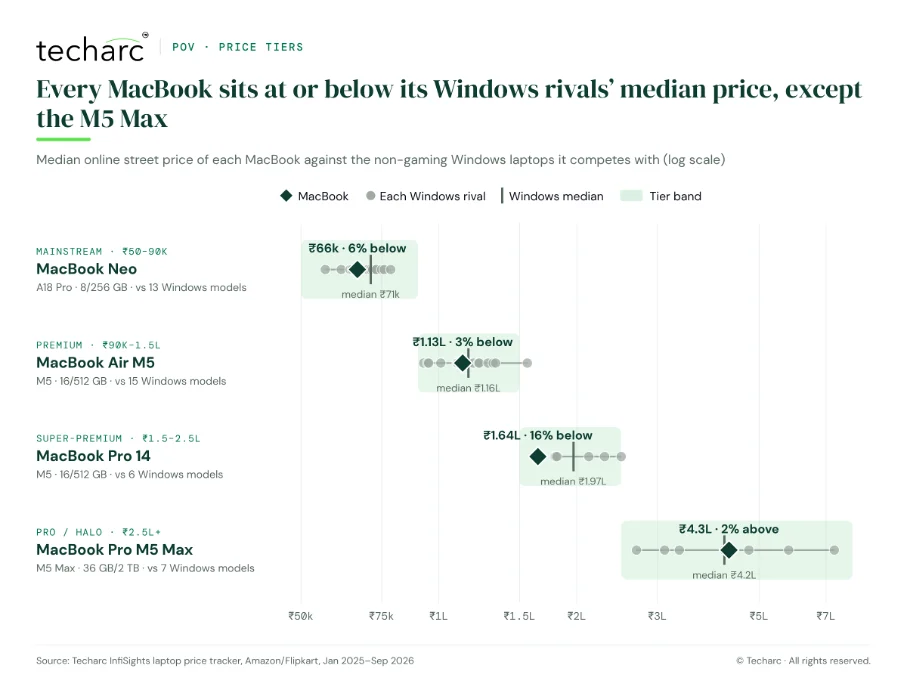
Figure 1. Price tiers and competitive sets. Each dot is a Windows rival; the diamond is the MacBook.
- Mainstream (₹50–90k), MacBook Neo: Samsung Galaxy Book 4 Edge, Motorola Moto Book 60 Pro, Lenovo IdeaPad Slim 3, HP OmniBook 3, Acer Aspire 5 AI, Dell 16 Plus, ASUS Vivobook 14/15/16/S14/S16/Go 15.
- Premium (₹90k–1.5L), MacBook Air M5: ASUS Zenbook 14, Zenbook S14, Zenbook A14, Vivobook S14/S16, Acer Swift Go 14 AI, Samsung Galaxy Book 6, Dell 14 2-in-1 Plus, Lenovo IdeaPad Slim 3 Gen 11 AI.
- Super-premium (₹1.5–2.5L), MacBook Pro 14 (M5): Samsung Galaxy Book 6 Pro, ASUS Zenbook S16, Zenbook A16, Zenbook Duo, Vivobook 14 Flip, HP OmniBook 7.
- Pro / halo (₹2.5L+), MacBook Pro M5 Max: ASUS ProArt P16, ProArt PX13, ProArt PZ14, Samsung Galaxy Book 6 Ultra, ASUS Zephyrus Duo 16.
Above ₹1 lakh, most Windows buyers who leave ratings are buying gaming laptops: ASUS TUF, Lenovo Legion, HP Omen, Dell Alienware. That segment is Windows’ moat, and nothing in this analysis suggests Apple is taking it.
Finding 1: Apple priced premium like mainstream
For most of 2026, every MacBook sold at or below the median price of the Windows laptops it competes with. The Air M5 sold at ₹1,08,300 in June, 14% below its rivals’ median of ₹1,25,990. Buyers noticed: one Air review mentions getting it “for 1 lac”. The MacBook Pro 14 (M5) sold at ₹1.61–1.64 lakh from October 2025 to February 2026, which was cheaper than all six of its Windows thin-and-light rivals.
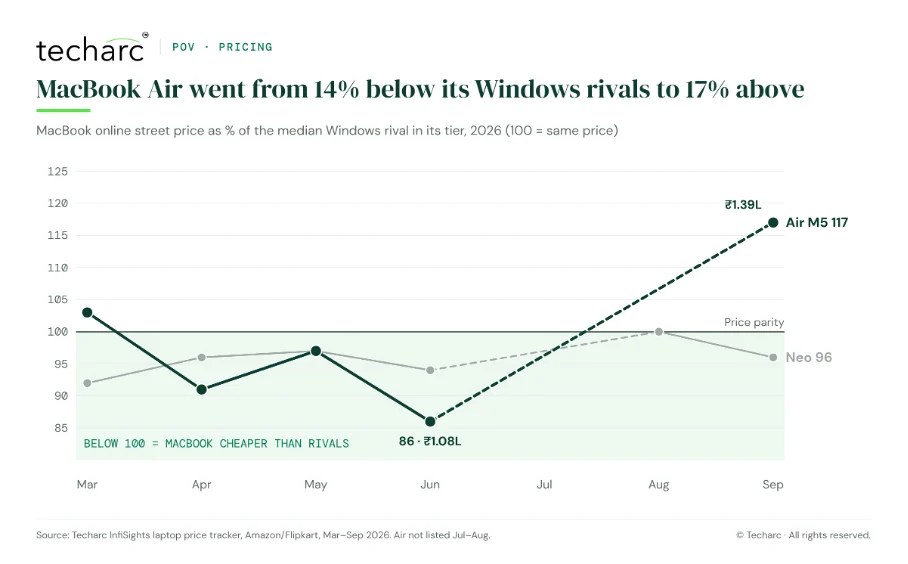
Figure 2. MacBook street price relative to the median Windows rival in its tier, March–September 2026.
That gap has now closed. From May–June to August–September, tracked MacBook prices rose 12% (Neo), 21% (M5 Max) and 26% (Air M5). Over the same period, the median non-gaming Windows laptop rose 4%. At ₹1,38,900, the Air is now cheaper than only 14% of its rivals. The M5 Max is the one MacBook that never followed this playbook: it sold at a premium over its competitive set throughout.
Finding 2: Buyers rarely regret a MacBook
At premium prices, Apple’s edge is consistency. MacBook reviewers do not praise any single spec more often than Windows reviewers do. What sets them apart is how seldom anything goes wrong. Across marketplace star ratings, 4.6% of Air M5 ratings are 1–2★, against 14.1% for its Windows competitive set. In the Neo’s tier, the gap is 4.3% against 7.6%.
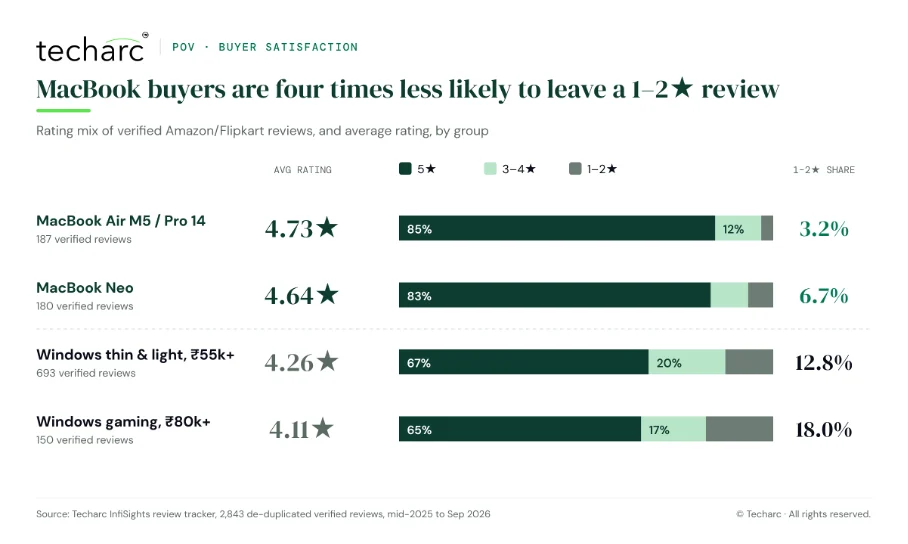
Figure 3. Rating mix and average rating of verified reviews, MacBooks vs Windows groups.
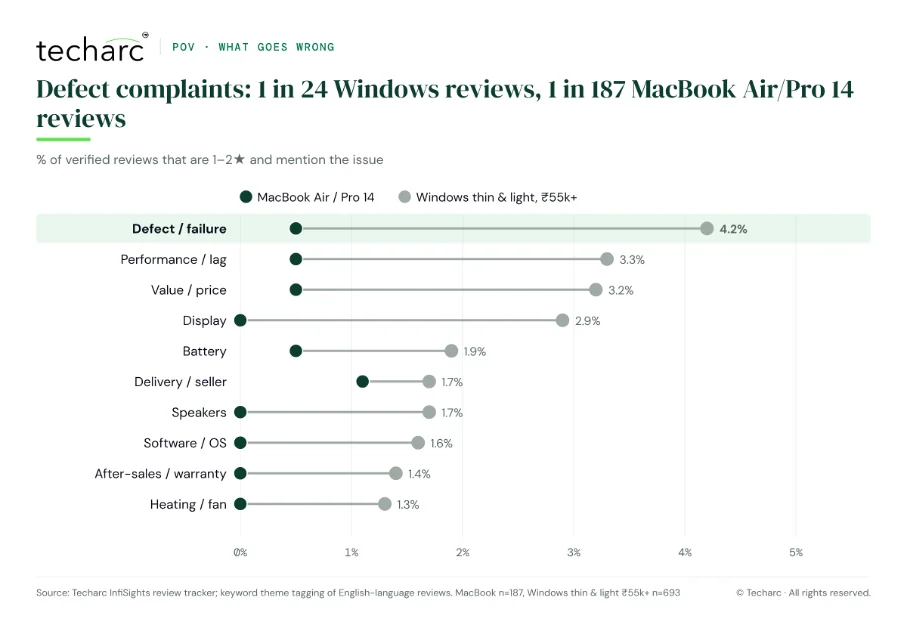
Figure 4. Complaint rates by issue: share of reviews that are 1–2★ and mention the issue.
Most MacBook complaints have little to do with the machine. Of 18 negative MacBook reviews, four are about delivery or the seller, and one is about Apple ID setup. Windows negatives concentrate on hardware: 29 of 89 mention a defect or failure, 13 mention battery, 10 mention service-centre experience and 9 mention heating.
The written reviews show buyers switching from Windows. “Switching from windows to macos feels like a big leap as if I time travelled to the future,” writes one Air M5 buyer. Another moved from an MSI laptop for software development. A Neo buyer coming from Windows cites “no glitches, no bloatware, no animation delay.” Of the Air and Pro 14 reviews, 6.4% mention a switch or a first Mac.
Finding 3: One MacBook outsells its whole Windows tier online
The speed at which a laptop collects ratings is the closest public proxy for online sales momentum. On that measure, the MacBook Air M5 is gaining about 222 ratings a month. Its 15 Windows rivals together gain about 12. If buyers of both rate at similar rates, the Air is selling roughly 19 times as many units online as its entire Windows tier combined.
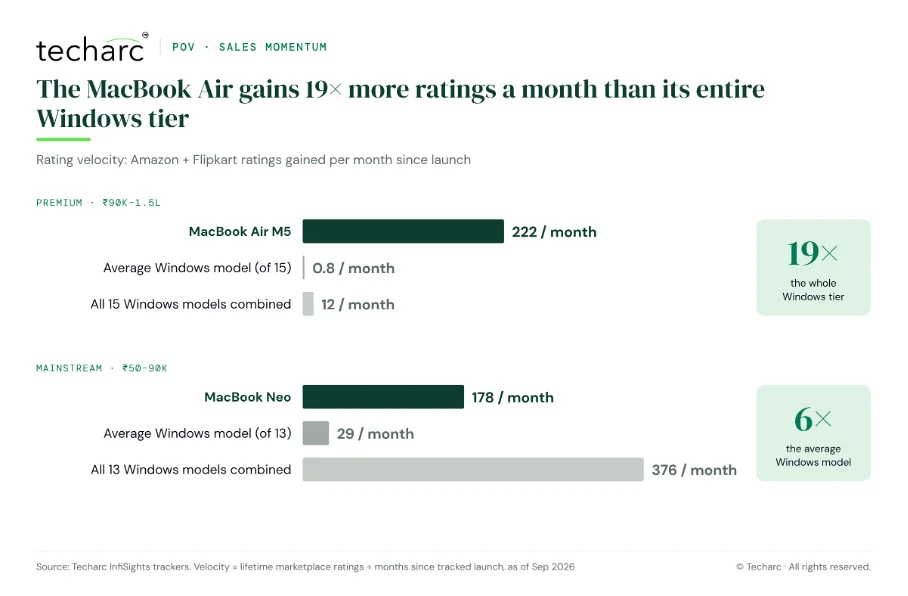
Figure 5. Rating velocity: ratings gained per month, MacBook vs the average and combined Windows rivals in its tier.
Premium (₹90k–1.5L). Since its March launch, the Air has gained about 222 ratings a month, against roughly 0.8 for the average Windows model in its tier. Only two Windows rivals register any ratings at all: the Acer Swift Go 14 AI at about 11 a month and the Dell 14 2-in-1 Plus at under one a month.
Mainstream (₹50–90k). The Neo gains about 178 ratings a month. That is six times the average Windows model in its tier (29) and 2.5 times the Motorola Moto Book 60 Pro (71). Only the Samsung Galaxy Book 4 Edge comes close, at up to 224 a month, and that figure is an upper bound because its listing predates our tracker. On its own, the Neo gains almost half as many ratings a month as all 13 Windows models in its tier combined.
How to read it. These are online proxies, not actual sales. Apple sells heavily through its own stores and offline resellers, so the figures are more likely to understate its momentum than overstate it.
Finding 4: Thinner, lighter, brighter, but not a spec-sheet win
MacBooks lead on what a buyer feels in the hand and sees on the screen. On paper, Windows rivals often match or beat them. Each MacBook below is compared against the median of its competitive set.
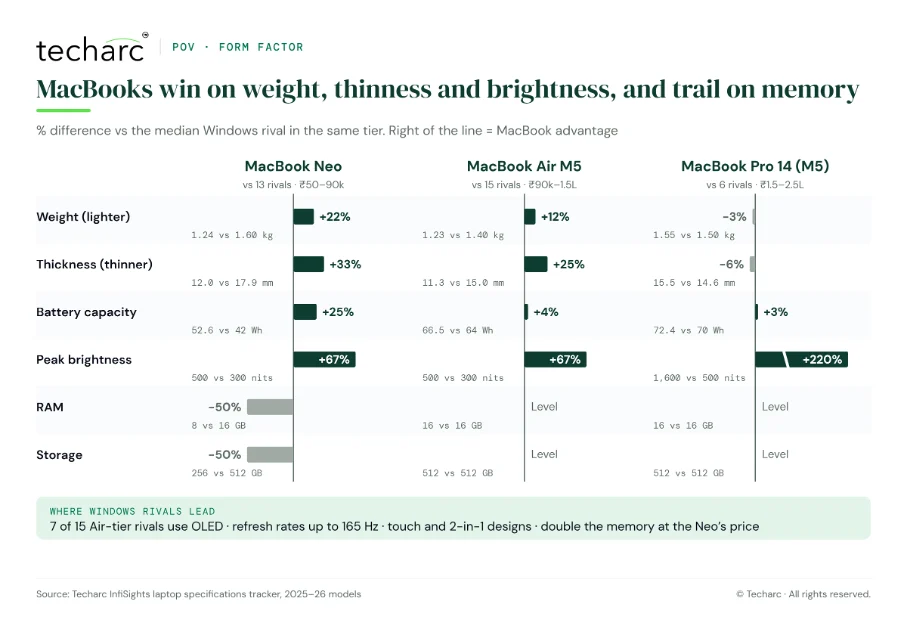
Figure 6. Spec differences vs the median Windows rival in each tier.
The Neo is 22% lighter and about a third thinner than its typical rival, but ships with half the memory and storage. The Air gives up OLED, high refresh rates and touch, all of which are common on Windows rivals at its price. Buyers have not punished Apple for that so far. They may start to if the October 28 lineup brings OLED and touch to the Mac only at higher prices.
What could stall the momentum
Apple’s lead rests on price, and the price advantage is the part that is already slipping.
- The street discount has disappeared. Tracked MacBook prices rose 12–26% between June and September. Windows rivals rose a median 4% over the same period. If that persists through the festive season, the Air goes back to looking like a luxury purchase.
- The Neo is judged on value. Its negative reviews focus on price, with complaints such as “Over priced, under powered”, the 8 GB/256 GB configuration and the missing keyboard backlight. Some reviewers say it should cost under ₹60k.
- The halo tier is unconvinced. The MacBook Pro M5 Max averages 2.2★ across only six marketplace ratings, at a tracked ₹5.1 lakh. The sample is too small to draw conclusions from, but it shows how little price tolerance there is above ₹4 lakh.
- After-sales confidence is still an open question. “The product is fantastic but I am worried about warranty norms,” writes one Neo buyer. As Apple brings in more first-time Mac buyers, its service reach outside the metros will matter more.
- Windows still owns gaming and configuration choice. Above ₹1 lakh, most Windows ratings go to gaming laptops. Rivals also offer more RAM, more storage, OLED panels and touch at each price point.
What to watch on October 28
Apple’s “Pro and Tell” event takes place in Los Angeles on October 28 at 10 a.m. PT (10:30 p.m. IST). It is billed as an “Apple Experience” rather than a keynote. Reports point to the first touchscreen MacBook Pro, with a tandem OLED display, and an M6 refresh of the 14-inch MacBook Pro. For India’s premium tier, four things will decide whether the momentum holds:
- M6 MacBook Pro 14 pricing. The M5 model sold at ₹1.61–1.64 lakh, below every Windows thin-and-light rival at that price. An M6 near that level would push further into the ₹1.5–2.5 lakh Windows tier.
- Touch OLED pricing. Reports suggest the touchscreen MacBook Pro will cost more than today’s M5 Pro and M5 Max models. That would make it a halo product, not a volume driver, and the M5 Max shows how thin halo demand already is.
- Air and Neo pricing after the event. Watch whether the 12–26% rise in tracked prices reverses with festive offers or holds because of memory costs.
- Apple closing its feature gaps. OLED and touch are the two features Windows rivals currently use to stand apart from the Mac. Apple adopting both confirms that Windows was right about them, and takes away two of their selling points.
Techarc view
“For years, the MacBook in India was an aspiration that buyers priced themselves out of. In 2026, that changed. At about ₹1.1 lakh, the MacBook Air cost less than most Windows thin-and-light laptops it competes with, and once buyers had one, they had almost nothing to complain about. That combination of a fair price and very little regret is why Apple now dominates buyer conversations in the premium tier. On October 28, the real story is not the touchscreen. It is whether Apple prices the M6 lineup to keep that position, or treats it as an opening to move back upmarket.”
For similar comprehensive analysis, subscribe to Techarc InfiSights for Laptops.
