
Lenskart’s profit is coming from its factories, not its shelves
Lenskart’s Q2 FY27 (Jul–Sep 2026) profit more than doubled on 36% revenue growth, and the reason is manufacturing, not retail. In-house frame output rose 72% and lens output 52%, so more of every pair it sells is made by Lenskart itself. That makes Lenskart less a D2C retailer and more a vertically integrated eyewear maker with a store network, and its next move, AI smart glasses, depends on exactly that capability.
Key takeaways
- Revenue from operations rose 35.7% to ₹2,845 crore; consolidated net profit rose 124.7% to ₹232.5 crore.
- EBITDA before Ind AS 116 (the closest measure to cash operating profit for a store chain) rose 65% to ₹392 crore, a 13.8% margin against 11.1% a year ago.
- International EBITDA margin stayed above 10% for a second quarter: the overseas business now adds to profit instead of diluting it.
- B by Lenskart, its AI smart glasses, reached more than 500 stores. Lenskart is the rare Indian company with the retail reach to make a wearable mainstream.
The quarter in brief
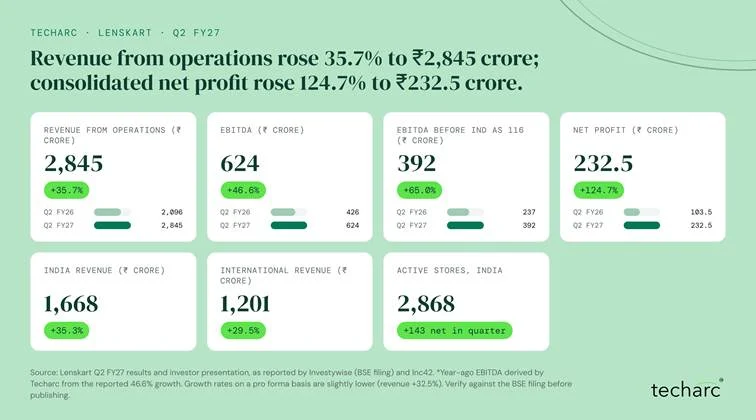
Source: Lenskart Q2 FY27 results and investor presentation, as reported by Investywise (BSE filing) and Inc42. *Year-ago EBITDA derived by Techarc from the reported 46.6% growth. Growth rates on a pro forma basis are slightly lower (revenue +32.5%). Verify against the BSE filing before publishing.
The factory behind the store
Lenskart made 36 lakh frames in-house in Q2 across India, China and Thailand, up 71.7%, and 20 lakh lenses, up 52.2%. Each pair it makes instead of buying lowers its cost and import duty and shortens delivery. That, more than store openings, is why EBITDA grew almost twice as fast as revenue.
The Bhiwadi plant uses robotics and AI-based quality checks. A second plant in Hyderabad, planned at 50 million pairs a year (roughly twice Bhiwadi), is being built mainly to serve international markets. Store-level operating leverage helped too: employee cost fell from 19.3% to 18% of India revenue.
International has turned from drag to contributor
International revenue grew 29.5% to ₹1,201 crore, and EBITDA before Ind AS 116 rose 87% to ₹127 crore, a 10.6% margin against 7.3% a year ago. With about 756 stores abroad and a supply chain run from India and Asia, Lenskart is one of very few Indian consumer brands that earns real profit overseas.
Smart glasses: the technology bet
B by Lenskart, its AI smart glasses built in-house on Google’s Gemini platform, was extended to more than 500 Indian stores and online during the quarter. Lenskart has three things most smart-glass entrants in India lack: prescription lens capability, an eye-test network, and over a crore Gold members to sell to. Whether that turns into volume is the open question; Lenskart has not disclosed unit sales.
One caution
Profit rose only 1.8% from Q1 FY27 (₹228 crore to ₹232 crore). The year-on-year doubling flatters the trend; the run-rate is steady rather than accelerating.
Implications
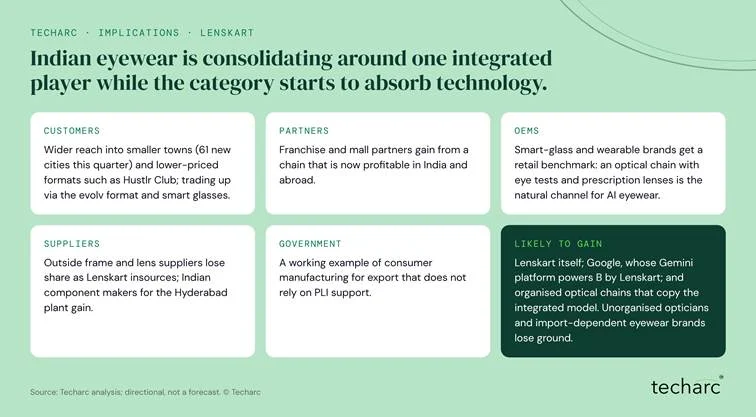
Techarc view
Lenskart’s results show the D2C playbook maturing into something sturdier: own the factory, own the customer, then add technology on top. The smart-glasses launch is the part to watch. If any Indian company can turn AI eyewear from a gadget into an everyday purchase, it is the one that already tests your eyes and makes your lenses.
What to watch
- Disclosure of smart-glasses volumes or attach rates.
- Hyderabad plant commissioning date.
- Whether profit growth holds once the year-ago base normalises in H2.
Sources
Company filings
- Lenskart Q2 FY27 results and investor presentation (4 Nov 2026), as summarised by Investywise.
Supporting coverage
