
Hyundai sold more cars than ever, and its technology bet is still a quarter away
Hyundai Motor India’s Q2 FY27 (Jul–Sep 2026) brought record volumes of 219,072 units and its first ₹20,000 crore quarter, yet profit fell 24% as commodity costs cut the EBITDA margin from 13.9% to 9.5%. The growth came from rural buyers and CNG, not electrification. Like Maruti, India’s number-two carmaker is earning today from proven powertrains while its EV push, a dedicated mass-market EV, waits for Q4 FY27.
Key takeaways
- Consolidated revenue rose 18.5% to ₹20,696 crore; net profit fell 23.9% to ₹1,196 crore.
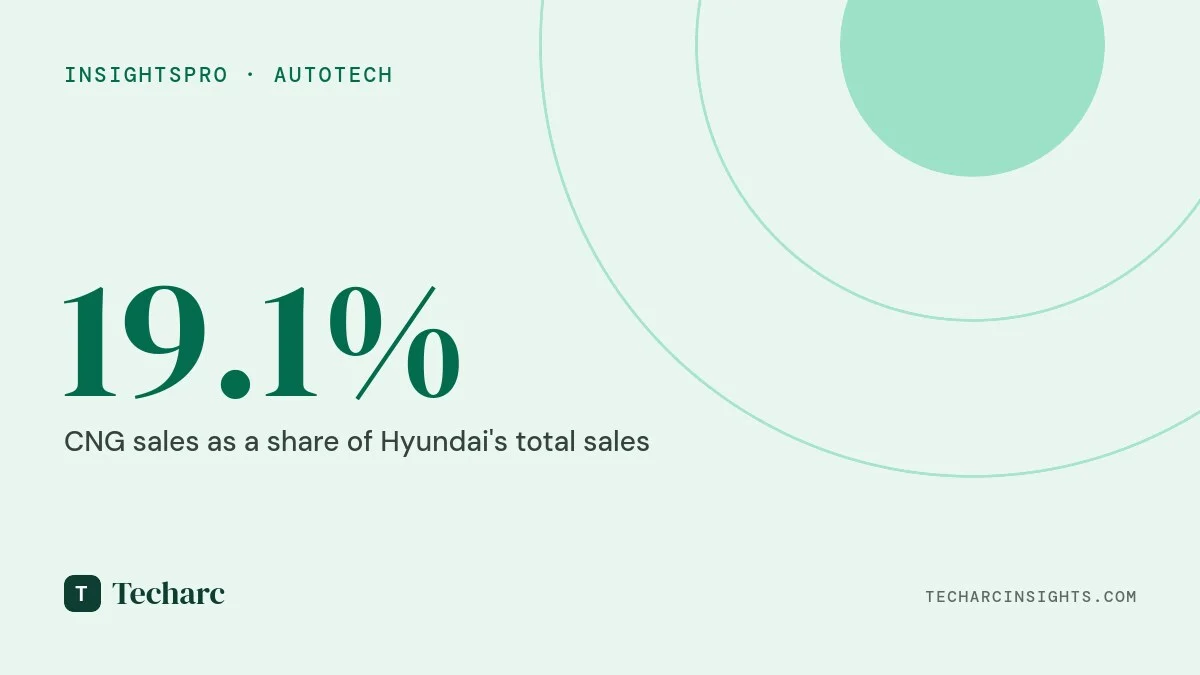
- CNG made up a record 19.1% of sales and rural penetration hit an all-time high of 26.6%.
- The margin squeeze is about materials, not demand: precious metals, copper and steel.
- The 11–14% full-year EBITDA margin guidance now needs H2 margins well above anything Hyundai has posted this year.
The quarter in brief
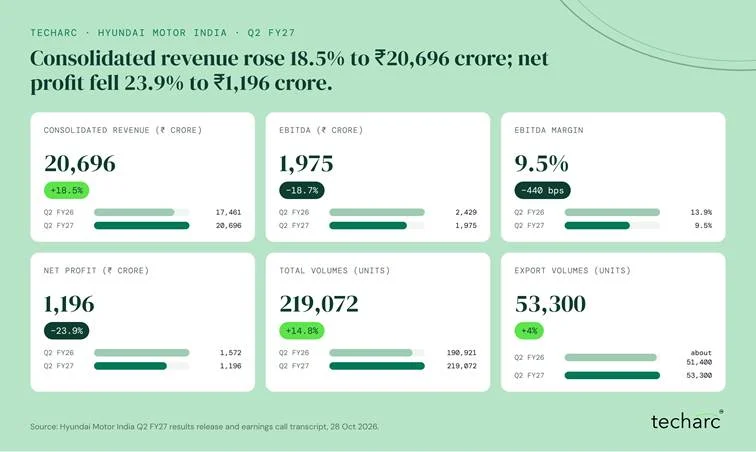
Source: Hyundai Motor India Q2 FY27 results release and earnings call transcript, 28 Oct 2026.
CNG, not EVs, is carrying the volume
Hyundai’s record quarter was built on the same pragmatic technology as Maruti’s: CNG reached a record 19.1% of Hyundai’s sales. Its EV presence in India today rests on the Creta Electric and the Ioniq 5, and the release did not mention either. The company’s real EV move is a dedicated mass-market EV due in Q4 FY27, which management says it is “fully geared up” to launch.
Together, the two largest carmakers send the same signal: India’s mass market is buying cleaner fuel through CNG and hybrids first, and the volume leaders are pacing their EV launches to that demand rather than to media attention.
Rural India is the growth engine
Rural penetration rose to an all-time high of 26.6%. That is where CNG makes most sense, where charging infrastructure is thinnest, and where an affordable EV will have to prove itself. Hyundai’s Q4 EV will be judged less in metros than in the towns now driving its volume.
The commodity squeeze
EBITDA margin recovered only slightly from 9.3% in Q1 to 9.5%. Management blamed raw material inflation, especially precious metals and copper, partly offset by higher volumes, a favourable rupee and price increases. With H1 at 9.4%, reaching even the bottom of the 11–14% guidance means H2 margins around 12.5%, by Techarc’s calculation.
Copper and precious metals are also the materials EVs use most. If those costs stay high, every EV Hyundai sells in H2 will cost more to build, which makes an aggressive launch price harder to hold without hurting margins further.
Implications
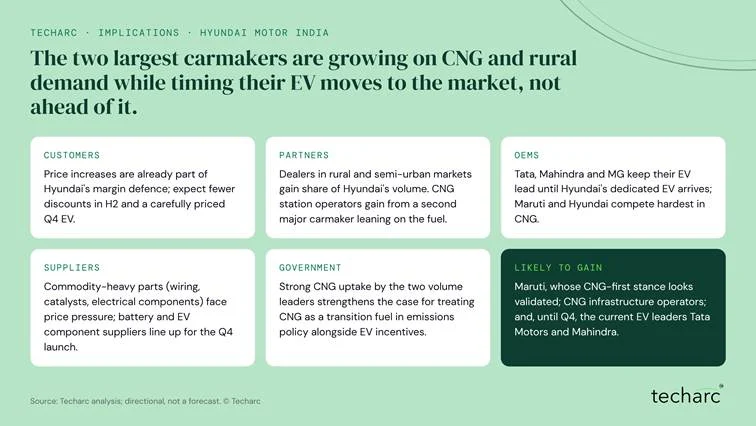
Techarc view
Hyundai’s quarter confirms the thesis from our Maruti viewpoint: technology gets the attention, but proven powertrains pay the bills. The difference is that Hyundai has put a date on its EV. Q4 FY27 is when the market learns whether a volume leader can make a mass-market EV work at Indian price points while copper and precious metals stay expensive.
What to watch
- Price and specification of the dedicated mass-market EV.
- Whether H2 margins reach the 12.5% needed to meet guidance.
- CNG share holding near 19% as more EV models arrive.
Sources
Company filings
- Hyundai Motor India Q2 FY27 results release (28 Oct 2026)
- Hyundai Motor India Q2 FY27 earnings call transcript
Supporting coverage
