
From Microduck to Full-Scale Humanoids. Why the Future of Physical AI Belongs to the Small?
Why NVIDIA CEO Jensen Huang’s viral 25-centimetre Microduck showcase and its 20,000+ pre-order surge signal a structural pivot from top-down industrial androids to ‘Artificial Ontogeny’—robots that start small and grow as they learn. 1. How a $399 Miniature Duck Stole the Spotlight from Six-Foot Humanoids When NVIDIA CEO Jensen Huang closed his keynote at GTC […]
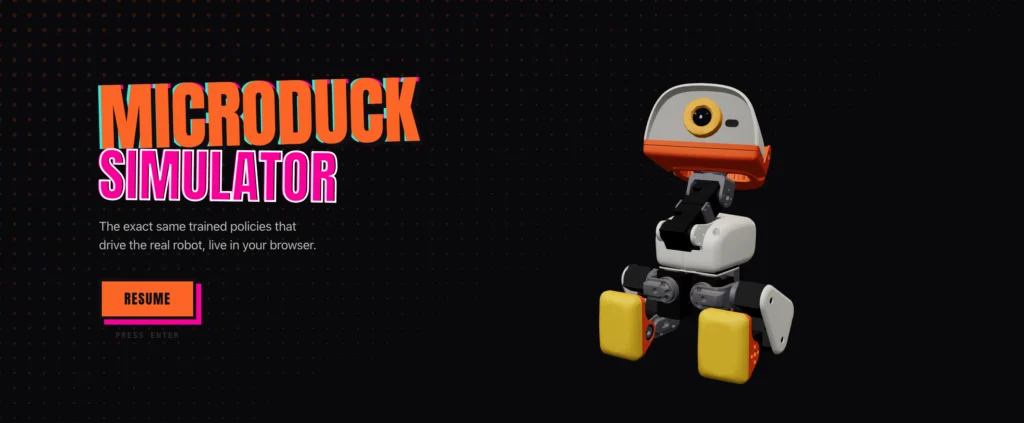
Why NVIDIA CEO Jensen Huang’s viral 25-centimetre Microduck showcase and its 20,000+ pre-order surge signal a structural pivot from top-down industrial androids to ‘Artificial Ontogeny’—robots that start small and grow as they learn.
1. How a $399 Miniature Duck Stole the Spotlight from Six-Foot Humanoids
When NVIDIA CEO Jensen Huang closed his keynote at GTC Berlin, he didn’t bring out a towering, six-foot industrial android. Instead, he shared the spotlight with a flock of 25-centimetre (10-inch), neon-accented plastic ducks.
On live voice command, these tiny bipedal machines—known as Microducks and developed by Hugging Face’s robotics division, Pollen Robotics—waddled across the stage, sat down, pretended to nap, and executed zero-shot front-flips before popping right back onto their feet. When one unit hesitated, Huang bantered with it live (“Pay attention! Stay focused. Come here”), and the tiny agent recalibrated its dual inertial measurement units (IMUs) and waddled over.
From an industry analyst’s viewpoint, what looked like a playful stage demo immediately triggered a measurable supply-chain and commercial inflexion point across the global robotics ecosystem.
Record-Breaking Commercial Bookings: Priced at an accessible $399, Microduck sold out its initial production batch almost instantly, racking up over 10,000 orders in the first 48 hours and surging past 20,000 cumulative pre-orders within days (sustaining daily run rates of 4,000+ units).
Supply Chain & Component Ripples: The sudden volume spike sent shares of South Korea’s Robotis—the exclusive supplier of the duck’s 15 modular XL330 smart servo actuators—surging over 12% in a single trading session, proving that mass-market miniature robotics can move upstream hardware equities.
Full-Stack Sim-to-Real Democratisation: Trained in virtual dreamscapes via NVIDIA Isaac Lab and RTX Spark workstations using reinforcement learning, and integrated into Hugging Face’s open-source LeRobot framework, the sub-800-gram robot transformed enterprise Sim-to-Real AI deployment into a sub-$400 desktop developer kit.
2. Why ‘Growing’ AI Must Start on a Developer’s Desk
For the past decade, tech giants and well-funded startups have raced to showcase ‘adult’ fully grown humanoid robots performing carefully choreographed warehouse routines. Yet this top-down capital allocation ignores a fundamental law of biology. You can’t manufacture complex intelligent systems as fully formed adults. The true embodied intelligence requires a childhood.
The viral explosion of the Microduck is not a hobbyist detour from the humanoid roadmap—it is the missing developmental link. It validates that the most capital-efficient path to general-purpose automation lies in Artificial Ontogeny – an engineering paradigm in which robots start small, learn through consequence-free physical failure, and scale up physically as their cognitive capabilities mature.
Classical physics and the Square-Cube Law govern the underlying economics. Kinetic energy scales linearly with mass, and structural stress compounds rapidly with size. When a 70-kilogram adult humanoid loses balance and falls, the impactcan crack carbon-fibre shells, strip precision harmonic drives, and bend steel shafts. A physical failure results in a fat repair bill and, worse, a morale hit. Hence, full-scale humanoids must operate conservatively behind rigid safety guardrails.
Conversely, when a 780-gram Microduck attempts an unscripted somersault and crashes off a desk, it hits the floor with less kinetic energy than a television remote dropping onto a rug. By making physical failure virtually free, miniature robots unlock the exact learning environment human toddlers rely on. They seek permission to fail aggressively. Tens of thousands of developers can now run real-world reinforcement and imitation learning loops simultaneously on their desks, feeding millions of stumbles, recoveries, and object manipulations back into shared open-source foundation models.
3. The Artificial Ontogeny Framework: 4 Stages of Physical AI Maturation
If desktop infancy is the starting point, what happens when the AI foundation model outgrows its 25-centimetre plastic chassis? Instead of treating miniature robots and full-scale humanoids as disconnected market segments, hardware roadmaps should treat them as sequential stages in a unified evolutionary lifecycle. As a policy network masters sensorimotor control at one physical scale, its ‘digital DNA’ migrates upward into progressively larger morphologies.
| Developmental Phase | Physical Form Factor | Core Cognitive Milestone | Primary Economic & Engineering Advantage |
| 1. Micro / Nano(Cellular Stage) | Millimeter-scale swarms, smart dust sensors. | Swarm coordination, localized cellular mapping. | Massive parallel environmental telemetry harvesting in confined spaces. |
| 2. Miniature / Infancy(The Microduck Era) | Sub-1kg desktop bipeds (e.g., Microduck / LeRobot). | Basic physics intuition, fall recovery, 50 Hz sensorimotor loops. | Near-indestructible, low-CAPEX ($399) real-world trial-and-error sandbox. |
| 3. Adolescent(Juvenile Scale) | Medium-scale frames (Toddler / quadruped size, 10–25 kg). | Dynamic spatial navigation, multi-room mapping, tool handling. | Proprioceptive scaling, momentum management, and dynamic balance tuning. |
| 4. Adult Humanoid(Industrial Maturity) | Full-scale, high-torque bipedal chassis (60–80 kg). | High-stakes industrial autonomy, heavy payload manipulation. | A battle-tested neural brain built on years of compounded physical data. |
4. Technical Friction: 3 Engineering Bottlenecks to Scaling a Robot’s Body
While migrating an AI brain from a miniature duck to an adult humanoid is conceptually elegant, translating biological growth into hardware introduces severe engineering friction. Virtual AI scales effortlessly across cloud clusters, but Physical AI is bound by materials science and Newtonian mechanics. To commercialise artificial ontogeny, R&D teams must solve three core bottlenecks:
- The Scaling Physics Paradox: No physical system scales linearly across all mechanical properties. As a robot doubles in height, its surface area quadruples while its mass increases eightfold. A servo configuration (such as Robotis XL330 actuators) that effortlessly balances an 800-gram Microduck operates under completely different latency, thermal dissipation, and structural torque profiles than a planetary or harmonic actuator driving a 70-kilogram humanoid leg.
- The Proprioceptive Software Migration Gap: While transfer learning allows neural networks to adapt to new morphologies in simulation, jumping from a 10-inch frame to a 6-foot frame drastically alters the robot’s centre of gravity, inverted-pendulum dynamics, and moment of inertia. Recalibrating learned locomotion policies across form factors without introducing severe operational instability remains a frontier control problem.
- The Materials Science Bottleneck: Biological organisms grow continuously via cellular division and bone remodelling; robots remain trapped in static metal and polymer shells. True developmental robotics will require either standardised, hot-swappable modular compute-and-actuator architectures or breakthroughs in smart metamaterials that can alter structural rigidity as the machine scales in weight and power.
5. Analyst Outlook: 3 Critical Questions Defining the Next Decade of Robotics
As the initial wave of 20,000+ Microducks ships into university labs, developer bedrooms, and enterprise R&D desks worldwide, the robotics industry stands at a strategic crossroads. Looking past the viral somersaults on Jensen Huang’s stage in Berlin, ecosystem leaders must answer three foundational questions:
- How do we standardise ‘Proprioceptive Bridges’? What mathematical and middleware frameworks will allow a neural network trained on a miniature 15-DOF (degrees of freedom) biped to seamlessly map its baseline balance reflexes onto an 80-DOF adult humanoid without retraining from scratch?
- Will ‘robotic childhood’ rely on modular chassis swaps or smart materials? Can materials science evolve fast enough to enable continuous physical expansion, or will growing a robot mean migrating a portable ‘brain-stem’ compute cartridge across a standardised family of Small, Medium, and Large hardware frames?
- Who captures the crowd-sourced physical data flywheel? How do we architect open-source telemetry pipelines (such as Hugging Face’s LeRobot paired with NVIDIA’s Cosmos world models) to aggregate the messy, real-world trial-and-error of millions of desktop ‘infants’ and distil that collective intelligence into a fault-tolerant foundation model for industrial humanoids?
The Analyst Verdict: The machines that will ultimately transform our factories, logistics hubs, and homes will not arrive in shipping crates as ready-made adults. They are being born right now—waddling, tumbling, and picking themselves back up on the corner of our desks.
