
Bajaj has made electric two-wheelers a profit line, not a cost centre
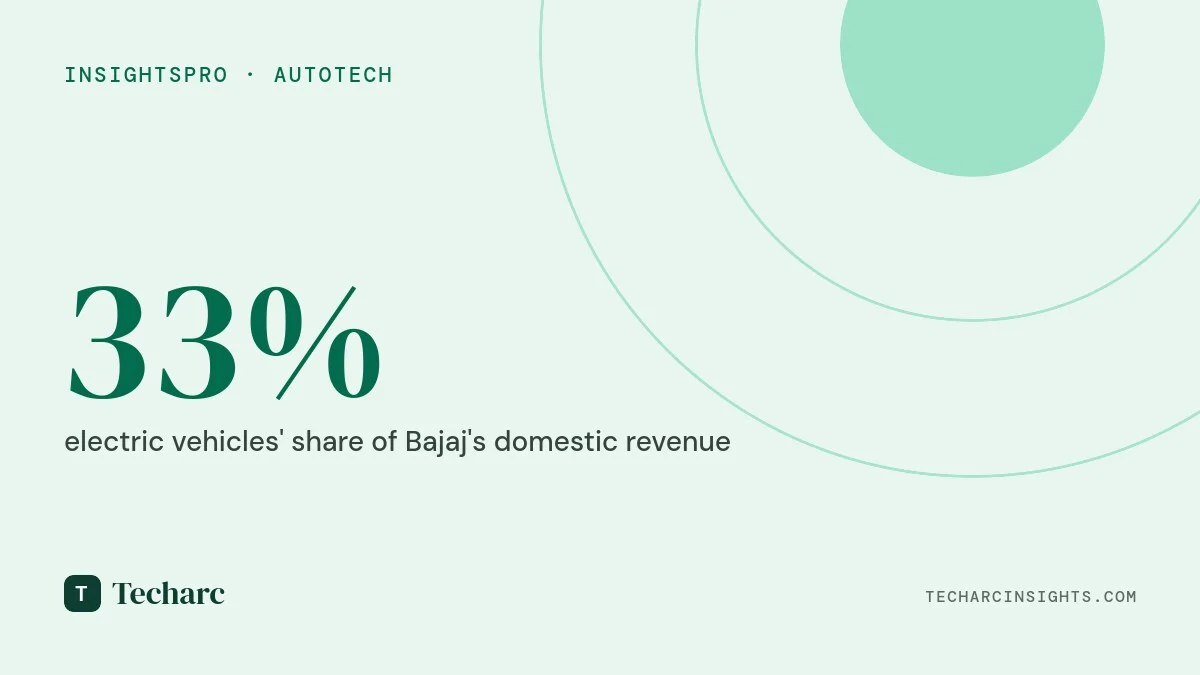
Bajaj Auto’s Q2 FY27 (Jul–Sep 2026) set records across volumes, revenue and profit, and two numbers stand out. Electric vehicles, mainly the Chetak scooter and electric three-wheelers, now make up about a third of domestic revenue, and Bajaj says the EV business adds to company margins. And for the first time, Bajaj sold more vehicles abroad than in India. With TVS, Bajaj shows that India’s two-wheeler incumbents can make EVs pay, which is exactly what India’s car leaders have not yet done.
Key takeaways
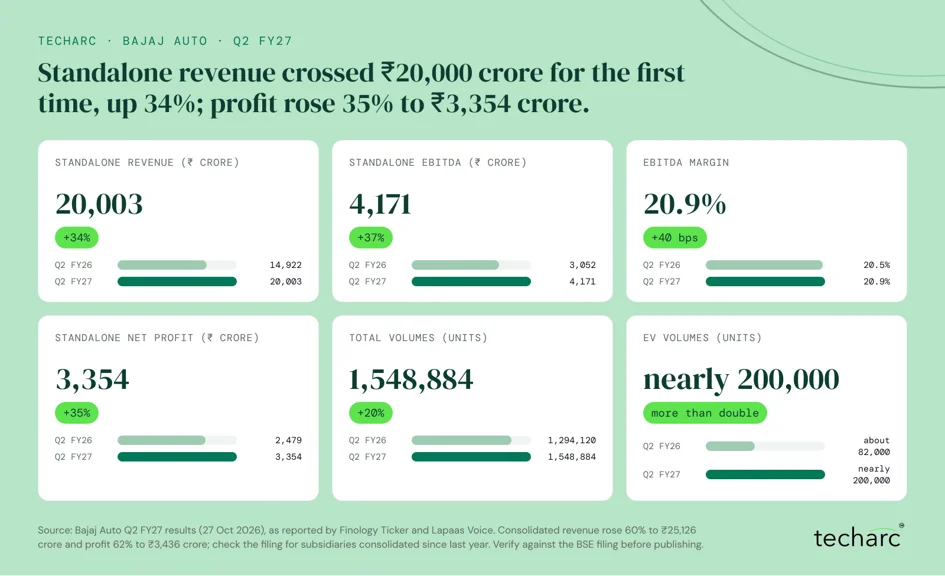
- Standalone revenue crossed ₹20,000 crore for the first time, up 34%; profit rose 35% to ₹3,354 crore.
- EV volumes were close to 200,000 units, against about 82,000 a year ago; Chetak revenue crossed ₹2,000 crore in the quarter.
- Exports of 778,528 units (+41%) exceeded domestic sales of 770,356 units.
- EBITDA margin rose to 20.9% despite higher metal and electronics costs.
The quarter in brief
EVs: a third of domestic revenue, and profitable
Bajaj’s EV volumes more than doubled to nearly 200,000 units, and Chetak scooter volumes more than doubled despite supply constraints. Management says the Chetak now earns a double-digit EBITDA margin and that the EV portfolio is margin-accretive for the company as a whole.
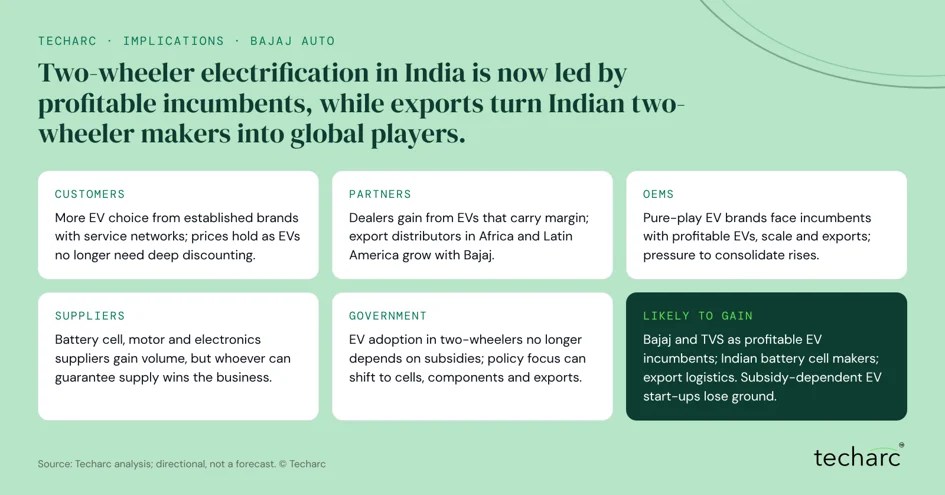
This is the clearest proof yet of the thesis in our TVS viewpoint: in two-wheelers, the EV transition is already mainstream and profitable for the incumbents. It is the opposite of what our Maruti and Hyundai viewpoints found in cars, where EVs remain a small, loss-making share for the volume leaders. The difference is battery size: a scooter’s battery is a fraction of a car’s, so cost parity arrived years earlier.
Exports overtake India
Exports grew 41% to 778,528 units, slightly more than domestic sales. Bajaj already holds about 41% of India’s two-wheeler exports, mainly to Africa and Latin America. Exports bring revenue priced in foreign currency against rupee costs, which helps explain how margins rose while metal and electronics costs went up.
Supply is the constraint
Chetak growth came “despite supply constraints”. With memory, rare-earth magnets and battery cells all tight in 2026, the limit on EV growth is shifting from demand to components. That favours makers with scale and long supplier relationships.
Implications
Techarc view
Bajaj’s quarter is the strongest evidence yet that India’s EV transition is happening on two wheels first, and profitably. The policy and media debate still centres on cars, but the money and the volume are in scooters. If Bajaj can keep EV margins in double digits as supply loosens, the question in two-wheelers will shift from whether EVs pay to how fast petrol scooters disappear.
What to watch
- Chetak supply easing and its effect on volumes.
- Whether EV margins hold as competition from Hero’s VIDA and TVS intensifies.
- Export momentum if currency or freight conditions change.
Sources
Company filings
- Bajaj Auto Q2 FY27 results (27 Oct 2026).
Supporting coverage
