
Infineon Q4 FY2026: Car chips trail AI power, but the gap is set to narrow
Infineon’s Q4 FY2026 (Jul–Sep 2026), reported on 10 Nov 2026, grew revenue 19% to €4,706m. AI power did the heavy lifting; Automotive grew 10%. Segment figures use the new structure in force from 1 Jul 2026.
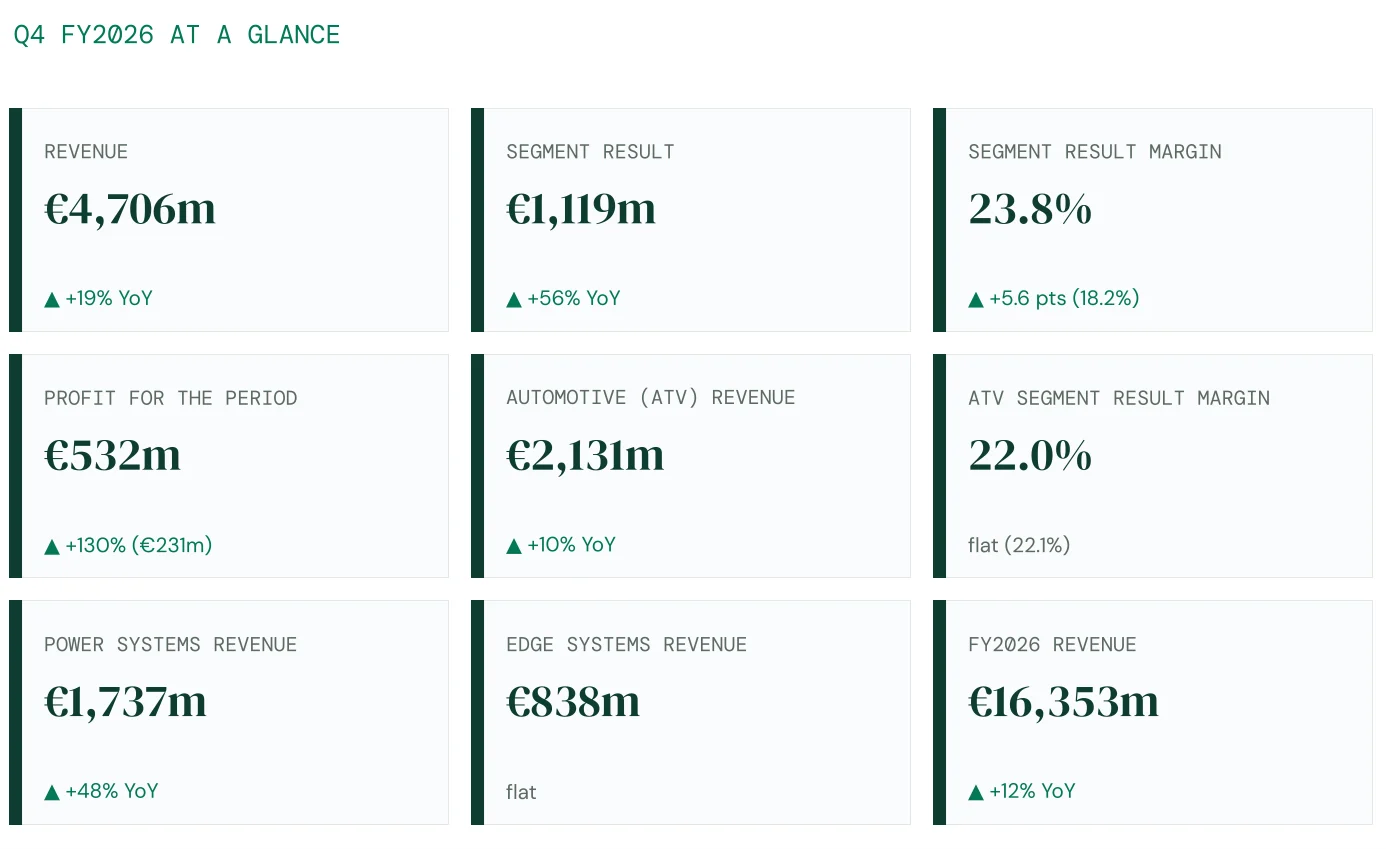
Segment figures use the new structure in force from 1 Jul 2026. Bracketed figures are year-ago values.
What the numbers say
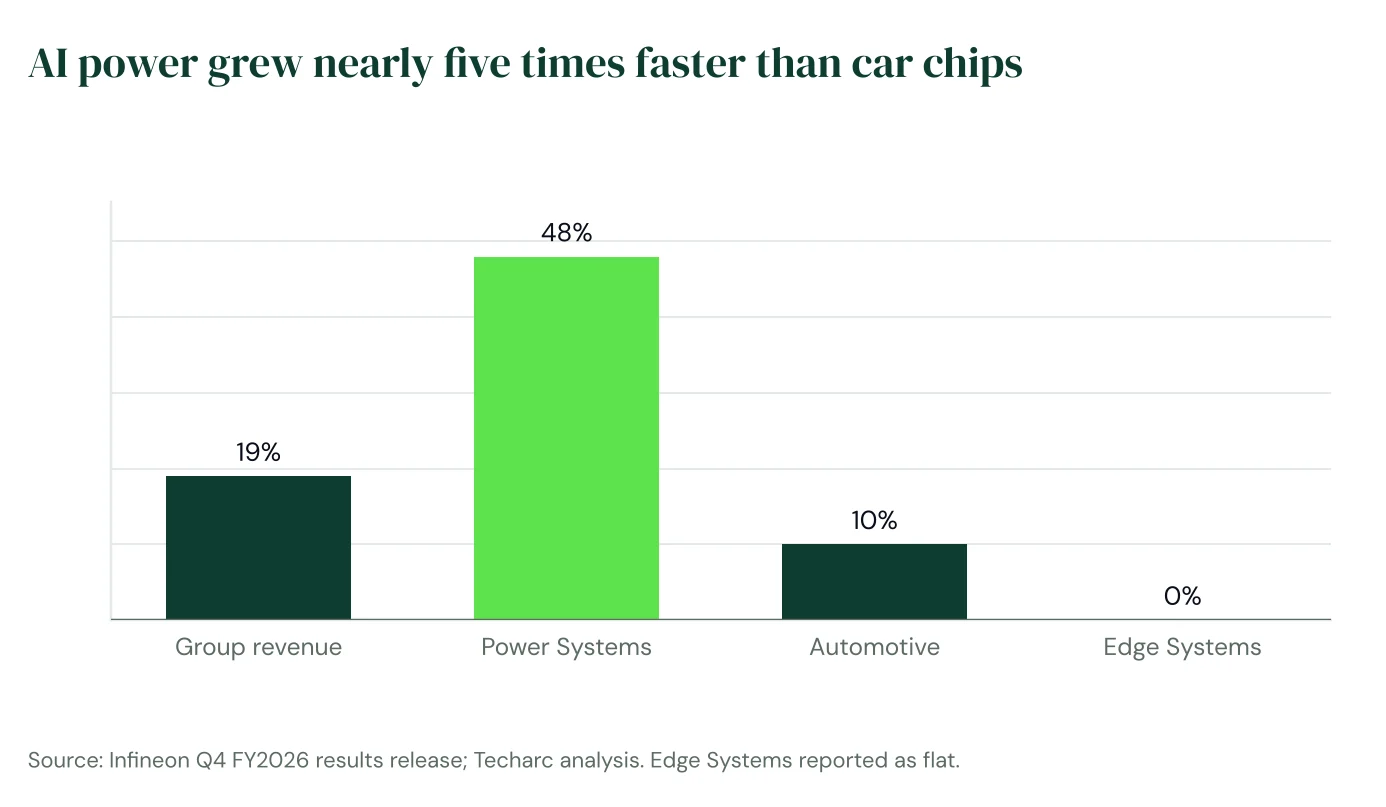
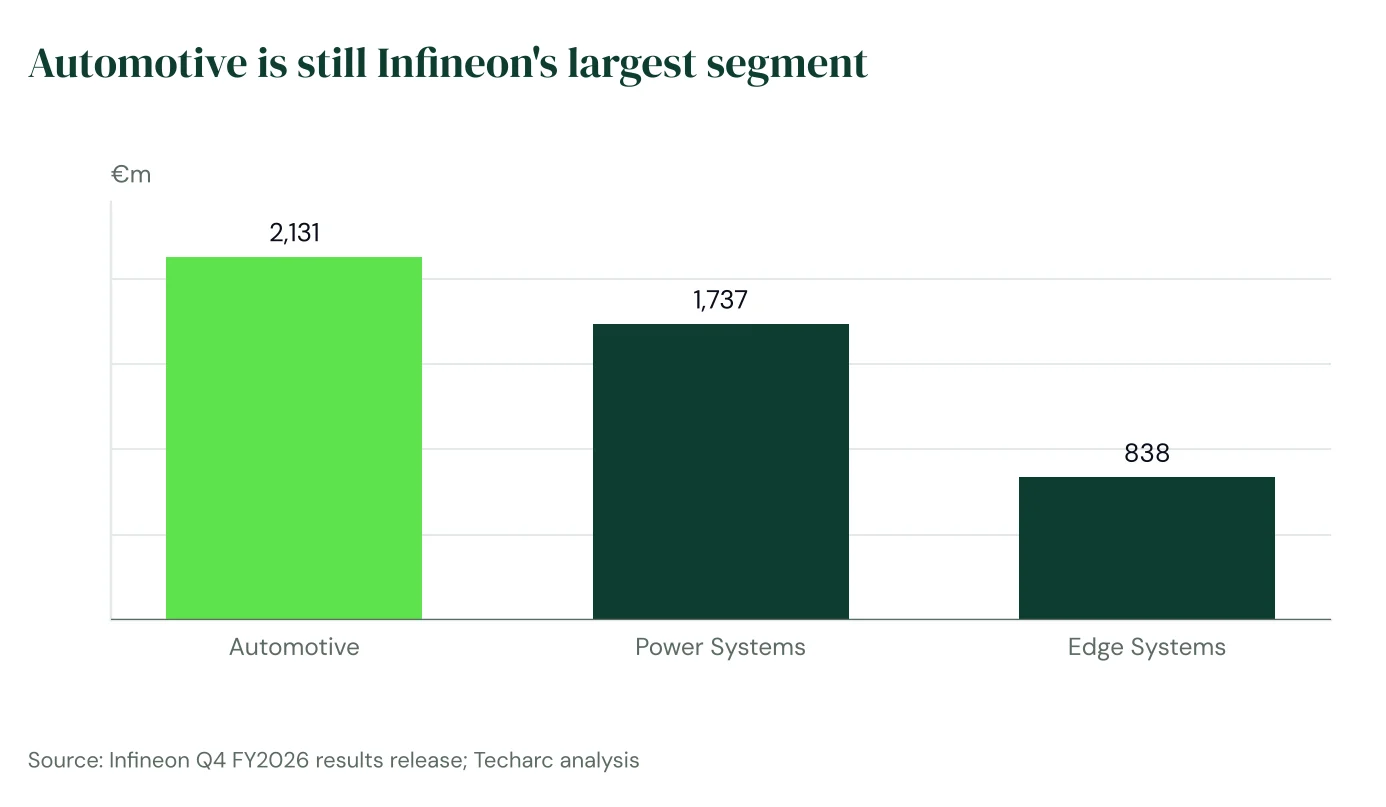
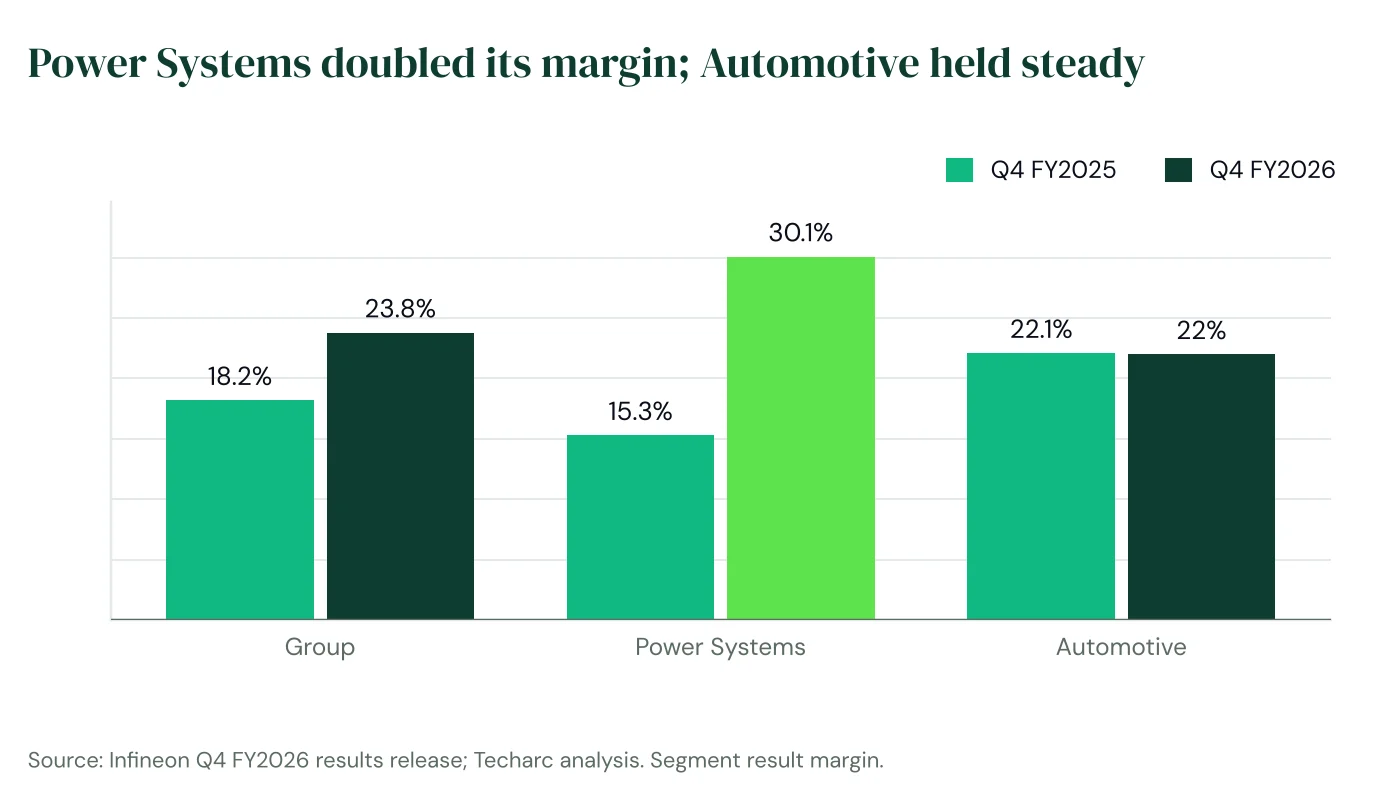
Infineon is now two businesses moving at different speeds. Power Systems grew 48% on AI servers and data centres, at a 30.1% margin. Automotive grew 10%, about half the group’s pace. Automotive is still the largest segment, at 45% of Q4 revenue.
The margin jump is mostly a Power Systems story. Its margin doubled from 15.3% a year ago. Automotive held at 22.0%, while Edge Systems was flat on revenue at a 14.8% margin.
The outlook is the real signal. Infineon guides FY2027 revenue to about €20bn, up more than 20%. Data-centre power supply revenue should be close to €4bn. Automotive is guided to mid-teens growth, a clear step up from 5% in FY2026.
The near term is flat. Q1 FY2027 is guided at about €4.6bn, with a segment result margin near 23%. Automotive and Power Systems should hold steady; Edge Systems should dip.
Industry read: the car is a slow customer, not a weak one
Car chips are a long-cycle business. Design wins land years before revenue, and Tier-1 inventories swing results. Qualcomm’s automotive chip revenue rose 89% last week, but from a much smaller base and on cockpit and driver-assist compute. Infineon sells the power, microcontroller and sensor content that every vehicle needs. Its growth tracks vehicle output and content per car, not new compute platforms.
Infineon names software-defined vehicles and electromobility as the drivers. Both raise content per car: more zonal controllers, more microcontrollers, and silicon carbide in inverters and chargers. That is why it can guide automotive to mid-teens growth while car volumes grow slowly.
India is part of this shift. Infineon has about 2,500 people across four Indian sites, mostly in R&D, and plans to double that by 2030. It supplies bare die to CDIL, which packages discretes and modules for Indian automotive and industrial buyers. It also signed with Tata Elxsi in June 2025 to build ready-to-deploy EV systems: inverters, battery management and onboard chargers for two-, three- and four-wheelers.
Techarc view
Techarc sees the mid-teens automotive guide as credible but back-loaded. Q1 FY2027 automotive is guided flat, so the step up must come in the second half. That leaves little room for a weak vehicle market or a Tier-1 inventory pause.
For India, the bigger opportunity is EV power electronics in two- and three-wheelers. These vehicles electrify fastest and are designed locally. Infineon’s model is to sell die and reference designs, and let Indian partners package and integrate. That fits the India Semiconductor Mission’s OSAT-first path better than waiting for a local fab.
The risk is that AI power pulls focus and capacity. If data-centre demand keeps outrunning cars, Indian automotive customers may find themselves lower in the queue for silicon carbide.
What to watch:
- Automotive growth in Q2 and Q3 FY2027, to test the mid-teens guide
- Silicon carbide supply to automotive versus data-centre customers
- New Indian packaging partners beyond CDIL, and Tata Elxsi EV designs reaching production
- Infineon India headcount against the 5,000 target
Sources
- Infineon Q4 FY2026 results release (10 Nov 2026)
- Tata Elxsi and Infineon MoU on EV systems for India (19 Jun 2025)
- Infineon aims to double India workforce to 5,000 by 2030 (Evertiq)
- CDIL partners with Infineon on power semiconductors (Circuit Digest)
ABOUT TECHARC
Techarc is an independent technology market research, analytics, and consulting firm based in India, covering consumer devices, telecom, auto-tech, and the e-commerce/D2C ecosystem across three pillars — Analytics, Research, and Consulting. techarcinsights.com
