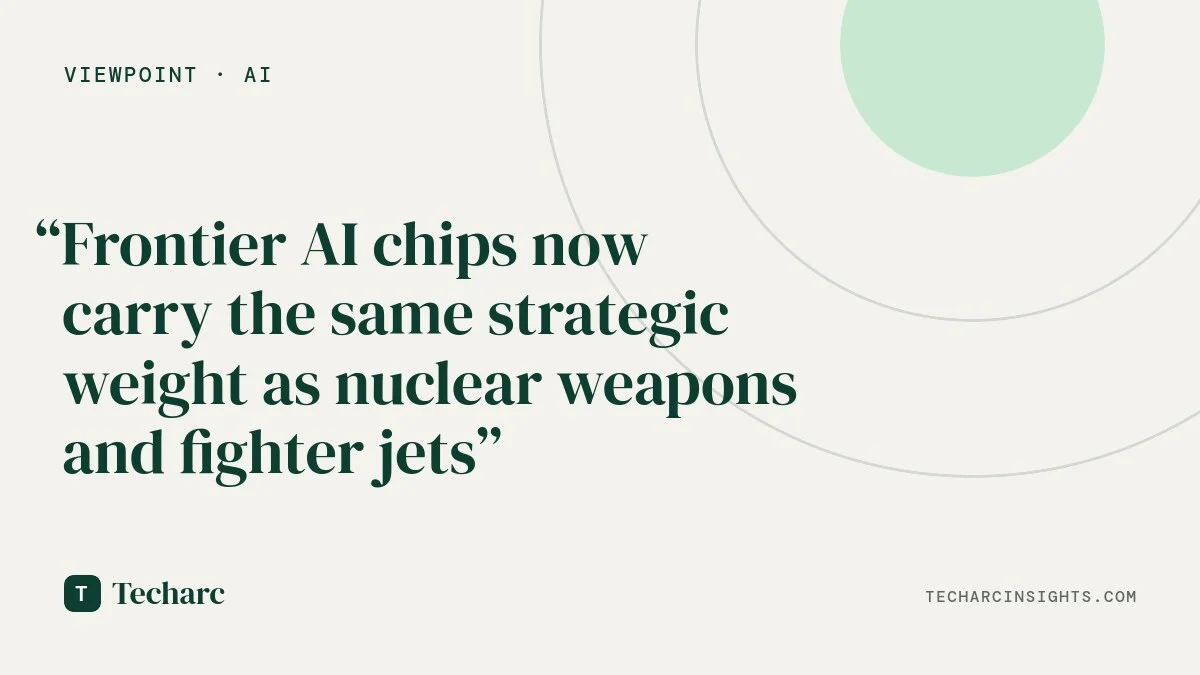
The NVIDIA crisis shows that who gets advanced AI chips is now a decision on a par with nuclear technology and F-16s. India should plan for that world.
Jensen Huang stepped down as NVIDIA’s CEO on 12 November 2026, after allegations that his proximity to a professional acquaintance could have helped China in the AI race. China denies the allegation, and an internal probe at NVIDIA, overseen by independent directors, is investigating it. The trigger was not a weak quarter or a failed product. It’s no longer a company matter but a diplomatic and geopolitical issue.
The US Commerce Department closed the route Chinese firms used to rent American AI chips in data centres abroad through its announcement on November 16. A day after this, NVIDIA’s interim CEO Colette Kress said it would stop selling its H200 chips in China.
The developments in less than a week reiterate what has been building for four years. Frontier AI supply and the value chain are no longer simply commercial decisions. Governments, geopolitics, and national security are now involved in selling AI chips and other capabilities. In a country like the US, the decision is made within Washington’s national-security system. It’s fair to say the decision now sits alongside decisions on nuclear technology and advanced weapons such as the F-16. On some counts, it already sits above them.
A boardroom’s concern became a security file
A CEO’s private conduct is a governance problem dealt with at the board level. At NVIDIA, it became a matter of trust in the custodian of an important asset. The company’s own response shows this. Alongside the leadership change, NVIDIA created a board-level committee to oversee national security policy, export-control compliance and global trade risk. That is how defence contractors are governed, not consumer technology brands.
The recently abandoned H200 arrangement was itself built like an arms deal. It was negotiated between the company and the White House, and the chips were routed through the US so the government could collect a 25% levy on each sale, while possibly retaining control over exports of this strategic resource. Ending it was as much a political call as a commercial one.
Now we have the rule. The Commerce Department’s November 16 rule was written at the direction of the Treasury and the National Security Council. Any data centre, anywhere, serving companies headquartered in China now needs a licence above a set compute threshold. Five countries — Indonesia, Malaysia, Singapore, Thailand and Brazil — are named as diversion risks, and existing operators have 90 days to comply. Compute has been placed on the same footing as physical shipment.
From the munitions list to the chip list
Let’s look at how the US has long been handling its most sensitive exports. An F-16 sale goes through a government-to-government process, Congress is notified, and end-use monitoring follows the aircraft for decades. Pakistan learnt in 1990, when the Pressler Amendment froze F-16 deliveries over its nuclear programme, that supply can be switched off. India learnt the same lesson on nuclear technology when the 2008 civil nuclear deal needed a new US law, IAEA safeguards and a special waiver from the Nuclear Suppliers Group.
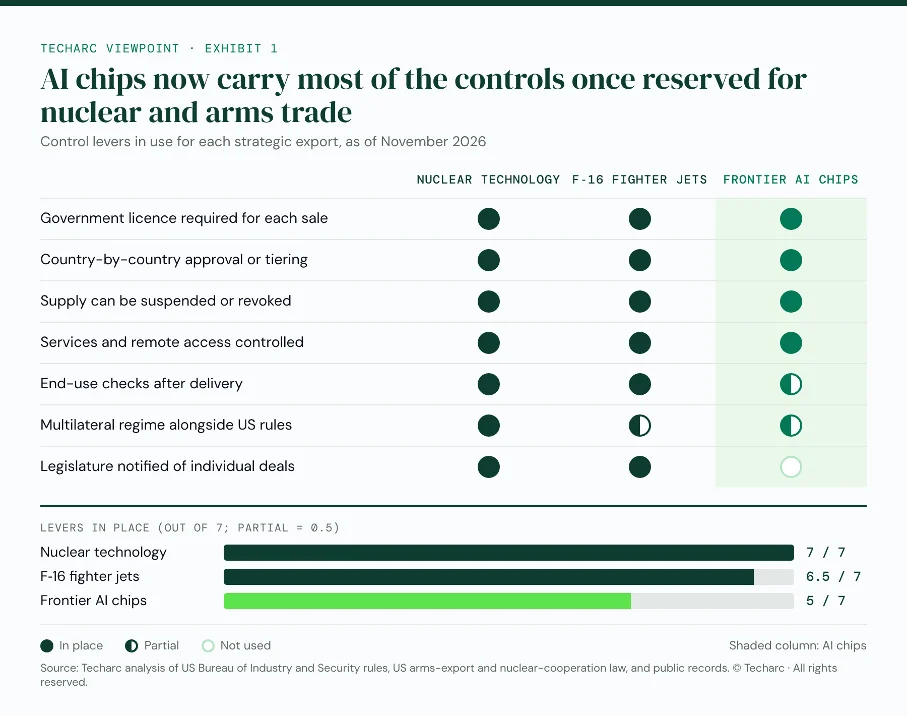
Frontier AI chips are now following the same pattern. Exhibit 1 scores the three exports on seven control levers. Chips already carry five in full and two in part. The one lever missing — the legislature being told of each deal — only shows that chip decisions sit even more firmly inside the executive’s security machinery.
Why chips may now matter more than jets
On at least four counts, frontier compute is a heavier lever than a fighter squadron.
- Reach. An F-16 shifts the balance in one theatre. A cluster of frontier chips shifts the capability of a whole economy — defence, intelligence, drug discovery, software, finance. Compute is a general-purpose input.
- Speed. A fighter fleet takes a decade to build. Compared to this, access to compute can be switched on through a cloud contract in weeks.
- Concentration. The supply chain runs through a handful of points: one dominant GPU designer, one leading-edge foundry, a few memory makers and packagers. SK Hynix expects memory demand to outrun supply until 2030. Scarcity turns allocation into politics.
- Dual use by default. There is no civilian F-16. Every AI chip is dual-use, so every sale is potentially a security decision.
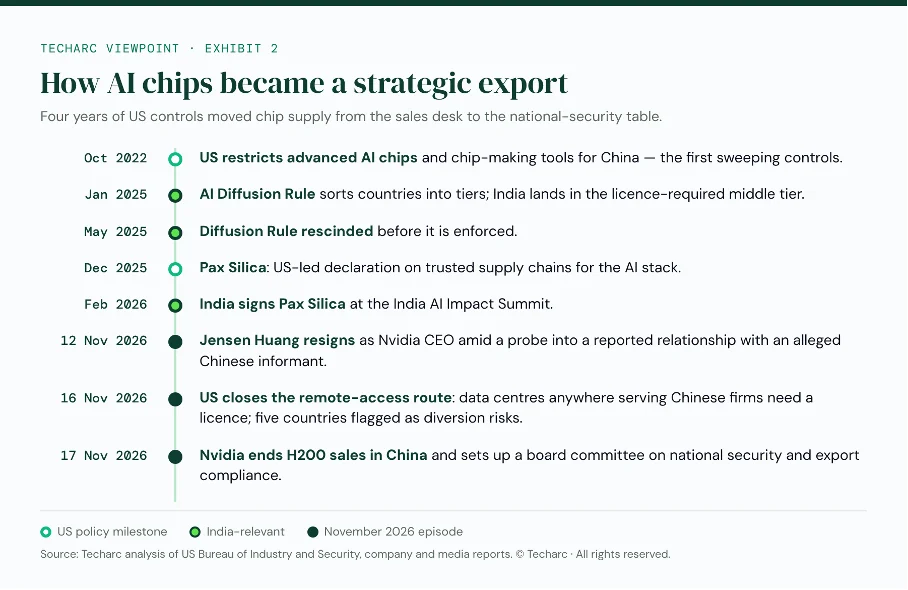
So, at the very least, chip supply is now at par with nuclear technology and advanced arms. In breadth of impact, it arguably outranks them. Exhibit 2 traces how fast that shift has come.
Where India stands
India has sat on both sides of this line. The January 2025 AI Diffusion Rule placed India in a licence-required middle tier for advanced chips, before the rule was rescinded that May. In February 2026, India signed Pax Silica, the US-led declaration on trusted supply chains for the AI stack. In eighteen months, India moved from managed recipient to close partner.
The November 16 rule is silent on India. However, it does not mean that India is not on its list of diversion-risk countries. India currently holds some trust, the new currency. The task is to turn it into capacity before the window closes.
How India can play it
There are three openings.
- Trusted compute hub. Data centres in South-East Asia that served Chinese clients now face licence and certification requirements. Some of that demand will look for a compliant home. India has the market, the land and a growing renewable pipeline; Amazon alone has committed another $7 billion to Indian wind and solar by 2030. Local inference offerings such as Sarvam’s Token Factory show the demand for in-country compute is real.
- Packaging and manufacturing. The new rule tightens checks on foundries and packagers. These are the layers in which trust matters most. India Semiconductor Mission 2.0, approved in July 2026 with an outlay of about ₹1.275 lakh crore, builds on 12 projects under the first mission, with Micron, Kaynes and CG Semi already in commercial production.
- Design and talent. India already hosts large design centres of global chip firms working on ARM and other architectures. ISM 2.0 funds domestic design. This gives India something to bargain with beyond being a buyer.
The risks are genuine. Indian data-centre operators and neoclouds will carry a new compliance load. A single diversion case could put India on a list. India knows from Tarapur and the post-1998 sanctions that trust can be withdrawn overnight.
What should New Delhi do?
- Police itself first. Build an Indian end-use verification framework for data centres, so Washington does not need to police Indian compute.
- Treat compute like a strategic reserve. Expand sovereign GPU capacity under the IndiaAI Mission and negotiate long-term supply at the government-to-government level, as India does for defence platforms.
- Trade what it has. Talent, a large market, packaging capacity and critical-minerals processing are bargaining chips under Pax Silica.
- Hedge. Back domestic design and open architectures such as RISC-V, so trusted status is never the only path to compute.
Implications
•Government: The chip diplomacy now needs the same seriousness, and the same institutions, as defence procurement.
•Data centres and cloud providers: Customer due diligence becomes a licence condition, not a sales formality.
•OEMs and device brands: AI hardware and memory will stay costly and allocated; expect fewer low-cost AI devices and more trading up.
•Global chip suppliers: India becomes a market where compliance and local partnership decide share.
The F-16 shaped South Asia’s security debates for four decades. The chips inside tomorrow’s data centres will shape the next many decades. India’s choice is whether to be a trusted node in that system or a managed customer.
