
Hero is growing its EV business fast, and paying for it out of the 100cc motorcycle
Hero MotoCorp’s Q2 FY27 (Jul–Sep 2026) headline profit jumped 41%, but that includes a one-time ₹397 crore gain. The operating business tells a different story: standalone revenue rose 21% while standalone profit rose only 5%, and EBITDA margin fell from 15.0% to 13.4%. Meanwhile VIDA, its electric brand, sold 66,531 units at retail, up 76%. Hero is using the cash from its dominant 100cc motorcycles to fund an EV catch-up, and the margin is the cost.
Key takeaways
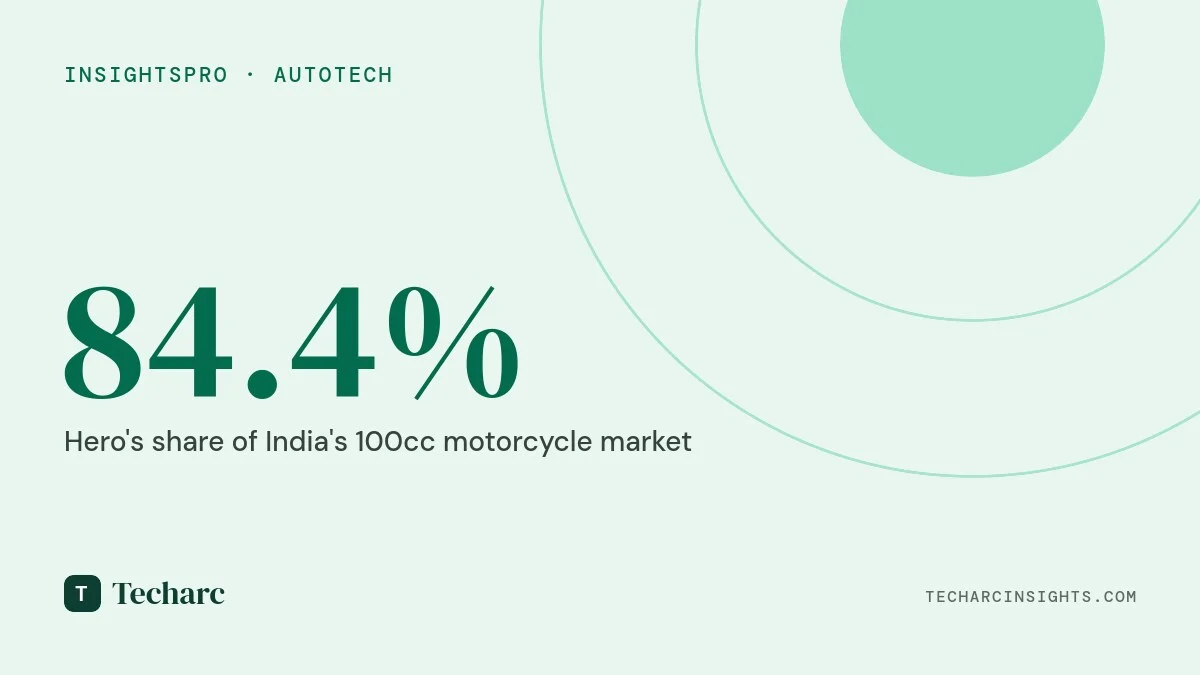
- Standalone volumes rose 10% to 18.68 lakh units; Hero’s share of 100cc motorcycles rose to 84.4%.
- Scooters (petrol and electric) grew 47% to 2.40 lakh units, a category where Hero has historically been weak.
- Hero discloses no separate revenue or profit for VIDA, so EV economics cannot yet be judged from the results.
- Contrast with TVS and Bajaj, which already report their EV businesses as profitable.
The quarter in brief
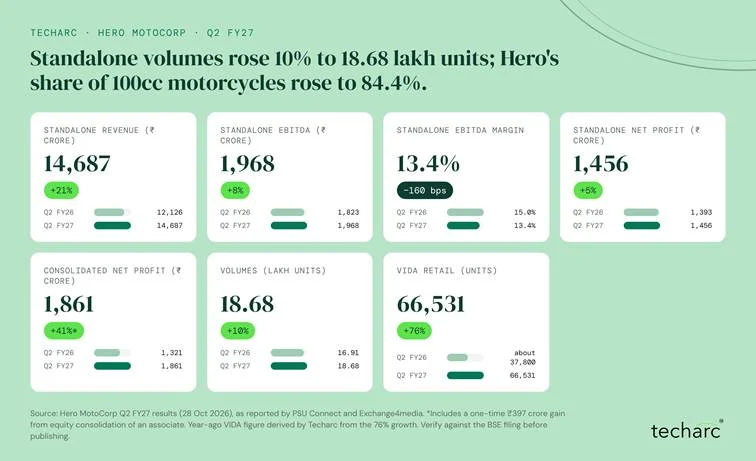
Source: Hero MotoCorp Q2 FY27 results (28 Oct 2026), as reported by PSU Connect and Exchange4media. *Includes a one-time ₹397 crore gain from equity consolidation of an associate. Year-ago VIDA figure derived by Techarc from the 76% growth. Verify against the BSE filing before publishing.
VIDA is scaling; its economics are still hidden
VIDA’s retail volumes rose 76% to 66,531 units and wholesale EV volumes nearly doubled. The VX2, sold with battery-as-a-service and buyback options to lower the upfront price, has made Hero a serious electric scooter player within two years. VIDA also entered its first overseas market, Nepal.
What Hero has not shown is whether VIDA makes money. TVS and Bajaj now say their electric two-wheelers contribute to margins; Bajaj says its EV business is margin-accretive at the company level. Hero gives no VIDA revenue or profit. Given the standalone margin fell 160 basis points in a quarter when volumes grew 10%, part of the gap is likely EV investment and commodity costs. Until Hero discloses more, the market should assume VIDA is still being funded, not funding.
The 100cc cash engine
Hero’s share of India’s 100cc motorcycle market rose to 84.4%, and that segment grew 10% in the quarter. This is the commuter bike of rural and small-town India, and it is where Hero’s cash comes from. It is also the segment least likely to electrify soon: buyers are the most price-sensitive and charging access is thinnest.
Scooters: the strategic win
Scooters, petrol and electric together, grew 47%. Petrol scooters (Destini and Xoom) grew 50%. For a company long known only for motorcycles, scooters are where Hero meets the urban buyer, and where the EV transition in two-wheelers is happening first.
Read the 41% carefully
The consolidated profit includes ₹397 crore from the equity consolidation of an associate company after its capital raise. Without it, consolidated profit would have risen about 11%, much closer to the operating trend.
Implications
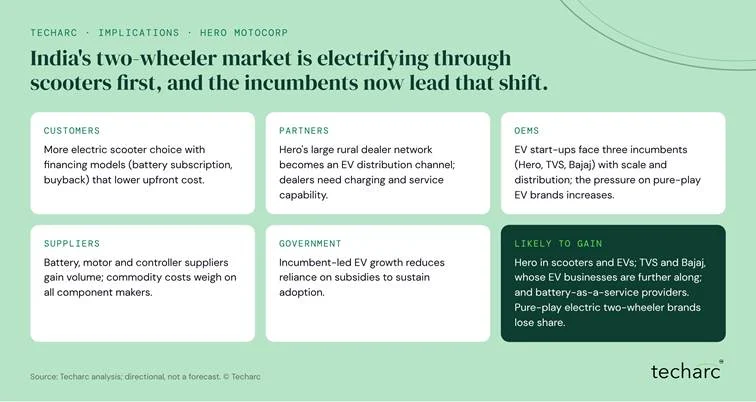
Techarc view
Hero’s quarter shows the cost of catching up. It is now a real EV player, but its margins show it is still paying to get there, while TVS and Bajaj already earn from their EVs. The 100cc motorcycle gives Hero the cash and the time to keep investing. The question for the next few quarters is when VIDA moves from a growth story to a profit story, and whether Hero will disclose enough for anyone to tell.
What to watch
- Any separate disclosure of VIDA revenue or margin.
- Standalone EBITDA margin recovery toward 14–15%.
- VIDA’s share of India’s electric two-wheeler market in H2.
Sources
Company filings
- Hero MotoCorp Q2 FY27 results (28 Oct 2026), as summarised by Investywise (BSE). Link the BSE filing before publishing.
Supporting coverage
