
The smartphone is now a minority customer at the world’s most important chip factory
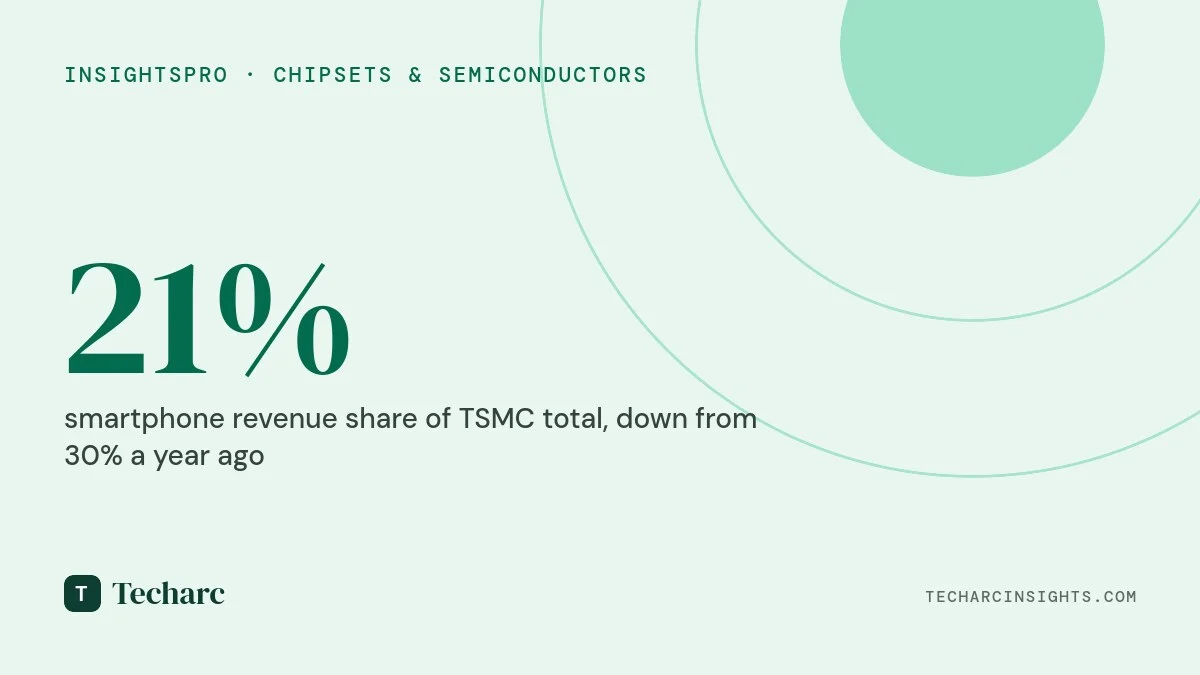
TSMC’s Q3 2026 (Jul–Sep) revenue rose 41% to $46.7 billion and net profit 69%, a sixth straight record. Underneath, the customer mix has flipped: AI and high-performance computing took 68% of revenue, while smartphones fell to 21%, from 30% a year ago. Phone chips are still growing, but they now compete for leading-edge capacity with AI accelerators that can pay more. For India’s smartphone market, that means higher chipset costs at the top end and slower access to the newest nodes for everyone else.
Key takeaways
- Gross margin was 66.4%, down 1.3 points from Q2 as the 2nm ramp diluted margins; 2nm reached 8% of wafer revenue, up from 3%.
- Q4 guidance of $52.3–54.3 billion implies about 58% year-on-year growth at the midpoint; full-year 2026 growth is now about 44% in dollars.
- Management says AI demand still exceeds supply, and capex for 2026–2028 will be significantly higher than the previous three years.
- Automotive grew 23% quarter on quarter, the fastest of any platform, though it is still only 4% of revenue.
The quarter in brief
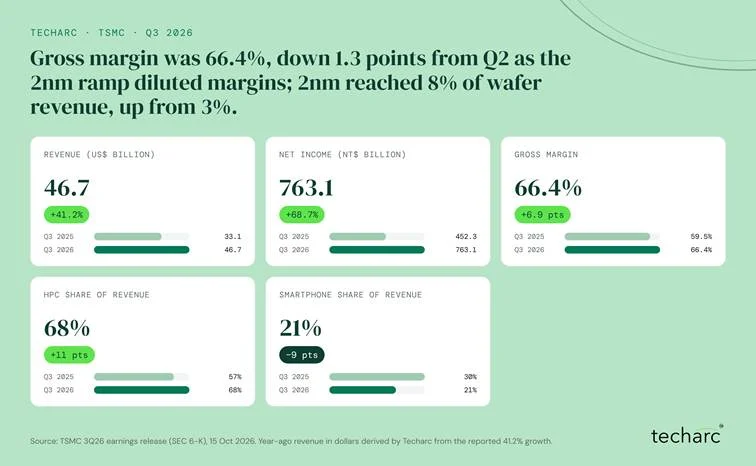
Source: TSMC 3Q26 earnings release (SEC 6-K), 15 Oct 2026. Year-ago revenue in dollars derived by Techarc from the reported 41.2% growth.
The phone slips down the queue
Smartphone revenue rose 10% from Q2, but HPC rose 22%, so the phone’s share kept shrinking. TSMC does not give dollar figures by platform or name customers, but the direction is clear: the company that makes nearly every flagship phone processor now earns more than three times as much from AI and computing as from phones.
That matters because leading-edge capacity is finite. Management said demand is “very, very high” and above supply, and that N2 (2nm) capacity will more than double in 2027 on demand from both smartphones and AI. When phone chips and AI chips bid for the same wafers, phone chipmakers pay more or wait longer.
2nm: the cost of the next flagship
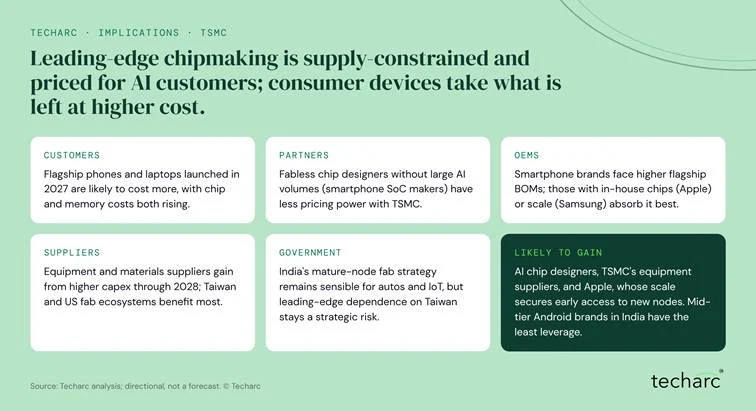
N2 went into volume production in Q4 2025 and is ramping at Hsinchu and Kaohsiung. Qualcomm’s next Snapdragon flagship and Apple’s newest iPhone processors are on it. New nodes cost more per wafer, and TSMC’s gross margin, even after dilution, is 66%. Expect 2027 flagship chipsets to cost phone brands more, on top of the memory price increases SK hynix described.
The India lens
India has no leading-edge foundry, and TSMC has no plant here. Three things follow for India’s device market:
- Flagship pricing: Indian buyers trading up to flagships will face higher launch prices as both processor and memory costs rise.
- Mid-segment lag: mid-range phones, the core of India’s market, stay on older nodes (5nm and above) longer, because leading-edge capacity goes to the highest bidders first.
- Policy relevance: India’s fab projects target mature nodes. TSMC’s results show where the margin is, at the leading edge, and how far India’s semiconductor programme still is from it.
Implications
Techarc view
TSMC’s quarter puts a number on a shift Techarc has been tracking: the smartphone is no longer the semiconductor industry’s main customer. For a decade, phones set the pace of chip progress. Now AI does, and phones ride along. Indian buyers will see this as fewer price cuts on flagships and slower arrival of the newest silicon in mid-range phones.
What to watch
- Smartphone’s share of TSMC revenue in Q4, when new flagship chips ship.
- Launch prices of 2nm flagship phones in India in early 2027.
- TSMC’s 2027 capex number in January.
Sources
Company filings
Supporting coverage
