
Jio is already a top-tier operator by scale and value, not yet by revenue per user or reach
Jio Platforms’ first results as a listed company (Q2 FY27, Jul–Sep 2026, reported 30 Oct) show a business with world-class scale: 542.4 million subscribers, a 54.1% EBITDA margin and a market value that put it within touching distance of the global top five on listing day. What keeps it out of the AT&T, Vodafone and Singtel league is a monthly ARPU of ₹218.8 (about $2.5) and a footprint that ends at India’s borders. Its plan to close that gap is not to buy networks abroad, as Airtel did, but to run other operators’ networks with its own technology.
Key takeaways
- Revenue from operations rose 11.4% to ₹40,475 crore; EBITDA rose 16.6%, faster than revenue, as operating leverage kicked in.
- ARPU grew only 3.5% year on year, from ₹211.4 to ₹218.8. Subscriber additions, not pricing, are still doing most of the work.
- The international plan is asset-light: 10–15 managed-service partnerships built on unlicensed broadband radio (UBR) and Jio’s OSS/BSS stack, with no foreign capex target.
- Jio may become a top-tier telecom technology company before it becomes a top-tier global operator.
The quarter in brief
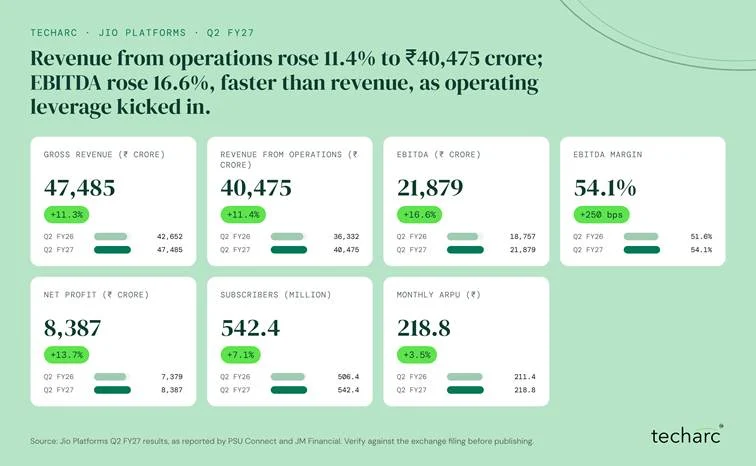
Source: Jio Platforms Q2 FY27 results, as reported by PSU Connect and JM Financial. Verify against the exchange filing before publishing.
Jio added 9.1 million net subscribers in the quarter, crossed 300 million 5G users and 30 million fixed broadband subscribers, and held monthly churn at 1.6%.
Where Jio already is top tier, and where it is not
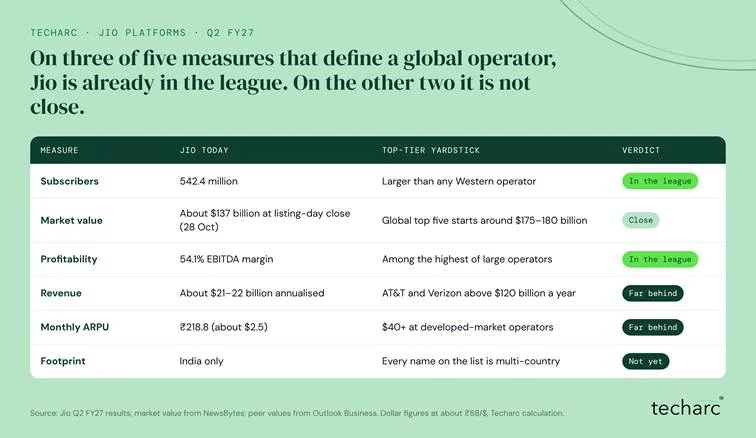
Source: Jio Q2 FY27 results; market value from NewsBytes; peer values from Outlook Business. Dollar figures at about ₹88/$, Techarc calculation.
The ARPU gap is the whole story
Jio’s market value prices in growth its revenue line has not delivered yet. ARPU rose 3.5% in a year in which Airtel reported ₹271. Every ₹10 of ARPU is worth roughly ₹6,500 crore of annual revenue at Jio’s subscriber base, which is why the next tariff move matters more to Jio’s global ranking than any overseas deal.
Two routes to going global
Airtel went global by buying networks; Jio wants to go global by running other people’s.
Airtel’s route: acquisition
Airtel bought Zain’s African operations in 15 countries in 2010, later sold some to Orange, and now operates in India and 14 African countries. That made it the world’s second-largest operator by subscribers, but it took a decade of heavy capex and currency risk to make Africa pay.
Jio’s route: technology export
Jio says it will be a managed-service partner to foreign operators, with no heavy capex and no competing operations in their markets. It is targeting 10–15 material partnerships, built on two products: UBR for home broadband and its full OSS/BSS stack. Management claims a two-and-a-half to three-year lead over the nearest competitor in UBR, and points to Radisys, which it already owns and which supplies technology to operators globally.
The credibility signals so far are thin but real. Dan Bailey, former chairman of Deutsche Bank’s TMT practice, was appointed President in March 2026 to lead the international business from London. No markets, timelines or signed partners have been named, and reported talks with MTN in South Africa did not close on valuation and licensing terms.
What the IPO money does not do
About ₹27,500 crore of the ₹30,213 crore IPO goes to repaying Reliance Jio Infocomm’s borrowings. The listing strengthens the balance sheet; it does not fund an overseas push.
Implications
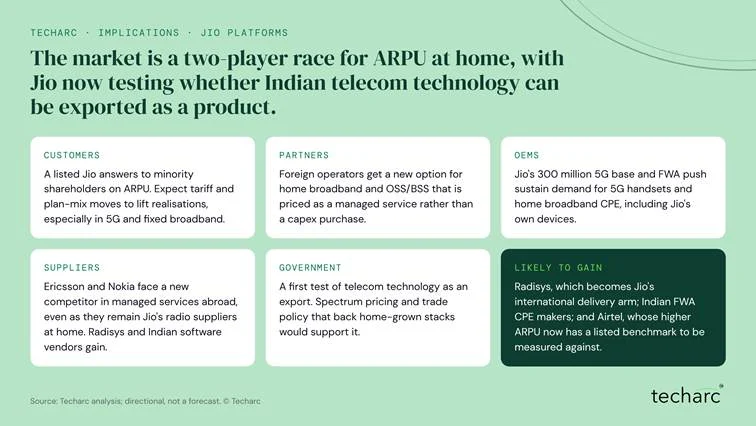
Techarc view
Jio is already a top-tier operator on the measures investors reward: scale, margin and value. It is not one on the measures customers pay for, and it cannot become one by footprint while its strategy is asset-light. The better question is whether Jio becomes the first Indian telecom company whose technology, not its network, is the global product. If two or three of its 10–15 target partnerships close in the next year, that question will have an answer.
What to watch
- The first signed international partner, and whether it is in a developed or emerging market.
- ARPU in Q3 FY27, and any tariff action now that Jio is listed.
- Disclosure of international revenue as a separate line.
- How Ericsson and Nokia respond to Jio as a managed-services rival.
Sources
Company filings
- Jio Platforms Q2 FY27 results release (30 Oct 2026), figures as reported by PSU Connect and JM Financial. Link the exchange filing before publishing.
Supporting coverage
- Light Reading: Jio eyes global telcos with managed services model
- Communications Today: Jio targets 10–15 overseas partnerships
- Business Today: Jio IPO and overseas expansion
- afaqs: Dan Bailey appointed President
- NewsBytes: Jio market value at listing
- Outlook Business: global telecom market-value ranking
