
Nokia’s growth now comes from AI data centres, not telecom operators
Nokia’s Q3 2026 (Jul–Sep) sales rose 10% to €5.15 billion and comparable operating profit rose 35%, but the engine has changed. IP routing grew 45% and optical networks 19%, driven by AI and cloud customers whose orders more than doubled to €1.5 billion. Mobile radio, the business built on telecom operators’ 5G spending, grew only 5%, and part of that was revenue pulled forward from Q4. The world’s network-equipment makers are following the same path as the chipmakers: from the phone network to the data centre.
Key takeaways
- Network Infrastructure sales rose 17% to €2.16 billion; IP Networks €839 million (+45%), Optical €933 million (+19%).
- Sales to AI and cloud customers grew 123%; orders from them grew 118% to €1.5 billion.
- Mobile Infrastructure grew 5% to €2.90 billion; radio networks +11%, core software −13%.
- Nokia completed an AI-RAN call on T-Mobile’s live network with NVIDIA, its bet on bringing AI into the radio network.
The quarter in brief
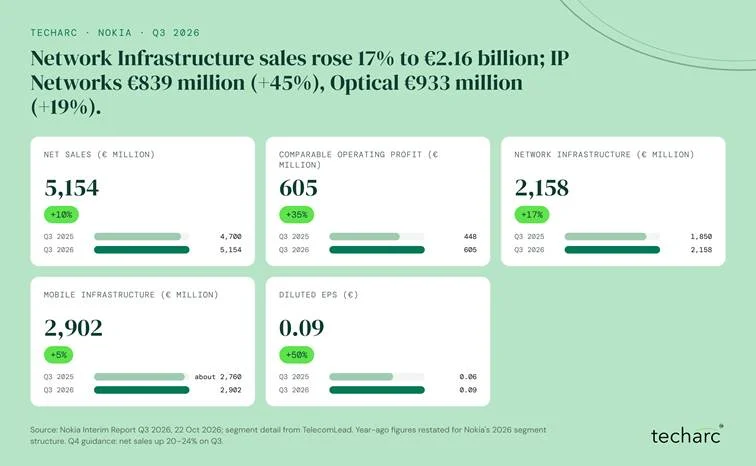
Source: Nokia Interim Report Q3 2026, 22 Oct 2026; segment detail from TelecomLead. Year-ago figures restated for Nokia’s 2026 segment structure. Q4 guidance: net sales up 20–24% on Q3.
Operators are holding back; hyperscalers are not
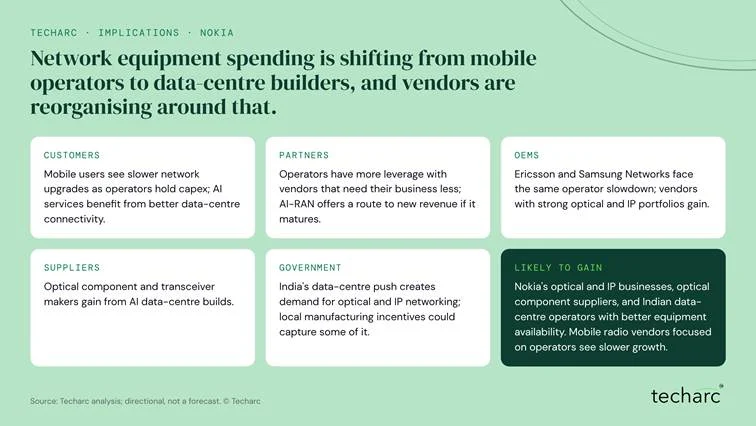
The split inside Nokia mirrors the split across the industry. Telecom operators, still digesting 5G investments and facing flat revenues in many markets, are spending cautiously. Hyperscalers building AI data centres need routers and optical links to move data between GPUs and across sites, and they are spending heavily. Fixed networks, which serve operators’ fibre rollouts, fell 21% as Nokia focused on higher-margin products.
What it means for India
India was one of Nokia’s fastest-growing regions in 2025, on 5G rollouts by Airtel, Jio and Vodafone Idea. With 5G coverage now largely built, Indian operator spending shifts to capacity, fixed wireless and core software. The next wave of Indian demand for Nokia’s growth products will come from data centres: India’s announced AI and cloud data-centre capacity needs the same optical and IP equipment driving Nokia’s growth elsewhere. Jio’s plan to sell its own network technology abroad also makes it a potential competitor in managed services.
Implications
Techarc view
Nokia, like Qualcomm, ARM and TSMC this quarter, is earning its growth from AI infrastructure rather than from the consumer’s phone or the operator’s mobile network. For India, the takeaway is that the next big wave of network spending will be in data centres and fibre backbones, not in the radio towers that defined the 5G years.
What to watch
- Whether Q4’s 20–24% sequential growth is led by operators or AI customers.
- India’s share of Nokia’s sales now that 5G rollouts have matured.
- Commercial AI-RAN deployments beyond trials.
Sources
Company filings
- Nokia Corporation Interim Report for Q3 2026 (22 Oct 2026)
Supporting coverage
