
Tesla’s growth is now in software; in India, it is still learning to sell cars
Tesla’s Q3 2026 (Jul–Sep) revenue was flat at $28.05 billion and car sales fell 3%, but services and other revenue rose 33% and paid Full Self-Driving subscriptions rose 67% to 1.74 million. The connected, software-defined car is starting to show up in the accounts of the one carmaker that built for it. India sees none of that yet: Tesla sells only an imported Model Y here, without FSD, and found demand only after a ₹9 lakh price cut.
Key takeaways
- Automotive revenue fell 3% to $20.56 billion; deliveries fell 2% to 486,532.
- FSD (Supervised) was taken on more than 75% of new North American deliveries; Cybercab robotaxi rides began in Austin on 3 September.
- Energy storage revenue fell 16% to $2.88 billion despite record order backlog, partly due to tariff-related refunds.
- In India, September registrations hit a record 294 and Tesla’s share of luxury electric cars reached 30%.
The quarter in brief
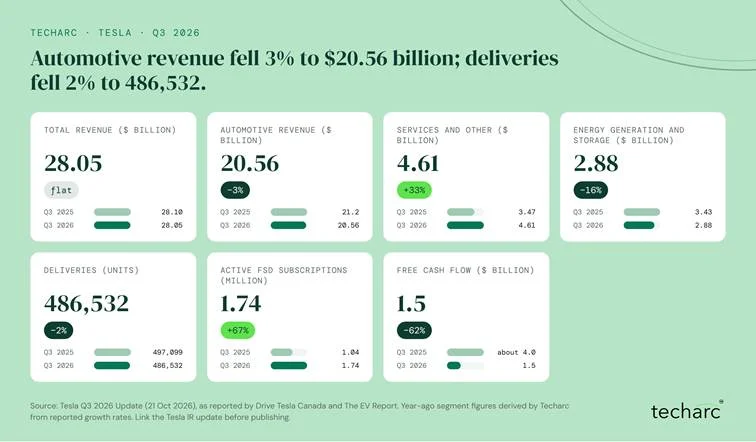
Source: Tesla Q3 2026 Update (21 Oct 2026), as reported by Drive Tesla Canada and The EV Report. Year-ago segment figures derived by Techarc from reported growth rates. Link the Tesla IR update before publishing.
The software-defined car shows up in the numbers
Services and other revenue, which includes FSD, Supercharging, insurance and used cars, grew to $4.61 billion, about a sixth of total revenue. FSD attach in North America jumped nearly 20 points in a quarter to over 75%, and FSD (Supervised) is now approved in nine EU countries. Musk said unsupervised FSD for owners in geofenced areas should arrive in Q2 2027.
This is what our Maruti viewpoint said is missing in India’s mass market: connected-car capability counted as revenue. Tesla shows it can be done, but only after a decade of building every car to be connected and updateable.
The car business is stalling
Deliveries fell 2% year on year and regulatory credit revenue collapsed from $417 million to $113 million. Profit and free cash flow both fell sharply at the same revenue level that produced billion-dollar profits a year ago. Tesla is spending heavily on robotaxis, the Semi, the Optimus robot and AI compute, and the car business is no longer growing fast enough to fund it all comfortably.
India: price unlocked demand
Tesla’s Indian launch was slow: double-digit monthly registrations for most of its first year. After a ₹9 lakh cut took the entry Model Y to ₹50.89 lakh and the six-seat Model Y L arrived, registrations jumped to 116 in July and a record 294 in September, when the Model Y L made up 81% of sales. Tesla now has six showrooms (Mumbai, Delhi, Gurugram, Bengaluru, Hyderabad, Chennai), and its Indian unit reported revenue of ₹247 crore and a profit in FY26. FSD is not offered in India.
Implications
Techarc view
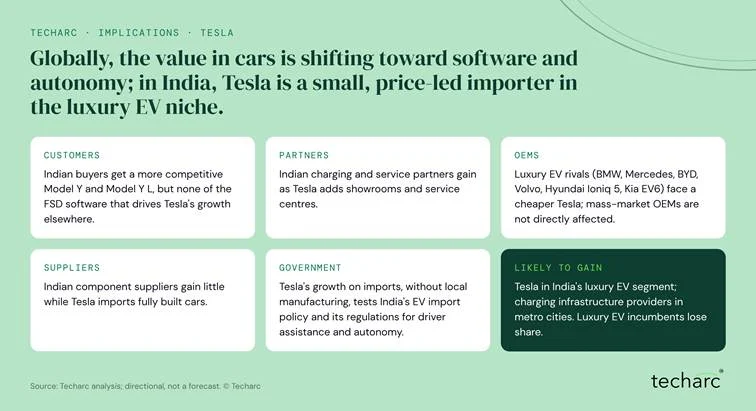
Tesla’s quarter is the clearest evidence that connected and autonomous features can become a revenue line, but it took a fully software-defined fleet to get there. India’s carmakers are years from that. For Tesla in India, the price cut proved there is demand at around ₹50 lakh. The bigger question is whether India’s regulators will ever allow the software that is Tesla’s real growth engine.
What to watch
- Tesla India registrations in the festive months.
- Any regulatory path for advanced driver assistance or FSD in India.
- Unsupervised FSD timing and Cybercab expansion beyond Austin.
Sources
Company filings
Supporting coverage
