
One warehouse fire cost Coupang $248 million: a warning for India’s dark-store model
Coupang, South Korea’s largest e-commerce company, swung to a $501 million loss in Q3 2026 (Jul–Sep) from a profit a year earlier. The single biggest reason was a July fire that badly damaged its leased fulfilment centre in Incheon, costing $248 million in the quarter. Revenue still grew 7% (11% in constant currency). For India, where quick-commerce players are packing ever more inventory into dense urban dark stores, Coupang’s quarter is a case study in how concentrated fulfilment turns physical risk into financial risk.
Key takeaways
- Revenue $9.96 billion (+7%); operating loss $450 million against $162 million income a year ago.
- Excluding the fire, the operating loss would have been $202 million, still a loss.
- Gross margin fell 364 basis points to 25.7%; 26.7% excluding fire costs.
- Coupang also recorded $410 million of administrative fines over nine months, linked in its disclosures to a data incident.
The quarter in brief
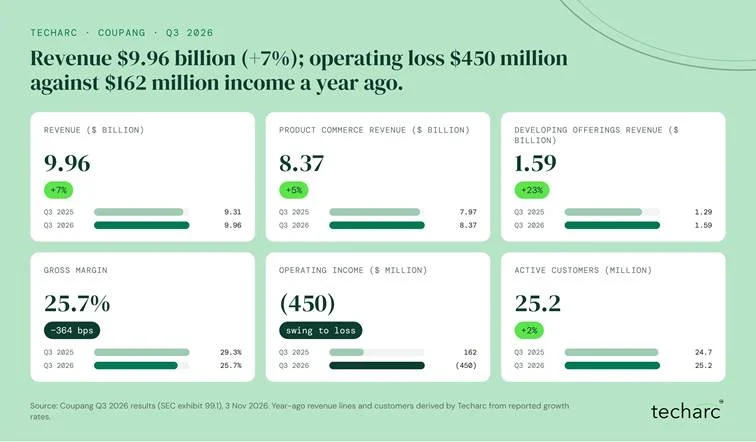
Source: Coupang Q3 2026 results (SEC exhibit 99.1), 3 Nov 2026. Year-ago revenue lines and customers derived by Techarc from reported growth rates.
What one fire did
The fire cost $95 million in cost of sales and $153 million in operating expenses in Q3 alone, about 2.5% of revenue. Coupang’s model, like Amazon’s and India’s quick-commerce players’, depends on a small number of highly automated, inventory-dense facilities to deliver fast. That density is what makes the economics work, and also what concentrates the risk: lose one site and both inventory and delivery capacity disappear at once.
The India parallel
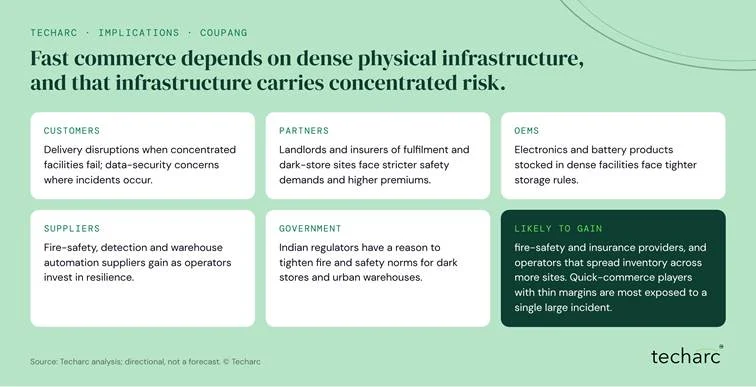
India’s quick-commerce operators run thousands of dark stores, many in converted basements and commercial units in dense neighbourhoods, often stocked with batteries, electronics and flammable goods. Fire safety norms, insurance cover and redundancy planning for these sites have not kept pace with their growth. Coupang shows the cost of getting this wrong at scale: a single incident wiped out the quarter’s profit.
Growth is slowing in the core
Even without the fire, Coupang’s core Korean commerce business grew only 5% in dollars, with active customers up just 2%. Growth now comes from newer businesses such as Coupang Eats and Farfetch. A maturing core plus new-business losses is the pattern Indian e-commerce players should expect once their own home markets saturate.
Implications
Techarc view
Coupang is the closest global analogue to where Indian e-commerce is heading: dense, automated, fast. Its quarter shows that the physical layer of digital commerce carries real risk, and that one incident can erase a quarter’s profit. India’s quick-commerce operators, now competing with Amazon Now as well as each other, should treat resilience as part of the cost of speed, not an afterthought.
What to watch
- Coupang’s recovery of Incheon capacity and any insurance recoveries.
- Fire and safety regulation for dark stores in Indian cities.
- Insurance cost trends for Indian quick-commerce operators.
Sources
Company filings
- Coupang Q3 2026 earnings release (SEC exhibit 99.1) (3 Nov 2026)
- Techarc data Techarc Viewpoint: Amazon Q3 2026
