
Why ₹3,501–₹5,000 Is India’s Smartwatch Sweet Spot – Techarc InfiSights
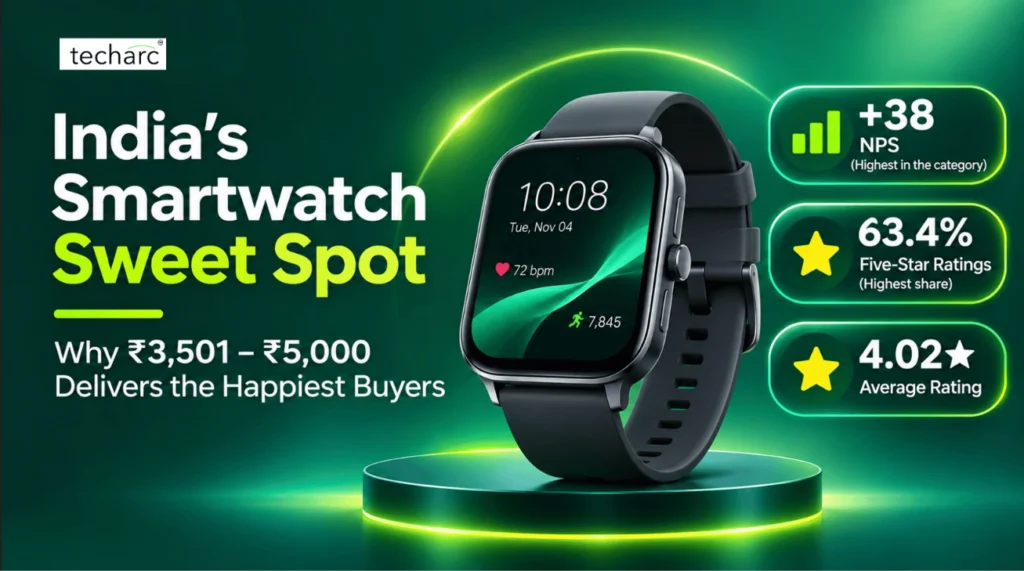
India’s smartwatch market is heavily concentrated in the affordable price segments, with approximately 77% of consumer feedback coming from smartwatches priced below ₹5,000. Within this crowded market, one price segment stands out: the ₹3,501–₹5,000 segment.
According to Techarc InfiSights, this segment accounts for 25% of all smartwatch consumer feedback, making it the second-largest price segment by feedback share. More importantly, it delivers the category’s highest Net Promoter Score (NPS) of +38, the highest five-star rating share of 63.4%, and an average consumer rating of 4.02 stars.
These findings make the ₹3,501–₹5,000 segment a strong contender for India’s smartwatch sweet spot. It combines meaningful market participation with a higher likelihood of delivering a satisfying ownership experience.
How the ₹3,501–₹5,000 Segment Compares With Other Smartwatches
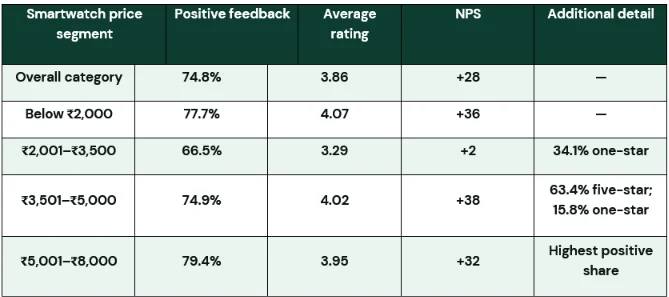
Across India’s smartwatch market, 74.8% of consumer feedback is positive, the average rating stands at 3.86 stars and the NPS is +28. The ₹3,501–₹5,000 segment performs better on the average rating and NPS, while its positive feedback share of 74.9% is marginally above the category average.
The comparison with neighbouring price segments makes its position more interesting.
Smartwatches priced between ₹2,001 and ₹3,500 represent the weakest-performing segment, with just 66.5% positive feedback, an average rating of 3.29 stars and an NPS of +2. As many as 34.1% of ratings in this segment are one-star.
Moving into the ₹3,501–₹5,000 segment brings a significant improvement. NPS increases by 36 points, while the one-star rating share falls to 15.8%.
The segment below ₹2,000 comes close, recording a 4.07-star average rating, an NPS of +36 and 77.7% positive feedback. Meanwhile, the ₹5,001–₹8,000 segment records the highest positive feedback share at 79.4%.
However, neither matches the ₹3,501–₹5,000 segment’s combination of five-star ratings and NPS. This distinction matters. A high positive feedback share indicates that consumers are generally satisfied, but a higher five-star share and NPS indicate a stronger likelihood of outright delight and recommendation.
What Makes ₹3,501–₹5,000 Smartwatches More Satisfying?
1. Battery life is a major source of satisfaction
Battery performance is the most discussed topic among consumers in this segment, and it is also one of its strongest areas.
Around 84% of battery-related feedback is positive, translating into a net favourability score of +75%. This is higher than the overall smartwatch category’s +70%.
Battery life is particularly important in the smartwatch category because it directly influences everyday convenience. Consumers expect their watches to remain usable without frequent charging interruptions.
The segment’s battery performance therefore plays an important role in strengthening the overall ownership experience.
2. Style-conscious and budget buyers are particularly happy
The consumer persona mix offers another explanation for the segment’s performance.
Style and fashion buyers account for 36% of persona-related feedback, while budget buyers contribute 30%. Both groups give their smartwatches an average rating of 4.7 stars.
These ratings are notably higher than the corresponding category averages of 4.48 stars for style and fashion buyers and 4.42 stars for budget buyers.
Budget buyers rate this price segment higher than any other smartwatch segment, suggesting that the ₹3,501–₹5,000 range delivers a particularly satisfying balance of affordability and ownership experience.
Even more demanding consumer groups report stronger satisfaction. Health-focused buyers give this segment an average rating of 4.1 stars, compared with 3.75 stars across the category. Fitness enthusiasts rate it 4.2 stars, against the category average of 4.06.
3. AMOLED displays strengthen the product proposition
Display technology is another differentiator.
Around 80% of the models in the ₹3,501–₹5,000 segment feature AMOLED displays. This compares with just 33% in the immediately lower ₹2,001–₹3,500 segment.
The higher presence of AMOLED displays gives buyers access to a more premium display proposition without moving into significantly higher price segments.
Combined with battery satisfaction and strong ratings from style-conscious buyers, this helps explain why the segment performs well across different consumer expectations.
A More Consistent Segment With Fewer Weak Performers
Average ratings and sentiment scores can sometimes hide significant differences between individual products. However, the ₹3,501–₹5,000 segment demonstrates a relatively consistent performance across the models with meaningful consumer feedback.
Every model with a meaningful volume of feedback records a positive NPS, ranging from +26 to +44. Brand-level NPS also remains positive, between +26 and +47.
The contrast with neighbouring segments is significant.
In the ₹2,001–₹3,500 segment, four out of five models with meaningful feedback record an NPS of zero or below. In the segment priced below ₹2,000, two out of six models also record non-positive NPS.
For consumers, this consistency reduces the risk of selecting a poorly performing product within the price segment. It does not mean every smartwatch is equally good, but the available feedback suggests a stronger and more dependable pool of choices.
What Does This Mean for Smartwatch Buyers and Brands?
For buyers
The ₹3,501–₹5,000 segment offers one of the strongest opportunities to get a highly satisfying smartwatch experience in India. It combines the highest five-star rating share and NPS with strong battery sentiment and a relatively consistent set of performing models.
Before purchasing, consumers should still compare individual products, particularly on health tracking accuracy and calling performance. These areas deserve attention rather than relying solely on the segment’s overall ratings.
For brands and retailers
The segment’s performance is supported by battery satisfaction, a style-conscious buyer base, budget-conscious consumers and a strong AMOLED display presence. Maintaining these strengths will be important as competition intensifies.
An opportunity remains in health tracking, where approximately one-fifth of consumer feedback is negative. Improving the reliability and consistency of health-related features could help brands strengthen satisfaction further.
The Bottom Line: ₹3,501–₹5,000 Is India’s Smartwatch Sweet Spot
The ₹3,501–₹5,000 smartwatch segment stands out as one of the strongest price Segments in India’s smartwatch market. It accounts for 25% of consumer feedback and delivers the category’s highest NPS of +38, the highest five-star rating share of 63.4% and an average rating of 4.02 stars.
Battery performance, strong satisfaction among budget and style-conscious buyers, wider AMOLED adoption and consistency across individual models contribute to its appeal.
While no price segment guarantees a perfect smartwatch, the evidence from Techarc InfiSights suggests that consumers have a better chance of finding a highly satisfying product in this range.
For buyers looking for the right balance of price and experience, ₹3,501–₹5,000 is India’s smartwatch sweet spot.
Frequently Asked Questions – FAQ
1. Which is the best price range to buy a smartwatch in India?
According to Techarc InfiSights, ₹3,501–₹5,000 is the strongest smartwatch price segment in India, recording an NPS of +38, 63.4% five-star ratings and an average rating of 4.02 stars.
2. Why are smartwatches priced between ₹3,501 and ₹5,000 popular?
The segment combines strong battery satisfaction, a high presence of AMOLED displays and positive ratings from budget-conscious and style-focused consumers.
3. What is the average rating of smartwatches priced between ₹3,501 and ₹5,000?
The segment records an average consumer rating of 4.02 stars, compared with 3.86 stars across the overall smartwatch category.
4. Which smartwatch price segment has the highest NPS in India?
The ₹3,501–₹5,000 segment records the highest NPS at +38 among the smartwatch price segments analysed by Techarc InfiSights.
5. What percentage of smartwatches in the ₹3,501–₹5,000 segment have AMOLED displays?
Approximately 80% of models in this segment feature AMOLED displays, compared with 33% in the ₹2,001–₹3,500 segment.
6. What should consumers check before buying a smartwatch under ₹5,000?
Consumers should compare battery performance, health tracking, calling quality, display technology and recent product-specific reviews before making a purchase
Explore more consumer insights with Techarc InfiSights for Wearables: