
Samsung Q3 2026 Results: Memory Profits Surge as Smartphone Business Slips into Loss

Samsung’s Device Solutions division earned KRW 106.5 trillion (US$79.8 billion) in July–September 2026, almost entirely from memory. Its Device eXperience division, home to Galaxy phones, TVs and appliances, lost KRW 0.8 trillion (US$0.6 billion). Techarc splits Samsung’s businesses by how exposed they are to memory prices, and reads what that split means for India.
Samsung Q3 2026 results at a glance
Samsung earned more operating profit in July–September 2026 than in all of 2025, and almost all of it came from memory. Consolidated revenue was KRW 195.3 trillion (US$146.3 billion), up 127% year on year and 14% quarter on quarter. Operating profit reached KRW 107.4 trillion (US$80.4 billion), up 783% year-on-year, the first time any technology company has crossed KRW 100 trillion (US$75 billion) in a single quarter (Samsung Newsroom).
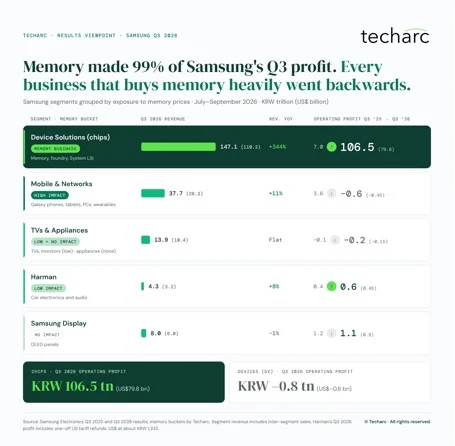
The Device Solutions (DS) semiconductor division made KRW 106.5 trillion (US$79.8 billion) of that profit, or 99% of the total. The Device eXperience (DX) division, which covers smartphones, TVs and appliances, lost KRW 0.8 trillion (US$0.6 billion). That was its second straight quarterly loss at the same scale, despite an 8% quarter-on-quarter revenue gain.
A year ago, the picture was balanced. In Q3 2025, DS revenue was KRW 33.1 trillion (US$24.8 billion), and the mobile and networks business was KRW 34.1 trillion (US$25.5 billion) (Samsung, Q3 2025). Today chips bring in nearly four times what phones do. Samsung has gone from a devices company with a chip business to a memory company with a devices business attached.
The company is putting the windfall back to work. Q3 capex was KRW 29 trillion (US$21.7 billion), with KRW 27.2 trillion (US$20.4 billion) in DS, and full-year 2026 capex is guided at about KRW 84.4 trillion (US$63.2 billion). The quarter’s dividend totals KRW 30 trillion (US$22.5 billion).
How memory prices split Samsung’s businesses
Sorted by how much memory prices touch them, Samsung’s businesses fall into four buckets: one that sells memory, and three that consume it to different degrees. Only the memory business grew profit meaningfully; every business that buys memory heavily went backwards.
Segment revenues include inter-segment sales, so they add up to more than the consolidated total.
Memory business: the profit engine
DS revenue more than quadrupled, and the memory business set all-time highs for both revenue and profit. Server demand lifted prices across every application, and Samsung significantly scaled up HBM4 shipments while managing its mix toward AI products under capacity constraints. Samsung does not split memory out of DS in its release, but foundry and System LSI are small by comparison. Notably, foundry’s own improvement came partly from HBM base-die sales, so even the non-memory chip units are riding the memory cycle.
High memory impact: smartphones, tablets, PCs and wearables
MX and Networks grew revenue 11% on new foldables and flagships, but swung from a KRW 3.6 trillion (US$2.7 billion) profit to a KRW 0.6 trillion (US$0.45 billion) loss. Samsung attributes the year-on-year decline to cost pressures. Memory is a double-digit share of a smartphone’s bill of materials, and a phone cannot be redesigned around it mid-cycle. Samsung’s Q4 plan is to lean on flagships and efficiency rather than price. That suggests the mass-market end of the portfolio is where the pain is concentrated.
Low memory impact: TVs, monitors, networks and car electronics
These products carry memory, but it is a smaller slice of their cost than in a phone. The VD (TV) business saw revenue fall after the major sporting events ended, and earnings fell on higher costs. Harman is the exception here. Profit rose on audio and automotive sales, but one-off US tariff refunds helped, so its true run-rate is softer than the headline numbers.
No memory impact: home appliances and display panels
Refrigerators, washing machines, ovens and air conditioners carry almost no memory. Yet DA earnings still declined, due to higher raw-material and logistics costs. Samsung Display (SDC) held steady at KRW 1.1 trillion (US$0.8 billion) profit on KRW 8.0 trillion (US$6.0 billion) revenue. The lesson is that being insulated from memory is not the same as being healthy: the combined TV and appliance line also lost money in Q3 2025.
One reporting caveat matters. Samsung reports TVs and appliances as a single VD/DA line, so the low-impact and no-impact buckets cannot be fully separated in the numbers.
What Samsung’s Q3 results mean for India
In India, Samsung sits entirely on the paying side of the memory cycle. It has no memory business here, so the windfall that rescues the group’s numbers never reaches the Indian arm.
The latest filing already shows the strain. In FY26 (April 2025 to March 2026), Samsung India’s revenue rose 1.2% to about ₹1.12 lakh crore (US$12.7 billion), while profit fell 36% to ₹7,228 crore (US$821 million), according to its regulatory filings. Mapped onto the four buckets, the India business splits like this:
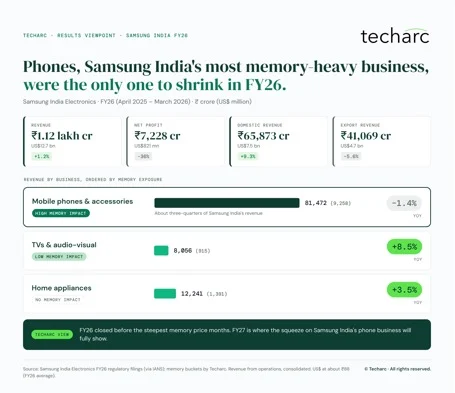
The pattern mirrors the group’s: the less memory a product carries, the better it did. Phones are about three-quarters of Samsung India’s revenue and were the only one of the three to shrink. Domestic revenue grew 9.3% to ₹65,873 crore (US$7.5 billion), but exports fell 5.6% to ₹41,069 crore (US$4.7 billion), a reminder that India is also a production base for Galaxy devices sold abroad.
FY26 also ended before the steepest months of the memory price surge, so FY27 is where the real squeeze will show. Three signals point that way. Samsung has raised prices on select smartphone models by 5–10%, and the rupee’s near-10% depreciation through FY26 adds to the cost of India-priced devices. The company has begun trimming its TV and appliance sales teams, with 80–100 executives reportedly let go and a second round expected after Diwali. And Korean media report that Samsung’s mobile division is cutting Q4 smartphone production by up to 30%, which could reach Noida’s output.
The counterweight is appliances. Samsung India expects double-digit growth in its appliance business in the second half of 2026, driven by festive demand and an upmarket shift in what households are buying.
The smartphone layoffs that did not happen are telling too. Large brands typically lock in memory pricing through supply agreements 12–24 months ahead, which gives the phone business a cushion the TV and appliance lines lack. That cushion runs out as contracts reset through 2027.
How much has Samsung raised smartphone prices in India?
Samsung is raising prices in India, but by less than the market, and almost entirely at the bottom of its range. Techarc’s launch data compares each successor’s launch price with the model it replaces. Since memory costs began climbing in November 2025, the median successor launched in India has been priced 29.2% above its predecessor. Samsung’s median is 17.5%, up from 5.6% before the surge. Along with Apple and OnePlus, it has absorbed more of the cost than any other major brand, while Tecno, iQOO, Poco, Lava, Vivo and Realme passed on the most.
This restraint is not uniform. Four in ten Samsung successors moved up a full Techarc price segment. The Techarc India Smartphone Price Trends dashboard, which tracks shelf prices for 2025 launches month by month through May 2026, shows the split clearly. Across 11 Samsung models, the average change was a modest +5.4%, but the Galaxy M16 5G rose 39.1%, from ₹11,499 (US$120) to ₹15,999 (US$167), lifting it from Base into Mid. The Galaxy M06 rose 34.8%. At the other end, the flagship Galaxy S25 fell 16.9%.
The pattern mimics the four-bucket picture portrayed by Techarc. Samsung is passing the memory costs through where memory is the largest share of a phone’s cost and margins are thinnest, and absorbs them in flagships, where supply contracts and group profits give it room. Across the industry, Entry successors rose 45.4%, the steepest of any Techarc segment.
Implications for the smartphone market and ecosystem
The memory cycle is changing the ‘profit centre’. It sits right on the board now rather than how you package it. Profits are moving out of devices into the chips. Samsung is the only large device brand that captures both. Every won of extra memory cost its phone business absorbs is, in part, revenue to its own chip division. Brands without in-house memory, which is nearly every other smartphone and TV maker selling in India, bear the full cost with no offset. That gives Samsung room to hold prices, protect shelf space and keep marketing spend up longer than rivals can. In a squeezed market, staying power is a competitive weapon.
Even if the magnitude is not, the direction is clear for the wider ecosystem. Consumers should be ready for more price increases and quieter spec trims. These could be lower base RAM and storage, with the entry end of the market shrinking fastest. Retailers are likely to face lower unit volumes and a mix that shifts upmarket, likely to favour organised and brand-led channels over small multi-brand stores. Contract manufacturers and component suppliers will feel production cuts first, pressuring volume-linked incentives and export targets. The one bright spot, however, is the policy. A memory shortage of this scale strengthens the case for India’s own memory assembly and packaging capacity. But this is long-term and cannot solve the immediate pressures the industry faces.
Techarc view: can memory keep carrying Samsung’s devices business?
Samsung is not a company under pressure; it is a company whose devices business is being subsidised by its memory business, and that is a deliberate, affordable choice. A KRW 0.8 trillion (US$0.6 billion) loss in DX is less than 1% of what DS earned this quarter. Samsung could push phone prices harder to defend margins. It is choosing volume, share and ecosystem instead, and its peers cannot afford to make the same choice. Techarc’s India price data already shows it: Samsung’s successor launches are up 17.5% against a market median of 29.2%.
The risk isn’t this quarter’s loss, but what it hides. First, the subsidy lasts only as long as the memory cycle. Samsung expects 2027 demand to exceed supply by a lot, but cycles turn, and when they do, the devices business will need to stand on its own. Second, the TV and appliance line was loss-making before memory prices took off, and the no-impact appliances bucket is still losing ground on other costs. That is a structural problem, not a cyclical one. Third, in India, the arm carries the cost without the offset, so that FY27 will show Samsung India’s real resilience.
What we will watch:
- Whether Samsung’s DX division returns to profit in Q4 on flagship season, or posts a third straight loss?
- How far the reported Q4 production cut reaches Indian factories and exports?
- How Samsung’s pricing moves across Techarc’s smartphone segments as supply contracts reset through 2027?
- Whether the appliance business delivers its promised festive-season growth?
Sources
Company filings
- Samsung Electronics Announces Third Quarter 2026 Results, Samsung Newsroom
- Samsung Electronics Announces Third Quarter 2025 Results, Samsung Semiconductor
- Samsung India Electronics FY26 regulatory filings, as reported by IANS (segment revenue)
Techarc data
- India Smartphone Price Trends dashboard: monthly shelf prices of 2025 launches, to May 2026
- From discounting to surging: how India’s smartphone pricing flipped between 2025 and 2026, Techarc InsightsPro
- Fewer launches, higher prices: 7 takeaways from India’s Q3 2026 smart device launches, Techarc
- Smartphones in India: analysis, data and reports, Techarc
Supporting coverage
- Samsung Q3 2025 results incl. Harman and SDC, Financial News
- Samsung Q3 2026 Harman figures, New Kerala / Korea Herald
- Samsung India’s smartphone business proves a mainstay, so far, Communications Today
- Samsung Q3 2026 guidance and production cuts, GSMArena
- Samsung India festive appliance outlook, Indian Retailer
Currency: KRW figures converted at about KRW 1,335 per US$ (late October 2026). Samsung India FY26 figures converted at about ₹88 per US$ (FY26 average); current retail prices at about ₹96 per US$. Conversions are approximate.