
Shielding the Buyer – Which Smartphone Brands Passed on the Least of the Memory Bill
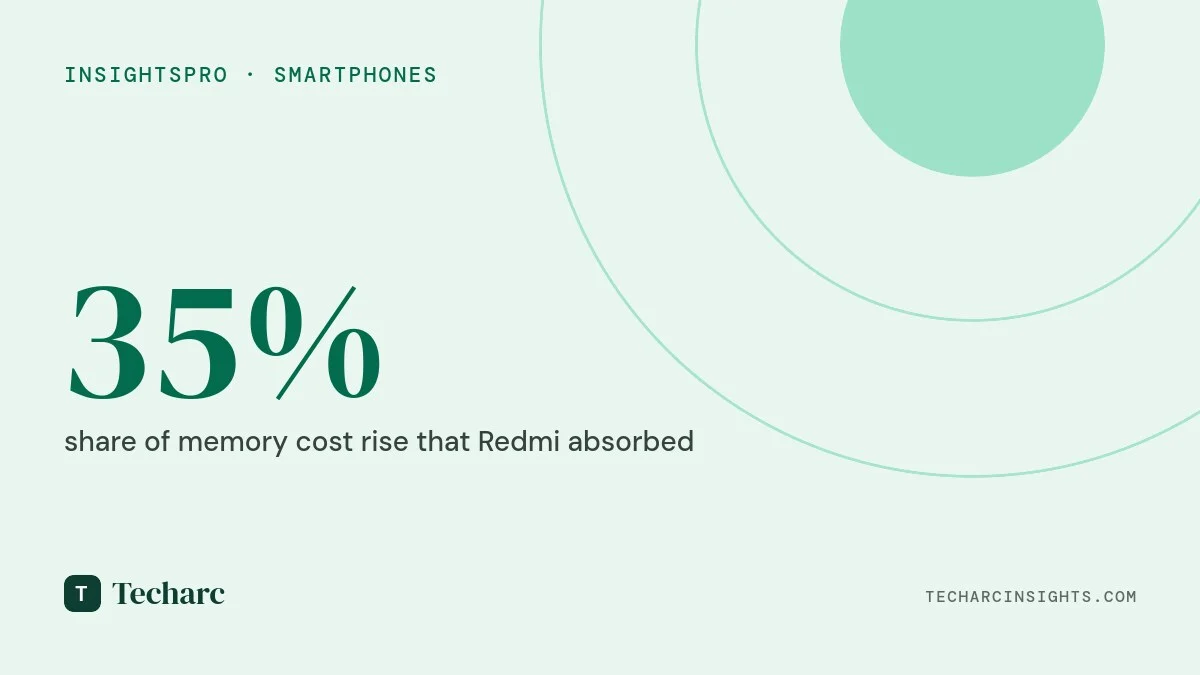
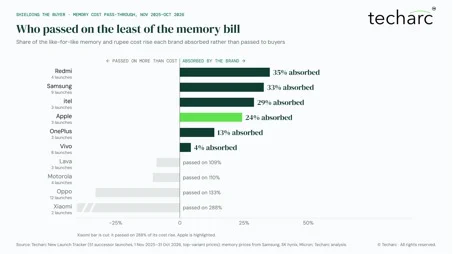
Redmi, Samsung and itel kept the largest share of the memory shock off their buyers. For the same RAM and storage, their phones’ cost rose 30–81% over the previous model; they passed on 65–71% of that and absorbed the rest. Across all brands, buyers bore 95% of the rise, and brands absorbed 5%.
Redmi absorbed the most in absolute terms: 28.2 points of the old launch price, about a third of its 80.7% cost rise. Samsung absorbed 33%, mostly by holding back price on its foldables. itel absorbed 29% and barely moved its sticker prices. Apple is fourth at 24%: it cut the iPhone 17e’s price and absorbed part of the cost on the iPhone 18 Pro and 18 Pro Max.
Shielding a buyer is not the same as shielding the price tag. Different brands used different strategies based on their strengths and the segments they focus on. Redmi and itel held prices down partly by shipping phones with less memory, which buyers pay for in specs. Samsung kept memory unchanged across its flagships and foldables and absorbed the cost into the price, while Apple added storage to the iPhone 18 Pro’s top variant.
Period covered: 51 successor launches from 1 November 2025 to 31 October 2026, from the Techarc New Launch Tracker updated to the end of October 2026.
The ranking
Redmi absorbed the largest share of its memory cost rise, at 35%, followed by Samsung (33%), itel (29%) and Apple (24%). OnePlus and vivo absorbed a little; Lava, Motorola, Oppo and Xiaomi passed on more of their cost rise. The measure counts both the sticker price and the memory taken out of the phone, against what the same memory configuration now costs.
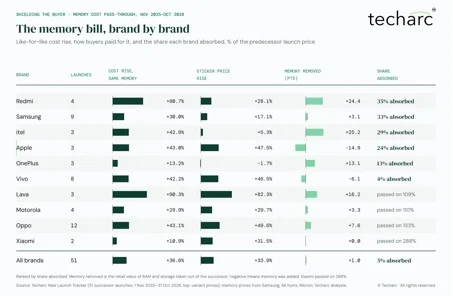
Oppo’s late-October launches weigh on its position: the Find X10 and Find X10 Pro Max were priced 82–100% above the Find X9 and Find X9 Pro, with less RAM.
Shielding the price tag doesn’t shield the buyer.
The brands that absorbed the most took two different routes. Samsung and Apple kept or added memory and held back on price; Redmi and itel held back on price partly by shipping phones with less memory.
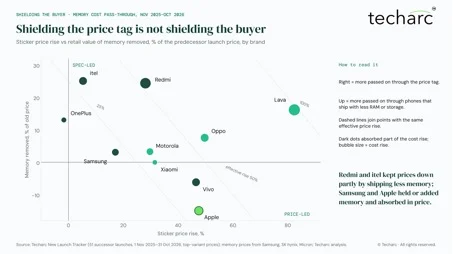
- Samsung absorbed the price. Memory was unchanged on its S26 series and Z Fold 8 and Z Flip 8, and its foldables launched at prices that recovered less than half of their cost rise. Its Entry and Mid models (Galaxy A08, F08, M08) did drop to 4GB/64GB.
- Apple added memory. The iPhone 18 Pro’s top variant doubled storage to 2TB, and the iPhone 17e launched below the iPhone 16e with the same memory. Apple’s sticker prices rose 47.5%, but the memory added was worth 14.9 points, so buyers got more phone for the higher price.
- Redmi absorbed despite cutting memory. Three of its four successors shipped with less memory, worth 24.4 points of the old price. Its cost rose 80.7% for the same memory, but it still absorbed 28.2 points.
- itel shielded the sticker more than the buyer. Prices rose just 5.3%, and two of its three successors cut storage to 64GB, worth 25.2 points. It still absorbed 29% of its cost rise.
- OnePlus cut its sticker price 1.7% but removed memory worth 13.1 points, so buyers bore most of the rise through specs.
On sticker price alone, OnePlus and itel would look like the strongest shields. Counting memory removed puts Redmi and Samsung ahead.
Models: the launches that absorbed the most
The Vivo T5 Lite 5G absorbed the most of any launch: its price nearly doubled to ₹24,999, but its like-for-like cost rose even more, leaving 52.4 points absorbed. Four of the top ten are Samsung, three are Redmi, and two are Vivo.
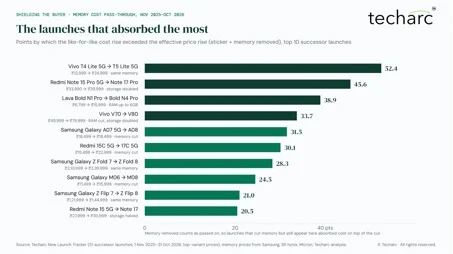
- Redmi Note 17 Pro (45.6 points): storage doubled to 256GB for a ₹6,000 rise.
- Vivo V80 (33.7): storage doubled to 512GB, partly offset by RAM falling from 12GB to 8GB.
- Samsung Galaxy A08 (31.5): same ₹18,499 price as the A07, though with 4GB/64GB instead of 6GB/128GB.
- Samsung Z Fold 8 and Z Flip 8 (28.3, 21.0): same memory, but prices rose ₹29,000 and ₹23,000 despite cost increases two to three times as large.
A brand that passes on most of its cost overall can still shield buyers on individual models: Vivo, sixth in the ranking, has two of the ten launches that absorbed the most, and Lava, seventh, has one.
Segments and industry: where brands held back
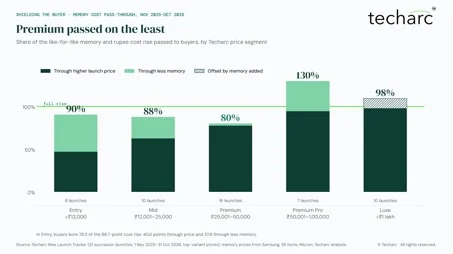
Premium phones (₹25,001–50,000) passed on the least, at 80% of their cost rise, followed by Mid (88%) and Entry (90%). Luxe passed on 98% once the iPhone 18 Pro, 18 Pro Max and Find X10 launches are included, and Premium Pro was the only segment where buyers bore more than the full rise, at 130%.
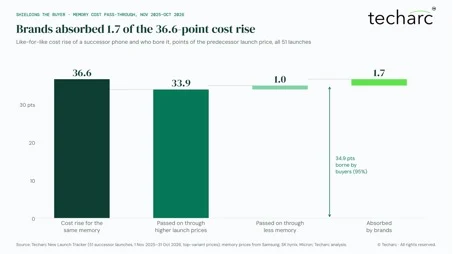
Across all 51 launches, brands absorbed 1.7 points of a 36.6-point like-for-like cost rise, or 5%. Buyers bore the rest: 33.9 points through higher launch prices and 1.0 through less memory.
Implications
Market condition. Few brands have shielded buyers from the memory shock, and those that did paid for it in margin while volumes fell an estimated 27–28% in calendar 2026. With memory still rising, the room to keep absorbing is narrowing, so the brands that shielded buyers in 2026 face the hardest pricing calls in 2027.
- Customers. The best value is in successors that kept their memory and held price, such as Samsung’s flagships and foldables. A low sticker price can hide a memory cut, so buyers should compare RAM and storage with the previous model.
- Retail and channel partners. Brands that absorbed cost have less margin to fund dealer schemes. Expect promotions to lean on financing and exchange rather than price cuts.
- OEMs. Absorbing cost builds goodwill and protects share, but it is not sustainable for brands concentrated below ₹25,000, where memory is the largest part of a phone’s cost.
- Suppliers. Brands absorbing cost will push hardest for lower memory prices and longer contracts, and will move faster to lower-capacity configurations if prices keep rising.
- Government. Relief on memory duty or GST would let the brands already absorbing cost pass the savings on directly, and would matter most in Entry and Mid.
Brands likely to gain
- Samsung – Held memory and price discipline in foldables and flagships, which strengthened its value-for-money position at the top of the ladder.
- Redmi – Gave buyers the most relief relative to cost. This supports its share in Mid and Premium as rivals raise prices.
- Apple – It cut the iPhone 17e’s price and added storage to the iPhone 18 Pro, giving buyers more phone for the money at both ends of its range.
Method and assumptions
- Launches covered: 51 successor pairs from ten long-haul brands (Apple, itel, Lava, Motorola, OnePlus, Oppo, Redmi, Samsung, Vivo, Xiaomi), where the successor launched between 1 November 2025 and 31 October 2026, from the Techarc New Launch Tracker updated to the end of October 2026. Each pair compares top-variant launch prices; the iPhone Duo and other launches without a direct predecessor are excluded.
- Like-for-like cost rise: the rise in a phone’s cost if it kept its predecessor’s RAM and storage, from higher memory prices and the weaker rupee, as a share of the predecessor’s launch price. Memory cost starts at $2.40/GB for DRAM and $0.16/GB for NAND in Q3 2025 and is indexed by quarter to the price changes Samsung, SK hynix and Micron reported; memory is bought a quarter before launch.
- Memory removed: the retail value, at current memory prices, of RAM and storage taken out of the successor (negative where memory was added).
- Absorbed = like-for-like cost rise − (sticker price rise + memory removed). Share absorbed = absorbed ÷ like-for-like cost rise. A negative share means the brand passed on more than its memory and rupee cost rose.
- From cost to shelf price: 18% GST, an 8% channel margin and a 15% brand gross margin; cost increases are passed on in rupees without adding margin.
- Weighting: brand, segment and industry figures are rupee-weighted by predecessor launch price.
- Volumes: Techarc estimates a 27–28% fall in smartphone unit sales in calendar 2026.
Sources
Techarc data
- India Smartphone Launchboard, Techarc: launch prices and configurations of smartphones launched in India, 2024–2026
- Fewer launches, higher prices: 7 takeaways from India’s Q3 2026 smart device launches, Techarc
- Smartphones in India: analysis, data and reports, Techarc
Company disclosures
- Samsung Q4 2025 earnings call, BigGo Finance, 29 January 2026
- SK hynix Q3 2026 earnings call transcript, The Motley Fool, 28 October 2026
Supporting coverage
- Samsung and SK hynix Q1 2026 memory price increases, Global Memory Supply
- Micron fiscal Q2 2026 memory pricing, MemoryMarket
- Samsung sees Q2 DRAM prices up 40%, NAND up 60%, Seoul Economic Daily, 30 July 2026
- Rupee: Motilal Oswal, Deccan Herald, HDFC Sky