
In March 2026, the Production Linked Incentive Scheme for Large Scale Electronics Manufacturing (PLI-LSEM) officially concluded its transformative tenure. By any conventional metric, the PLI scheme was a historic success. It catapulted smartphones from a negligible blip on the trade radar into India’s single largest standalone merchandise export product, bypassing traditional giants like polished diamonds. […]
In March 2026, the Production Linked Incentive Scheme for Large Scale Electronics Manufacturing (PLI-LSEM) officially concluded its transformative tenure. By any conventional metric, the PLI scheme was a historic success. It catapulted smartphones from a negligible blip on the trade radar into India’s single largest standalone merchandise export product, bypassing traditional giants like polished diamonds.
Yet, a closer look at the ecosystem revealed a structural vulnerability. India had become the world’s second-largest mobile manufacturer by volume, but the industry remained heavily reliant on a multi-billion-dollar corridor of advanced components and sub-assemblies imported from China and Hong Kong. The ecosystem was fundamentally anchored in final-stage assembly rather than end-to-end manufacturing.
To catalyse the next evolutionary leap, the Union Cabinet approved the Mobile Phone Manufacturing Scheme (MPMS) on July 15, 2026. Backed by a formidable budgetary outlay of ₹62,500 crore and running from FY 2026-27 to FY 2030-31, MPMS is not merely an extension of the PLI era—it is a fundamental pivot in India’s industrial strategy.
Here is an analytical breakdown of how MPMS differs from its predecessor, the strategic gaps it bridges, and the outcomes it aims to orchestrate for the global electronics supply chain.
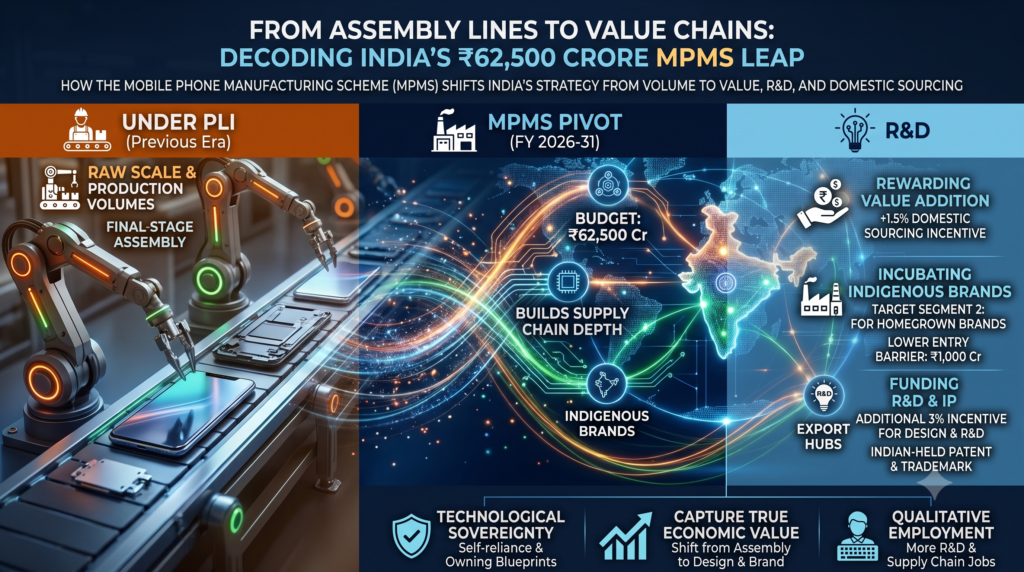
While the PLI scheme operated as a blunt instrument designed to generate raw scale, MPMS is a precision tool engineered to build supply chain depth and technological sovereignty. The operational differences manifest in three core areas:
Under the original PLI-LSEM, manufacturers earned incentives primarily by hitting incremental production and sales thresholds. It rewarded the sheer volume of units pushed off the assembly line.
MPMS introduces a highly nuanced incentive structure. While it retains a base incentive of 2.25% to 5% on eligible sales, it introduces a crucial Domestic Sourcing Incentive. Manufacturers can earn an additional payout of up to 1.5% if they source key components and sub-assemblies domestically (provided these components are localised for a minimum of 25% of total mobile production). This alters the core financial calculus for original equipment manufacturers (OEMs). Companies are now directly financially motivated to develop, partner with, and procure from local component vendors rather than relying on imported knocked-down kits.
Perhaps the most glaring critique of the PLI era was the absence of a globally competitive, homegrown Indian mobile brand. PLI-LSEM evaluated all applicants equally based on scale, which inherently favored established global behemoths and top-tier Electronics Manufacturing Services (EMS) players who already possessed massive capital and global distribution networks.
MPMS structurally corrects this by bifurcating the market. It establishes two distinct target segments:
This bifurcation ensures that emerging indigenous brands are not forced to compete against the economies of scale wielded by global trillion-dollar tech giants just to qualify for government support.
Under the new framework, the government is actively funding the creation of intellectual property. Applicants under TS2 (Indian brands) are eligible for an additional 3% incentive on eligible sales specifically earmarked for product design and R&D. MPMS mandates that the company, IP, and trademark must be held in India, and the applicant must maintain in-house design capabilities. This is a strategic shift from subsidising blue-collar assembly labor to subsidising white-collar engineering, software development, and industrial design.
The strategic objectives of the scheme target both macroeconomic growth and micro-level ecosystem maturity. By the end of its five-year run in FY 2030-31, the policy is engineered to deliver the following outcomes:
The transition from PLIS to MPMS represents an evolution from capacity building to capability building, addressing several critical blind spots:
The most frequent criticism of PLI-LSEM was that it fostered an “assembly-only” ecosystem. While millions of phones were built in India, the core technologies—processors, displays, memory chips, and camera modules—were imported. This left India vulnerable to global supply chain shocks. MPMS bridges this gap. By tying up to 1.5% of total incentives to domestic sourcing, it shifts the industry from a Semi-Knocked Down (SKD) model to a Completely Knocked Down (CKD) model, forcing localisation deeper into the bill of materials.
MPMS does not exist in a vacuum; it acts as the demand-side engine for the government’s supply-side policies. In April 2025, the government notified the Electronics Components Manufacturing Scheme (ECMS), subsequently boosting its outlay to ₹40,000 crore in the 2026-27 Union Budget. While ECMS funds the factories that build the components, the MPMS domestic sourcing clause creates the guaranteed commercial demand for those components. This synchronised policy loop was entirely absent during the early years of the PLI scheme.
In the modern technology hardware market, the physical assembly of a device accounts for a fraction of its retail price. The lion’s share of economic value is captured by the entity that holds the brand, the design patents, and the software ecosystem. Under PLI, foreign brands captured this premium, while India captured only the assembly margin. By offering a 3% bonus for R&D to Indian brands, MPMS explicitly targets this gap, ensuring that over the next five years, India captures not just the labor value of electronics, but the intellectual and brand value as well.
For industry stakeholders, OEMs, and supply chain leaders, MPMS signals the maturation of India’s tech policy. It acknowledges that building factories was merely phase one. Phase two is about owning the blueprints, securing the component supply chain, and putting an Indian brand name on the back of the device.

The weekly read on where technology is heading — 75,000+ subscribers across the industry.
Questions about our reports, dashboards, InsightsPro or a custom engagement? Send a note and the team will get back to you.