Telecom market spending is flat, but the operators are improving efficiency. This was the central takeaway of Ericsson’s recently announced Q3 2026 (Jul-Sep 2026) results. The Swedish company, celebrating its 150 years, grew 7% organically in a flat RAN market. Rising AI component costs and slow 5G monetisation cap upside. Ericsson reported net sales […]
Telecom market spending is flat, but the operators are improving efficiency. This was the central takeaway of Ericsson’s recently announced Q3 2026 (Jul-Sep 2026) results. The Swedish company, celebrating its 150 years, grew 7% organically in a flat RAN market. Rising AI component costs and slow 5G monetisation cap upside.
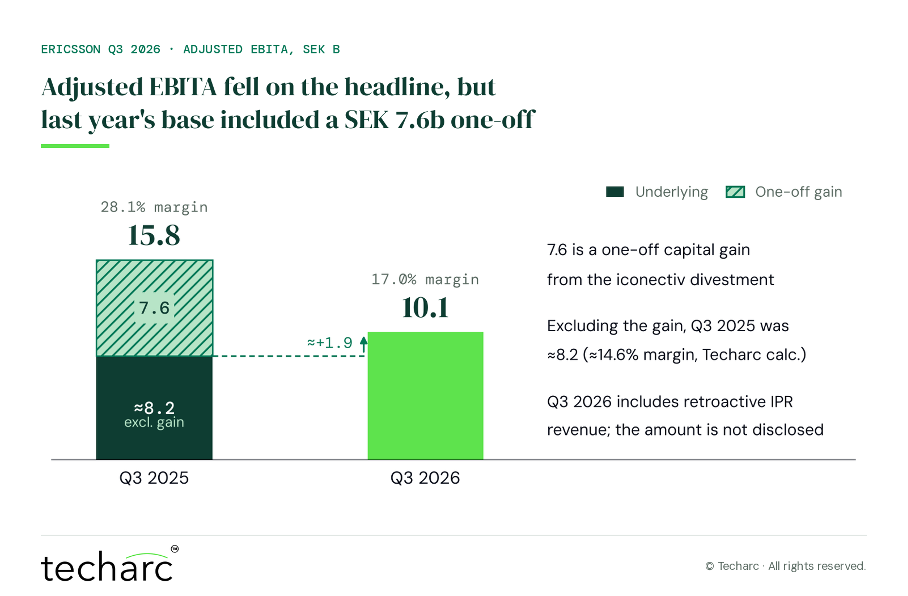
Ericsson reported net sales of SEK 59.5 billion (US$ 6 billion / ₹56,890 crore) and adjusted EBITA of SEK 10.1 billion (17.0% margin). Its President and CEO, Per Narvinger, noted a flat RAN market and component-cost pressure on 2027 margins.
This viewpoint draws five sector takeaways, then explains what they mean for India and Ericsson’s position there.
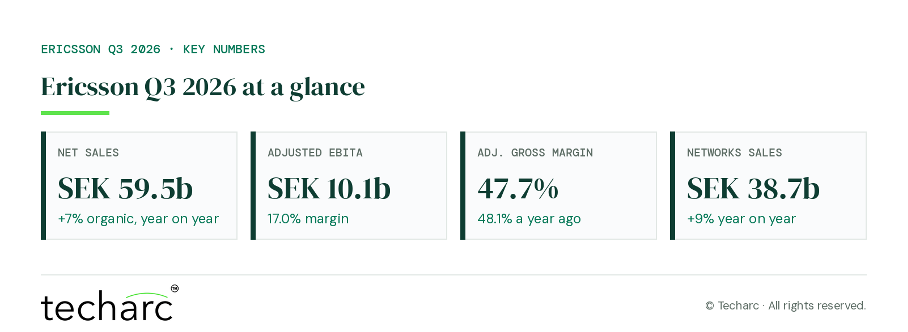
Organic sales rose 7% year on year, led by Networks (up 9%), and grew in three of four market areas. Yet management expects the RAN market to stay flat, and nine-month organic growth is only 4%. Q3 reads as a strong quarter for one vendor, not a market upcycle.
CEO Narvinger said component costs tied to AI demand are a gross-margin headwind into 2027. Telecom equipment now competes with data centres for chips and memory, which raises costs for vendors first and potentially for operators and devices later.
Ericsson’s AI-native link-adaptation feature delivers a 10% spectrum-efficiency gain and is live with three operators across more than 60,000 base stations. Operators facing scarce, costly spectrum are buying software that extracts more from existing sites. Ericsson also argues AI applications will raise the bar for reliable, resilient mobile networks.
Quality on Demand and 5G slicing are gaining traction but aren’t at scale yet. Ericsson says its current portfolio should be upgradable to 6G, though new spectrum bands will still require new radios, so the next hardware cycle is further out than the 6G headlines suggest.
Adjusted EBITA margin was 17.0% against 28.1% a year earlier, and that prior-year quarter included a SEK 7.6 billion capital gain. Net income fell to SEK 5.8 billion from SEK 11.3 billion. Networks margin benefited from retroactive IPR revenue, while Enterprise margin fell after the iconectiv divestment. Ericsson is also simplifying its operating structure, while geopolitical uncertainty remains elevated.
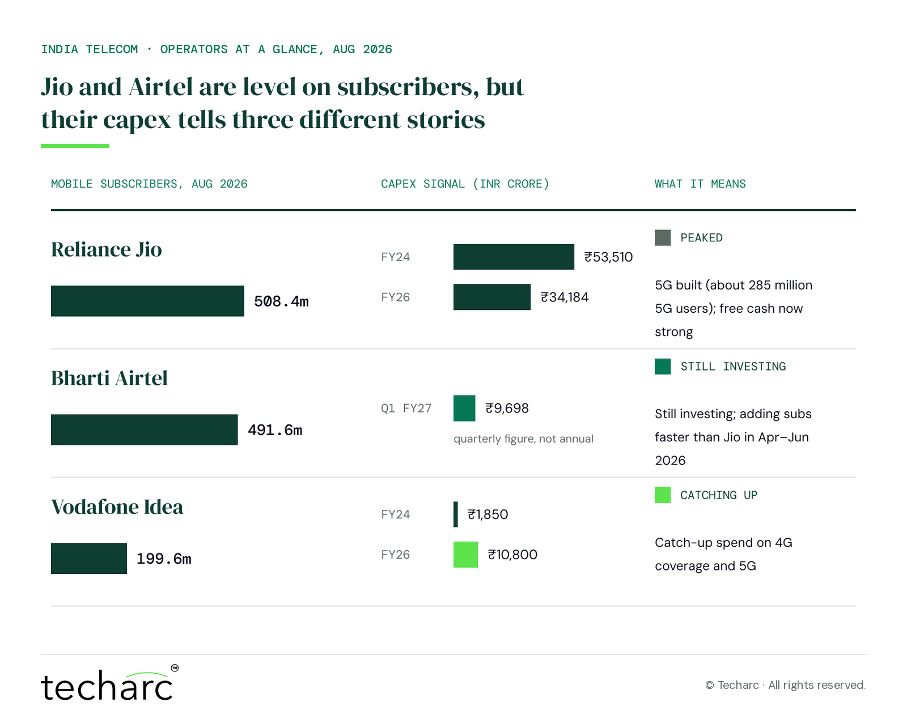
India’s network spend is shifting from rollout to monetisation and catch-up. Jio’s capex has fallen sharply now that it has built its 5G network, while Airtel keeps investing and Vodafone Idea (Vi) is spending to close a coverage gap. TRAI data put Jio at 508.4 million wireless mobile subscribers, Airtel at 491.6 million and Vi at 199.6 million at the end of August 2026.
Three points matter for the Ericsson read-through:
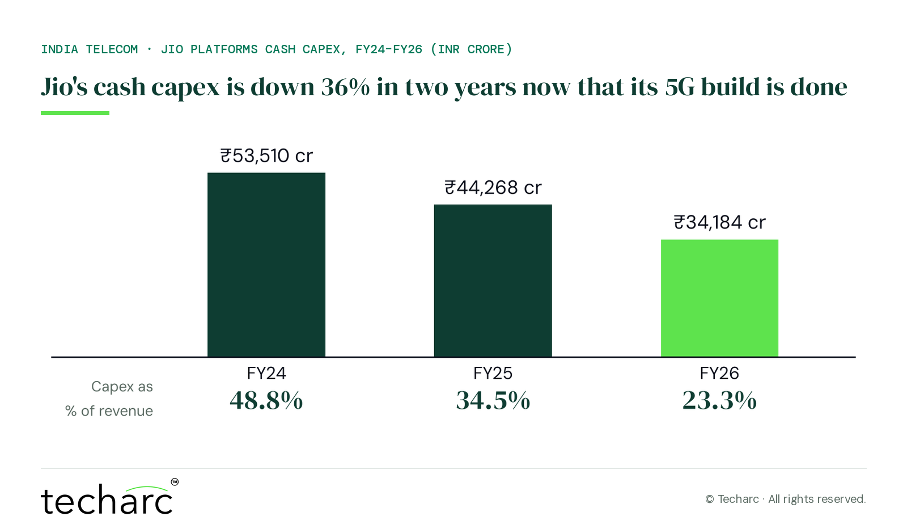
Capex has peaked at the top. Jio’s cash capex fell to 23% of revenue in FY26 from 49% in FY24, so the next wave of equipment orders depends more on Airtel and Vi than on a second Jio build.
Growth is moving to the challengers. Airtel narrowed Jio’s subscriber lead by 1.82 million in April–June 2026, and Vi ended Q1 FY27 with 130.1 million 4G/5G subscribers, up from 127.4 million a year earlier.
Monetisation is the next test. Airtel’s ARPU is about 22% above Jio’s and 35% above Vi’s, which is why 5G standalone, slicing and FWA matter more than raw coverage from here.
Ericsson’s point that 5G features such as slicing are not yet at scale applies in India too. The market has scale and coverage, but the premium-tier revenue case for advanced 5G is still unproven.
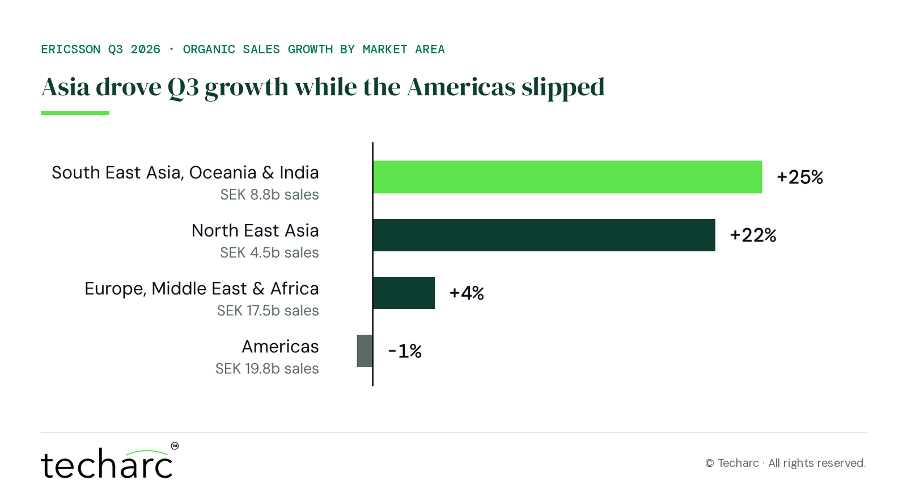
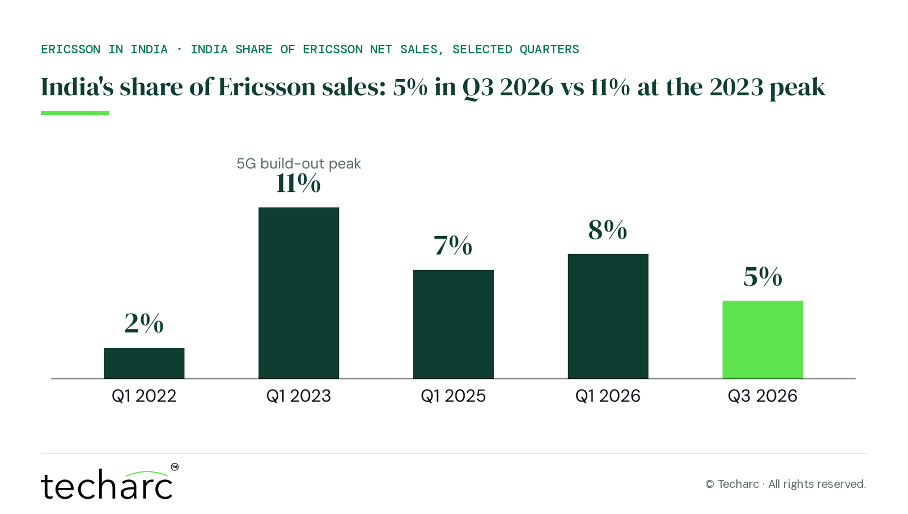
India was Ericsson’s second-largest market year to date in 2026, at 5% of Q3 net sales and 6% for January–September, and it drove the fastest-growing region in the quarter. The market area covering Southeast Asia, Oceania and India posted SEK 8.8 billion in sales, up 25% organically and 15% of group sales. Ericsson attributes that to the timing of project deliveries in India, Vietnam and Southeast Asia, so it should be read as a delivery cycle, not a run-rate.
Earlier in 2026: Ericsson India’s revenue rose 29% in constant currency to ₹4,228 crore in Q1 2026 (8% of group sales), on higher deliveries in India.
The swing is large: Sales in this market area fell 44% in Q2 2024 as India’s first 5G build slowed, and India was about 11% of group sales at the Q1 2023 peak.
Reporting is changing: From January, Ericsson will combine North East Asia with South East Asia, Oceania and India into one Asia Pacific market area, so India’s growth may be harder to isolate.
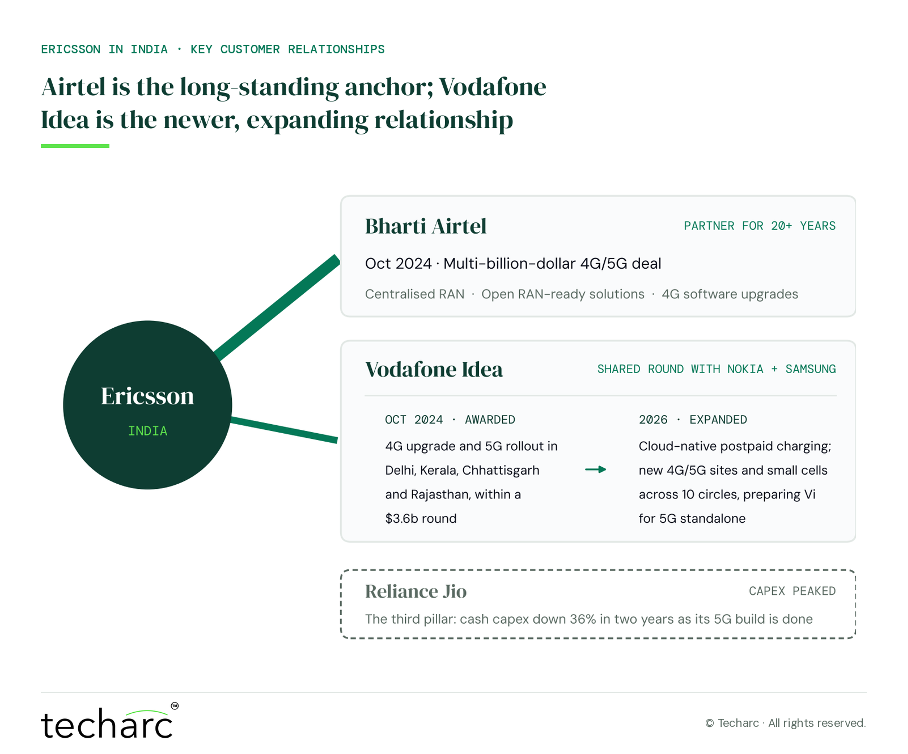
The India picture relates to the five takeaways:
India will keep adding to Ericsson’s growth for a few quarters from Airtel and Vi deliveries. Still, durable upside depends on 5G standalone and enterprise or network-API revenue, where Ericsson says traction is still early.

The weekly read on where technology is heading — 75,000+ subscribers across the industry.
Questions about our reports, dashboards, InsightsPro or a custom engagement? Send a note and the team will get back to you.