
Retired now, most of my mornings move at the unhurried pace retirement was always supposed to have. Azaad, my humanoid AI companion, woke me up this morning, as per routine, right on schedule. It had already set the bathroom and water temperature as per my preferences. I finished my bath and morning prayers, and by […]
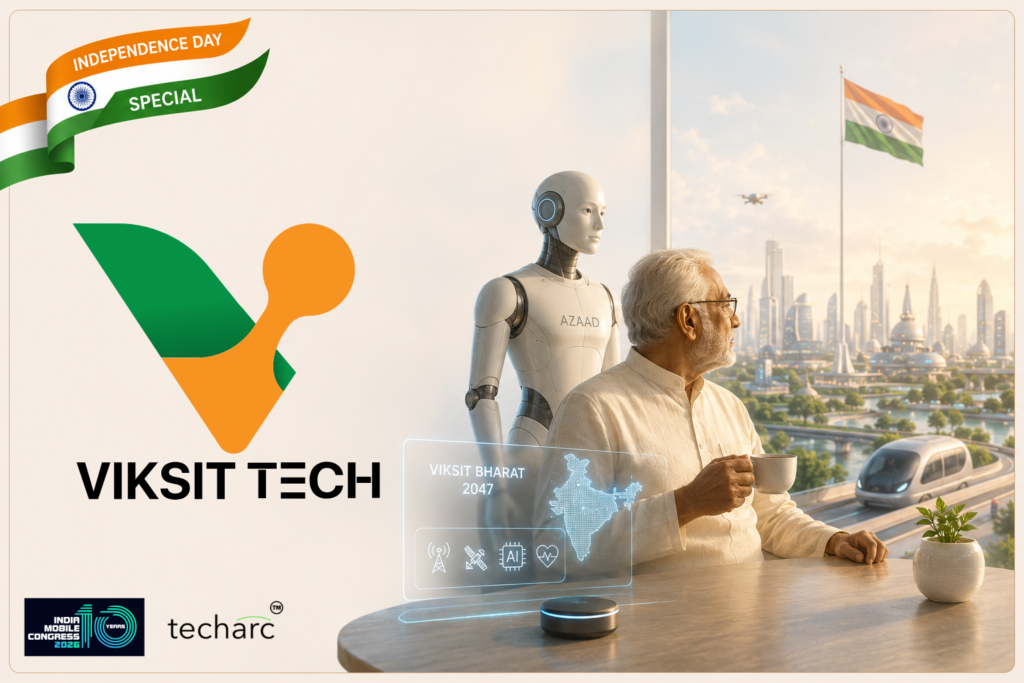
Retired now, most of my mornings move at the unhurried pace retirement was always supposed to have. Azaad, my humanoid AI companion, woke me up this morning, as per routine, right on schedule. It had already set the bathroom and water temperature as per my preferences. I finished my bath and morning prayers, and by then Aladin, the humanoid who runs our home, had already laid out breakfast. Everything, again, was as per my preferences. Azaad had already shared the real-time data of my vitals with Aladin, who used it, along with what was available in the pantry and the refrigerator, to decide what I should eat today.
It is the 15th of August, 2047, India’s first Independence Day as a fully Viksit nation. There was something special in the air this morning that felt worth pausing on.
I am no longer actively tracking the industry the way I did through my entire career. But I know this journey as intimately as anyone can. My career as a tech market analyst, and my entrepreneurial journey at Techarc, was all about this evolution. Back then, Techarc was a small, independent research firm out of India. Today, I am happy to see it as the World’s No. 1 technology analyst firm, publicly traded and present in over 25 countries. Retirement has given me the distance to finally sit back and tell this story the way it deserves to be told, not as an analyst’s report, but as someone sharing experiences lived through. Maybe it’s time to write a book on this wonderful, fulfilling journey of India evolving from a tech-dependent country to a Viksit Tech nation.
At breakfast, as per routine, Azaad started scanning the internet, TV channels, magazines, and newspapers to bring up important events I should be aware of, as well as things that would interest me. It knows the love I have for technology.
So the conversation started. Azaad shared news, and I shared my views, my perspectives, and the story of how it all happened over the past few decades. It was a conversation between two individuals who could think and hold their own views and opinions, besides possessing knowledge. Azaad was reading out to me an editorial featured as an Independence Day special in a leading daily, on the role technology played in India becoming a Viksit nation. Soon, I realised there was a strong story to be told. A story about the ambient display flickering awake on the kitchen wall, the breakfast Aladin had just cooked, and Azaad itself. It was all the result of a very long journey spanning over two decades.
“You won’t remember this, Azaad, because you weren’t built yet,” I began, “but two decades ago, we lived very differently. We used to carry a smartphone everywhere.” Azaad had already toured the vitrine in my lobby that houses precious memories, including some gadgets from the past, kept as souvenirs of technology. So it knew exactly what I was talking about. I explained to Azaad how we used to tap and swipe on this slab of glass for everything, including calls, messages, maps, payments, and more. There also used to be a pad or tablet, which I used for reading and sometimes for watching interesting content. For work, I used a laptop, and for content like OTT apps, I had a large display on the wall, a smart TV, for that.
There were also a bunch of wearables, almost one for every part of the body where a device could fit. A watch, a pair of glasses, a band, a ring, and a pair of buds were all doing their own narrow tasks, and would barely talk to each other.
I gestured around the kitchen. “Today, all of that has folded into one AI-native core.” My slim band woven discreetly into my kurta collar, does what the phone, tablet, laptop, and every wearable I once owned used to do separately. It listens, it watches, it anticipates, and when I actually need a screen, it simply projects one onto my palm, onto the wall, or onto thin air, and then dissolves it the moment I’m done. There’s no app to open. I just think out loud, and it responds. My continuous health monitoring, including a track of my heart, sleep, and recovery, things once handled by my old ring and band, now runs quietly through a bio-sensing thread woven into my clothes, reporting to you, Azaad, rather than to me directly. I only hear about it when it actually matters. Even the television is gone, in the old sense. Any wall, any window, any surface in the house can become a display the instant you decide what would give me the best immersive experience.
“And the driving, Azaad, you’ll find this hard to imagine. We used to drive ourselves. There was automatic transmission, but the steering wheel was still ours. We had to navigate through the traffic, the lanes, and everything else on the road.” Today, you keep my pod ready at the porch, and it already knows where I need to go. Like you, I have a conversation with the pod in any language I like. It could be English, Hindi, Urdu, or even Kashmiri. Now the windscreen is my digital theatre, where I watch a live cricket match while travelling. Even the appliances that never needed reinventing (the air conditioner, the refrigerator, the washing machine, the air purifier) now quietly coordinate with each other and with the AI core, rather than sitting as isolated boxes the way they once did. Earlier all this was happening with a noise and visible to everyone. Now it’s all like natural and discreet.
I shared my excitement about a piece of genuinely game-changing news. Indian research consortiums had announced an early breakthrough in 8G, connectivity that treats the network itself as a computing fabric, and how American telecom and chip majors were now formally lining up to co-develop the next phase with us. These were once the very companies we would lean on for expertise. I told it about the satellite story beneath that one. India’s own low-earth-orbit constellation, with our ground stations and satellite payloads now being licensed to other countries. Also about the quantum computing mission. What was once a modest announcement in the mid-2020s had grown into real work, optimising telecom networks, simulating new drugs, and securing our banks with quantum-safe encryption designed at home.
“Even you, Azaad,” I said, “and Aladin, who made our breakfast, are Indian-built and Indian-designed, doing work at home and in offices across the country that felt like science fiction when I was starting out in this profession. None of us back then were even imagining a world where the phone itself would disappear.”
I reminded Azaad about the old American friend who had visited me at the office a few months ago, after thirty years away. He had picked up an iPad off my desk and laughed when he realised it cost less than his own, made in a market that had become Apple’s largest manufacturing and design base. He had also brought a Vision Pro as a gift, only to find we already owned the same device, cheaper still. “Back home now,” he had told me, “if you want a proper Apple device, half the time the box says Designed and Manufactured in India.” He said his own cousin now asked him to bring back Indian phones and Indian earbuds as gifts, a complete reversal of the suitcases full of American gadgets people used to carry home to India, back when I was his age.
And then I told Azaad the part of the story that mattered most. None of this was guaranteed. In 2026, an ordinary Indian’s day looked nothing like this morning. Every alarm, every app, every chip, every cell tower belonged to a global brand, and satellites, quantum computers, and humanoids were still headlines from elsewhere, not homegrown industries. India today stands not merely as a Viksit nation by name; it has an evolved, efficient Viksit Tech ecosystem that acts as the backbone of this transformation. I told it about the very first edition of the ViksitTech47 (VT47) flagship programme, launched at India Mobile Congress 2026, and how it began by identifying and recognising the promising Indian brands willing to walk this long journey, back when they were still small, still unproven, still easy to overlook.
I paused here and told Azaad something more personal. I hadn’t attended India Mobile Congress myself since 2040, and I was genuinely looking forward to this year’s 31st edition. I’d recently read about the theme launch event for IMC’47, where fifteen Indian brands across gadgets, devices, and appliances were expected to showcase their latest innovations on that stage. People privy to what was being prepared were already saying the buzz around this edition felt different, more consequential, in their words, than CES or MWC had felt in years. “At my age,” I told Azaad, “I don’t get excited about tech events anymore. But I just want to make the trip for this one.”
I told it, too, that this was never an India-alone story, that global technology leaders had chosen to lean in rather than stay on the sidelines back in 2026, bringing decades of silicon expertise, platform maturity, and frontier AI research to the table as genuine partners in VT47 and its subsequent editions. Even this business of folding a phone, a tablet, a laptop, and a fistful of wearables into a single AI-native core, I told Azaad, didn’t happen on Indian ingenuity alone. The neural processors driving devices like mine still owe a great deal to co-designed silicon with global chip makers, and to on-device AI research built in partnership with processor and LLM providers. Their role hadn’t disappeared over the years. It had simply evolved, from suppliers to co-architects, running joint R&D on Indian soil, co-designing chips, training frontier models together, and now lining up to co-develop 8G with the very teams they’d once mentored.
I told Azaad, setting down my cup, “This is what made VT47 different. It wasn’t a protectionist push. It was a platform that stitched Indian ambition and global partnership into one ecosystem, and two decades later, here we are.”
I didn’t ask Azaad to do anything with what I’d told it. It was breakfast conversation, nothing more. A man thinking aloud on a significant morning, to the companion who’d been listening.
But Azaad, I would learn later that day, understood exactly what it had just heard. Sensing that I had narrated something larger than a memory, a piece of India’s own coming-of-age story told over breakfast on the very day it deserved to be told. It quietly wrote it all down, in the words you have just read.
This article, in other words, was not written by me. It was written by Azaad, my humanoid companion, whose name in Hindi means exactly what this whole story was about: free. Free of a smartphone. Free of a foreign chip. Free, even, of dependence on the very global technology companies that once helped us get here. Azaad had understood the assignment better than I had.
It’s time to watch the Prime Minister’s address live from the Red Fort. While I am not there in person at the venue, Azaad has already booked me into a holographic projection event for that immersive experience. This is really going to be fun and exciting, something happening for the first time on this Independence Day. It’s going to be just as exciting as this year’s Republic Day parade, where we watched the spectacular, colourful display of the President’s Bodyguard (PBG), the oldest regiment, alongside the Jawanoids, the newest humanoid-based regiment inducted into the Army. They do not have a life like humans, but they secure the nation with the same passion and patriotism as our jawans!
Note: This is a speculative, forward-looking viewpoint set in 2047. References to future living and technologies are illustrative examples of India’s technology ambition and global collaboration, not statements of fact about future products, partnerships, pricing, or roadmaps.

The weekly read on where technology is heading — 75,000+ subscribers across the industry.
Questions about our reports, dashboards, InsightsPro or a custom engagement? Send a note and the team will get back to you.