
Parliament has cleared the way for charges on UPI. For pure-play payment apps that is a margin problem. For Samsung, it is the first credible chance in a decade to make a wallet a reason to buy a phone — and the numbers say it is affordable. For a decade, UPI in India has been […]
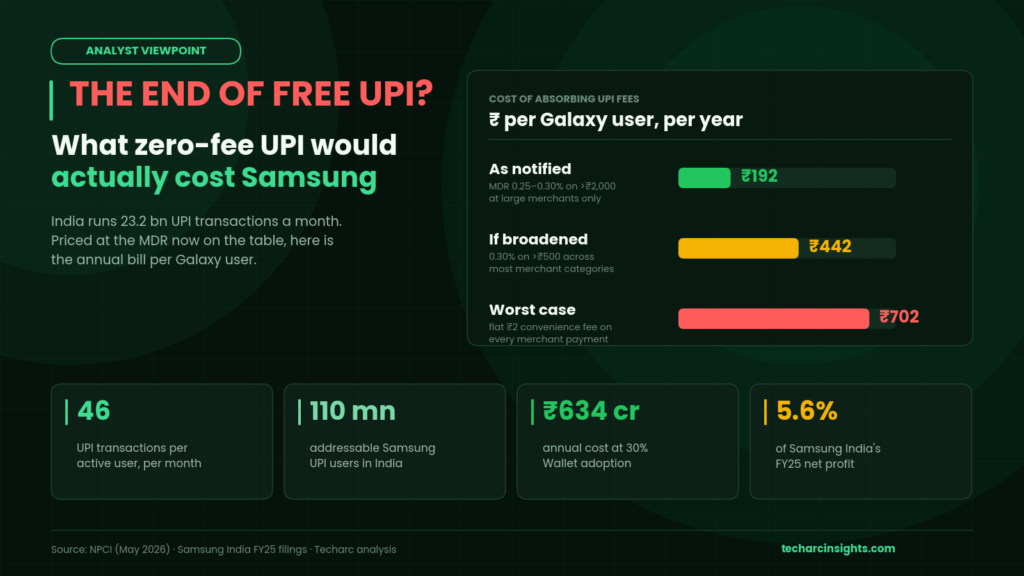
For a decade, UPI in India has been a free resource just like air. Be it paying ₹10 for a roadside cup of tea or transferring a few thousand to a friend, there was nothing additional required to pay as transaction fee, facilitation fee, convenience fee, or any other fee, commonly seen on many digital platforms. With the new law passed this can change now, highly likely will change.
On 6 August 2026, the Lok Sabha passed the Taxation and Other Laws (Amendment) Bill, which rewrites Section 10A of the Payment and Settlement Systems Act, 2007. This clause had imposed a blanket ban on Merchant Discount Rate (MDR) across UPI and RuPay debit since 2020. It no longer exists. Replacing it we have an enabling framework under which the Central Government can notify, by executive order, which payment modes stay exempt.
Nothing has been charged yet. But the legal floor under free forever has been removed.
Most commentary on this Bill has collapsed two very different things into one. It is worth separating them, because Samsung’s entire opportunity and its entire risk lives in the gap.
Samsung cannot absorb MDR directly as it is not the acquirer. What Samsung can do is guarantee its users a zero-fee experience by reimbursing pass-through charges through its banking partner or underwriting the acquiring economics on Samsung Wallet volume. That distinction matters legally, and it changes the size of the cheque. It also means the honest framing of this strategy is not Samsung pays India’s MDR. Rather it is that Samsung guarantees the consumer never sees a fee, whatever the ecosystem decides to do.
Handset makers have spent years failing to make native wallets matter. Samsung Wallet, Mi Pay, and every OEM equivalent have lost to PhonePe, Google Pay and Paytm for one simple reason. When both options are free and instant, habits win. There was no wedge.
A fee creates the wedge. The moment a user sees ‘₹6 convenience fee’ on one app and nothing on another, a decade of habit is worth about a few seconds of hesitation. Unlike a cashback promotion which every competitor can match for a quarter, a zero-fee guarantee funded by hardware margin is something a pure-play payments company structurally cannot copy.
The pitch writes itself. Buy a Galaxy, never pay a UPI fee! This will not be a promotion with an asterisk and an expiry date. It would be just like a specification, a KSP on the box next to other features and functions.
The instinctive design is a transaction count allowance. Something like first 50 UPI payments free each month. That is the wrong approach. The arithmetic explains why.
MDR is ad valorem, a percentage of value, applying only above a value threshold. A user could make 200 transactions in a month and generate almost no fee exposure if they are all small. Another could make four and generate meaningful exposure. A transaction cap therefore polices the wrong variable. It restricts the very behaviour Samsung wants (frequency, habit, daily-driver status) while leaving the actual cost driver (a handful of high-value payments) completely uncapped.
The better design is a monthly rupee cap on fees absorbed. As per the framework notified, average exposure is around ₹16 per user per month. So even a ₹25/month cap covers effectively every mainstream user, while hard-capping Samsung’s tail risk if the fee regime later broadens.
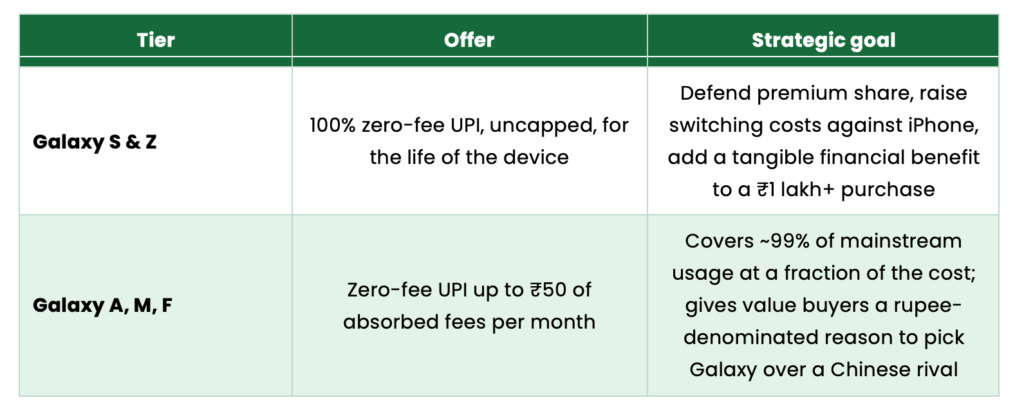
A rupee cap is also cleaner to communicate than it looks. Users never see it, because almost nobody hits it. It exists to protect the P&L, not to ration the benefit.
The strategy is only interesting if the burden is small. So here is the arithmetic, built from NPCI’s published volumes.
India recorded 23.2 billion UPI transactions in May 2026, roughly ₹29.9 trillion in value with about 738 million transactions a day. Against an active base of approximately 500 million UPI users, that works out to about 46 transactions per user per month, or 1.5 a day. Roughly 63% of that volume is person-to-merchant, giving ~29 merchant payments a month at an average P2M ticket of about ₹600.
That 46 is a mean, not a median. A minority of high-frequency users pulls it up, so it is a conservative basis for this model.
Three fee regimes, three costs
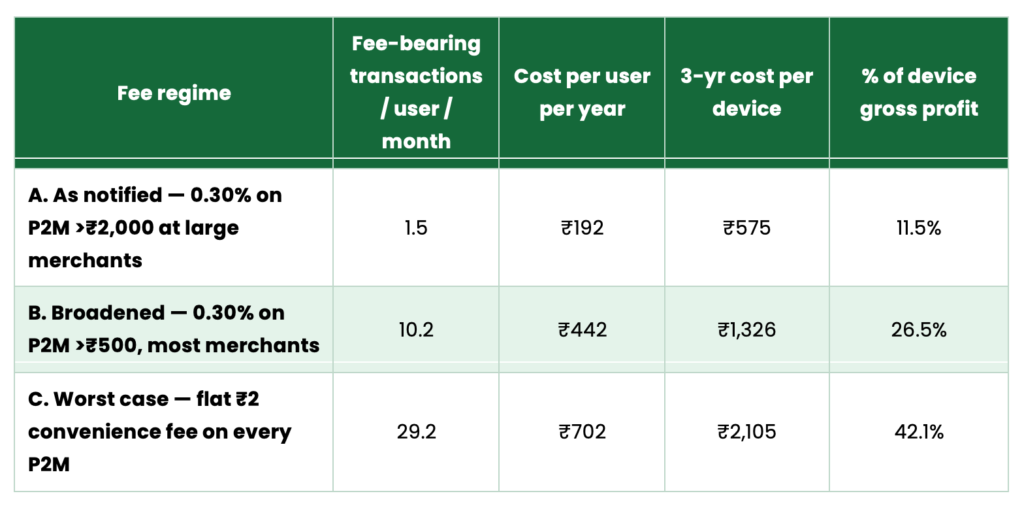
Device economics assume a ₹25,000 India ASP at a ~20% hardware gross margin (₹5,000 gross profit) over a three-year replacement cycle.
Scaled to the installed base, two filters matter. Samsung’s active India smartphone installed base is estimated over 150 million. This is worked out on cumulative shipment of 25–29 million a year since 2019 against a ~4-year replacement cycle, and about 20% of India’s ~800 million active smartphone base. Of that, only the UPI-active share is addressable. India has ~500 million active UPI users against ~800 million active smartphones, or 62%. Samsung skews urban and premium, so assume ~70%.
That gives an addressable base of roughly 110 million Samsung users. Wallet adoption within it is the swing variable and the only variable that really moves the cheque.
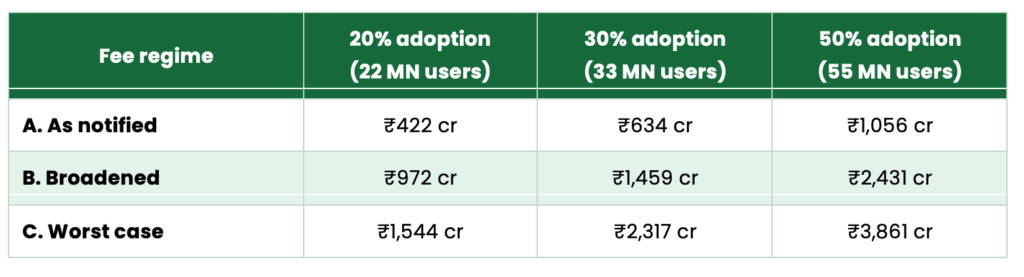
Samsung India Electronics reported ₹1,11,183 crore of revenue in FY25 and net profit of ₹11,286 crore. Under the framework as actually notified, at 30% Wallet adoption — about 33 million users — the base case costs ₹634 crore a year: 5.6% of Samsung India’s net profit, and under 0.6% of revenue. The worst-case fee regime at the same adoption is ₹2,317 crore, or 21% of net profit.
If Samsung converted the entire 110 million addressable base, the notified regime would cost ₹2,112 crore (19% of net profit) and the worst case ₹7,722 crore — 68% of net profit, which is not a marketing line item but a strategic change. That asymmetry is the whole argument for the rupee cap. Success and cost scale together, so the cap has to be structural rather than promotional.
Read that as a marketing line item rather than a payments loss. ₹634 crore buys a permanent, structural, competitor-proof purchase reason across 33 million users at roughly ₹192 per user per year. Very little else in the India handset marketing budget converts at that rate, and unlike a price cut it does not reset the ASP.
Zero-fee UPI is a loss leader, and loss leaders only work if something monetises behind them. Two candidates sit inside the wallet already.
At 33 million active wallet users, even a 3% attach rate on a credit product materially offsets the ₹634 crore.
Three risks deserve to be enumerated because the case above is not unconditional.
Regulatory shifts create disruption for most players and leverage for a few. The end of mandated zero-MDR hurts anyone whose revenue depends on payments. Samsung’s revenue does not.
For something in the range of ₹420–650 crore a year under the regime India is actually likely to get, Samsung can convert a system-wide anxiety into a brand-specific guarantee finally giving its wallet the one thing a decade of pre-installation never did. Consumers get a reason to open it. That is not a software feature. That is a reason to buy the phone.

The weekly read on where technology is heading — 75,000+ subscribers across the industry.
Questions about our reports, dashboards, InsightsPro or a custom engagement? Send a note and the team will get back to you.