
India’s Smart TV market is driven by high-speed broadband penetration and a shift toward OTT-first consumption, buyers are moving away from entry-level screens and investing heavily in the digital centrepieces of their living rooms. However, as the Average Selling Price (ASP) creeps upward, a critical dynamic is shifting for OEMs: consumer expectations are scaling just […]
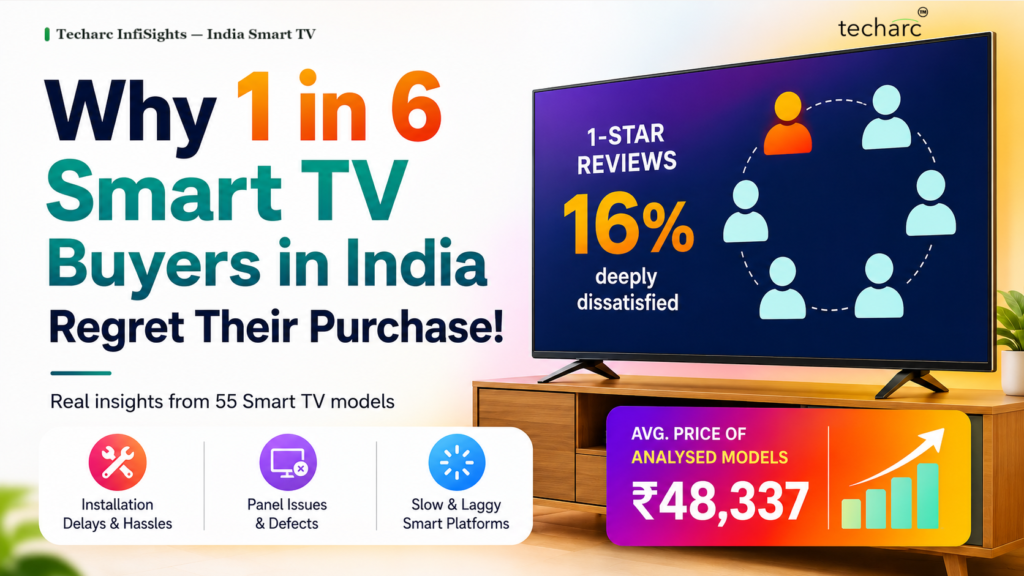
India’s Smart TV market is driven by high-speed broadband penetration and a shift toward OTT-first consumption, buyers are moving away from entry-level screens and investing heavily in the digital centrepieces of their living rooms. However, as the Average Selling Price (ASP) creeps upward, a critical dynamic is shifting for OEMs: consumer expectations are scaling just as fast, and the margin for error is shrinking.
To understand the real pulse of post-purchase consumer sentiment, Techarc leveraged the InfiSights platform of verified reviews across 55 Smart TV models sold on major e-commerce platforms. The findings reveal a market sharply divided by customer experience, where higher price tags are amplifying buyer scrutiny. The Polarisation of the Smart TV Buyer
The Smart TV market in India is not a market of compromise; it is a market of extremes. Buyers generally don’t feel just okay about their purchases.
Notice the middle ground? It barely exists. Only 6% of buyers left a neutral 3-star review. You either turn on your TV and love it (74% rate it 4 or 5 stars), or you are deeply, frustratingly dissatisfied.
A staggering 16% of all reviews are 1-star. In fact, of all the low ratings (1-2★, which make up 20% of the base), they are heavily concentrated at the absolute bottom.
2. The ₹48,337 Expectation Gap
To understand the anger behind that 16%, we have to look at the price tag. The data shows that the average price of the models in this scope is ₹48,337.
This is a critical data point. We aren’t just looking at entry-level, budget televisions where consumers might forgive a sluggish interface or a plasticky remote. At nearly ₹50,000, consumers are buying into mid-to-premium tiers. They expect 4K resolution, snappy platforms, deep contrast panels, and above all, a premium experience.
When you spend ₹48,337, your tolerance for friction drops to zero. A single dead pixel, a delayed installation, or a clunky user interface isn’t a minor annoyance, it’s a 1-star offense.
3. Decoding the Triggers & Fixes
While the 3.95★ average looks nice on an e-commerce listing, that 16% chunk of 1-star reviews acts as a massive anchor on a brand’s overall conversion rate.
Using the Triggers & Fixes and Panel & Platform metrics from the InfiSights dashboard, brands can usually trace this 1-star trap back to a few critical failure points:
4. The Takeaway for Brands
Scaling that 16% means tens of thousands of deeply unhappy customers actively warning others not to buy your product.
To boost that NPS of 31 even higher, brands need to stop focusing solely on adding more Delight Factors for the 5-star crowd and start executing targeted Fixes for the 1-star crowd.
The data is clear: to win the Indian Smart TV market, you don’t just need a better panel, you need a frictionless, end-to-end consumer experience that justifies the ₹48,000 price tag.
Write us for an InfiSights demo at: Info@techarc.net

The weekly read on where technology is heading — 75,000+ subscribers across the industry.
Questions about our reports, dashboards, InsightsPro or a custom engagement? Send a note and the team will get back to you.