
Motorola and Samsung retain their ‘Best 5G Smartphone Brand’ rankings for 2024. 3rd rank is taken over by Realme displacing Oppo comparing 2023 rankings. Gurugram – According to the 2nd edition of Techarc’s ‘India Best 5G Smartphone Brand’ report released today, 89% of the total 5G smartphone sales for the calendar year 2024, will lie […]
Gurugram – According to the 2nd edition of Techarc’s ‘India Best 5G Smartphone Brand’ report released today, 89% of the total 5G smartphone sales for the calendar year 2024, will lie in the price range of ₹10,000 – 40,000. Out of the remaining 11%, 5G smartphones priced above ₹40,000 are expected to contribute 6% of the sales while the sub ₹10,000 sales of 5G is expected to fetch 5% of the total 5G smartphone sales pie for the year. Overall, the report estimates 123 5G smartphones to be sold during the calendar year amounting to 77% of the overall smartphones expected to sell in 2024.
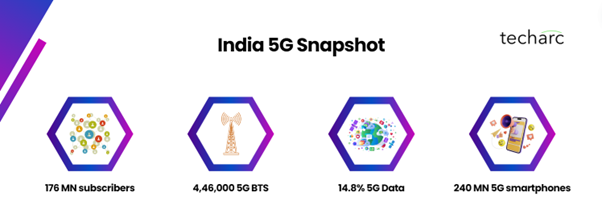
Quoting key takeaways of the edition, Faisal Kawoosa, Chief Analyst, Techarc said, “This year we see a paradigm shift in the consumer asks when it comes to 5G smartphones. In 2023, consumers were wanting access to 5G giving preference to brands that offered seamless connectivity and coverage. This year consumers are looking beyond these hygiene factors and prefer brands offering superior experiences and wider choice to consumers looking to buy 5G smartphones.”
“Smartphone makers will have to carefully design their 5G smartphones using superlative specifications across key features defining the experience along with having a pampering palette to offer a wide array of choice,” explained Faisal while decoding the consumer preferences regarding 5G smartphones.
Owing to their scoring higher with regards to uncompromising capabilities and offering a wide range of choice of 5G smartphones to consumers to buy from, Motorola and Samsung have been able to retain their spots in 2024 in the list of ‘Best 5G Smartphone Brands’ in ₹10,000 to 40,000 price range, which is expected to contribute 89% of the sales for the year. After a dwindling year, Realme has made a comeback ranking 3rd, in terms of aligning its portfolio with the expectations of the consumers buying 5G smartphones.
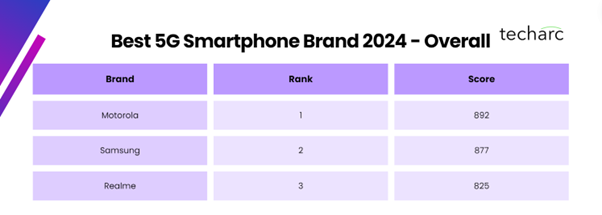
The rankings are derived using 4C framework with Connectivity, Coverage, Capability and Choice as the four pillars defining preferences of consumers buying 5G smartphones. Compared to 2023, Choice has emerged as the fourth pillar in the framework as an important deciding factor for consumers in the absence of convincing 5G use cases. As consumers are buying 5G smartphones in their natural process of upgrade and replacement, they evaluate brands basis the choice offered. Choice is defined by the number of models being offered, variants in terms of RAM/ROM configurations and the colours within these models and variants.
In the analysis of 5G smartphone models in currency (available for retail in online and/or offline channels), Motorola had 14 models to offer giving a choice of 68 options to consumers to choose from. Realme had 12 models expanding into 59 choices followed by Samsung with 11 models and 73 choices.
The other brands making it to the top 10 ‘Best 5G smartphone brands’ included Redmi, Vivo, Poco, Oppo, iQoo, OnePlus and Nothing / CMF in that order.
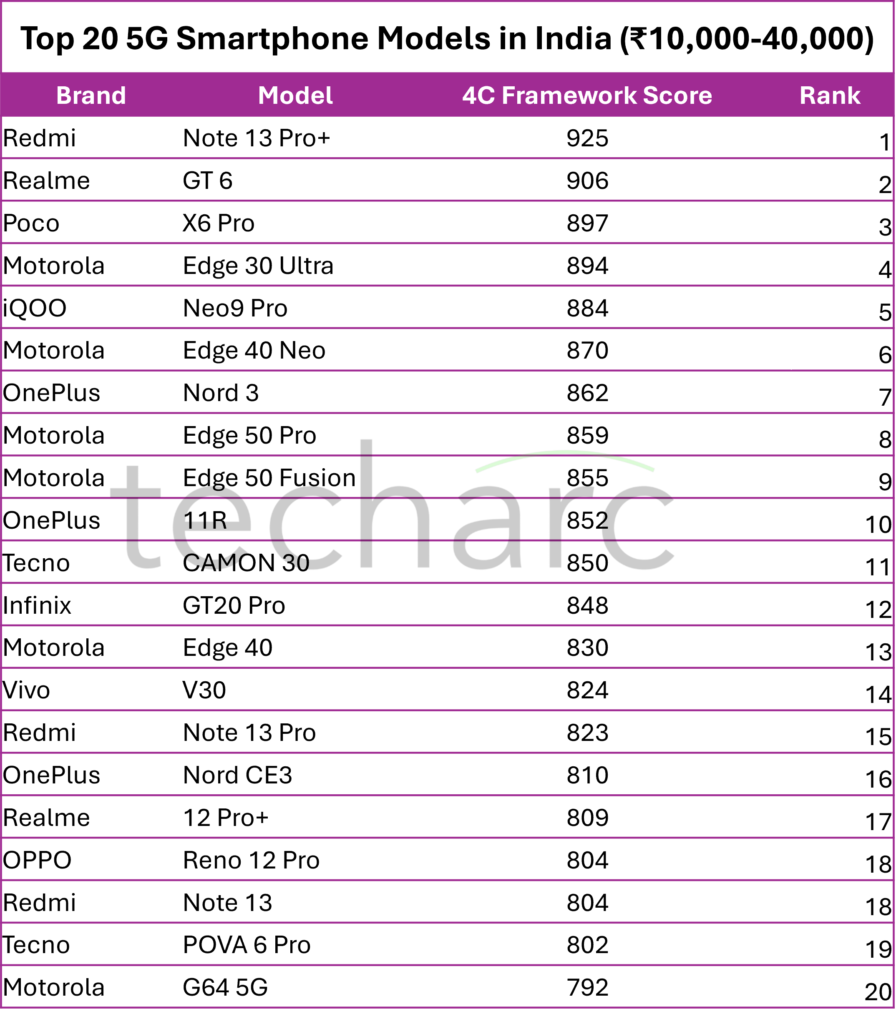
In terms of 5G smartphone models, Redmi’s Note 13 Pro+ scored top rank followed by Realme’s GT 6 and Poco’s X6 Pro at 3rd spot. In top 20 5G smartphone models, 6 models featured from Motorola, while Redmi and OnePlus had 3 each 5G smartphone models. Realme and Tecno had 2 each models in the list. By chipset makers, MediaTek’s Dimensity powered 11 out of top 20 5G smartphone models while Qualcomm Snapdragon chipset powers 10 models. By specific SoC, Qualcomm’s Snapdragon 7s Gen 2 powered 3 out of top 20 5G smartphone models in the range. Qualcomm’s Snapdragon 8+ Gen 1, Snapdragon 7 Gen 3 and MediaTek’s Dimensity 6080 powered 2 each 5G smartphone models of the top 20 in ₹10,000 – 40,000 range. Notably, none of the Samsung 5G smartphones in the range featured in top 20 as per the 4C ranking framework used by Techarc.
With 5G yet to find out a convincing use case for consumers, the 5G smartphone sales will be driven by the routine upgrade and replacement needs of consumers. This means from 5G standpoint finding a straight and direct evaluation criterion for consumers to select their preferred 5G smartphone or brand will continue to be challenging. In this scenario, consumers will continue to evaluate 5G smartphones basis the capability as defined by specifications and the choice as determined by CMF.
As a consequence, the smartphone OEMs will result in a ‘specs war’ where the incremental innovation and differentiation is defined by the additional strength of specifications of various features and attributes of a smartphone. However, instead of camera being the key criteria, consumers will now evaluate a bouquet of specifications that includes display, battery, processor, memory and storage. These are essentially the factors that will define the performance of a smartphone while consuming resource guzzling applications like AI, gaming, rich multimedia content, etc.
The other factor will remain choice helping OEMs to package the upgrade experience for consumers. In essence, consumers will perceive best 5G smartphone brands and models basis adjacent factors and features and not the real 5G factors like the gigabit data speeds, zero latency, etc. For now, we don’t have use cases where these would make the real difference in consumer experience besides the network quality.
If you have any queries about the report or want to understand deeper about the 5G smartphone landscape in India, please connect.
The weekly read on where technology is heading — 75,000+ subscribers across the industry.
Questions about our reports, dashboards, InsightsPro or a custom engagement? Send a note and the team will get back to you.