
Measuring Reliance Jio’s Impact on Indian Telecom, 2016-2026 Reliance Jio’s commercial launch in September 2016 is the single most consequential event in the history of Indian telecom. A decade on, the data bears this out unambiguously on volume and reach, more ambiguously on industry economics, and decisively on market structure. 1. Industry Size: Before and […]
Measuring Reliance Jio’s Impact on Indian Telecom, 2016-2026
Reliance Jio’s commercial launch in September 2016 is the single most consequential event in the history of Indian telecom. A decade on, the data bears this out unambiguously on volume and reach, more ambiguously on industry economics, and decisively on market structure.
1. Industry Size: Before and After
At the point of Jio’s launch (September 2016), India’s telecom subscriber base stood at 1,074.24 million, of which 1,049.74 million were wireless connections and only 367.48 million were internet subscribers, the market was still overwhelmingly a voice-and-SMS business. A decade later, total telephone subscribers have crossed 1.3 billion and internet subscribers exceed 1.09 billion, with broadband alone accounting for over 940 million connections (Source: TRAI).
Because India was already close to subscriber saturation by 2016, the more meaningful measure of industry size is revenue and usage intensity rather than headcount, and that is where the Jio effect gets more interesting, and more nuanced, than the popular narrative suggests.
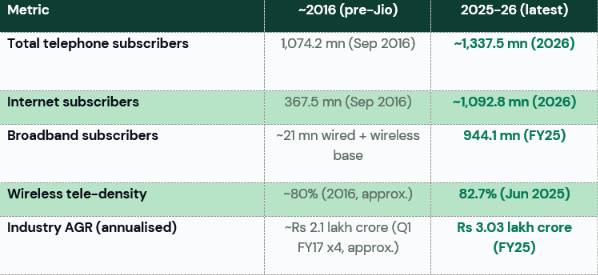
Note: pre-2016 figures for AGR are approximated by annualising the last full pre-Jio quarter (Apr-Jun 2016); TRAI’s standardised public quarterly series is most complete from around 2017 onward. All figures are sourced to TRAI and DoT publications; see Sources.
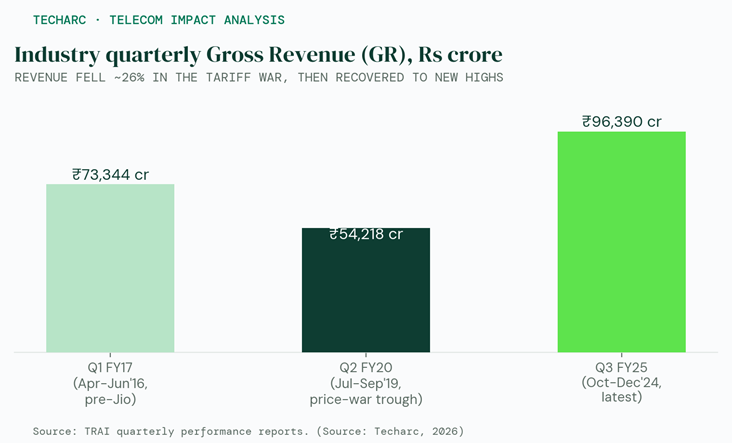
The revenue story is a V, not a straight climb. Jio’s introductory free-data strategy and the tariff war that followed collapsed industry Gross Revenue by roughly a quarter between 2016 and 2019 as legacy operators matched Jio’s pricing to defend subscriber share. Revenue only re-crossed pre-Jio levels after the tariff hikes of December 2019, November 2021, and July 2024 restored some pricing power. In nominal terms, the industry is only modestly larger today than it was on the eve of Jio’s launch, the real growth story is in volume, not value.
2. Where Jio’s Impact Is Unambiguous: Data
If revenue growth is a nuanced story, data is not. Jio’s core bet, that price would create consumption, and consumption would eventually create revenue, played out almost exactly as designed on the volume side.
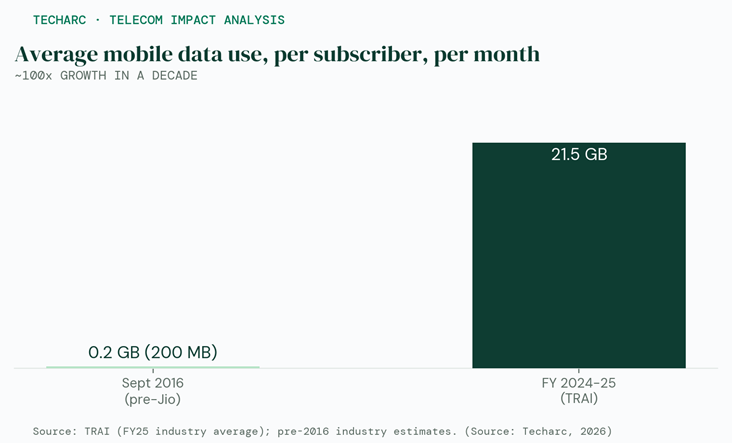
Average monthly data consumption per subscriber has risen roughly 100-fold, from under 0.2 GB in 2016 to about 21.5 GB industry-wide in FY25 (TRAI); Jio’s own subscriber base, by several recent estimates, now averages over 40 GB per month, nearly double the industry mean, reflecting its younger, more data-intensive user base and continued aggressive bundling.
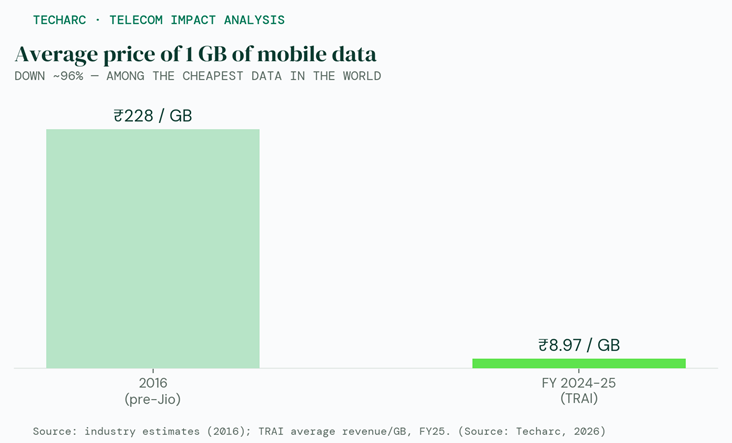
This was made possible by a roughly 96% collapse in the price of data, from about Rs 228 per GB in 2016 to roughly Rs 9 per GB now (TRAI, FY25 average revenue per GB). India is routinely cited in global cost-of-data comparisons as one of the cheapest mobile data markets in the world, a direct and durable legacy of the 2016-2019 price war.
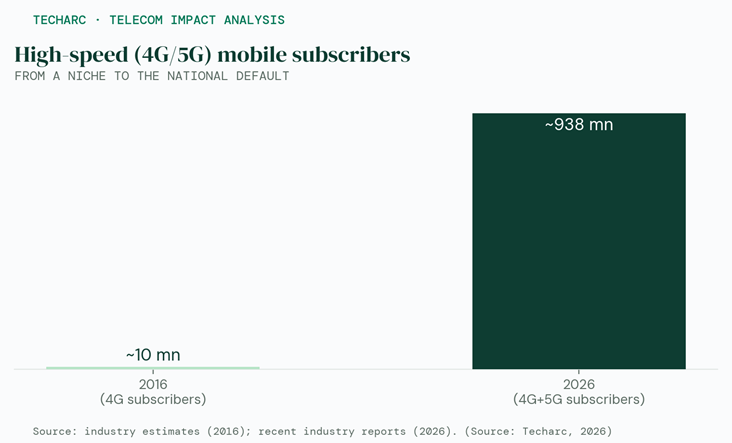
Network technology moved in step. Fewer than 10 million Indians had 4G access in 2016, with average speeds under 2.5 Mbps; today, active 4G and 5G subscribers are estimated at around 938 million, and 5G, commercially launched only in late 2022, has scaled to a meaningful share of that base within about three years, one of the fastest national 5G rollouts globally.
3. ARPU and Market Structure
Average Revenue Per User (ARPU) tells the industry-economics side of the story most directly. ARPU had been rising steadily through the first half of the 2010s; as a share of per-capita income it stood at roughly 1.6% before 2016. The tariff war crushed this to about 0.69% by FY19, a near-halving of telecom’s claim on household spending. Successive tariff hikes since December 2019 have pulled this back up, and blended wireless ARPU now stands at roughly Rs 174-175 per month (TRAI, FY25, up ~17% year-on-year) as operators pivot from subscriber acquisition to monetisation.
Market structure was reshaped just as sharply. India had 10-12 active operators in 2016, Airtel, Vodafone, Idea, Reliance Communications, Aircel, Tata Docomo, Telenor/Uninor, BSNL, MTNL, and the newly launched Jio among them. A decade of sub-cost pricing made that structure unsustainable: Reliance Communications, Aircel, Tata Docomo and Telenor all exited or were absorbed, and Vodafone India merged with Idea Cellular in 2018 to survive as a single entity. The market today is effectively a three-private-player field, Jio, Airtel, and Vodafone Idea, alongside state-run BSNL and MTNL, a level of concentration with few parallels among large telecom markets globally.
4. What This Means for Techarc’s Coverage
Sources
The weekly read on where technology is heading — 75,000+ subscribers across the industry.
Questions about our reports, dashboards, InsightsPro or a custom engagement? Send a note and the team will get back to you.