
Look at every India-launched smart glass model where the processor brand is actually disclosed, and one name shows up every single time: Qualcomm. Of the 30 XR glasses launches tracked, only 10 name a chipmaker at all, and 7 of those 10 run on Qualcomm silicon. The remaining 20 launches simply don’t disclose a processor, […]
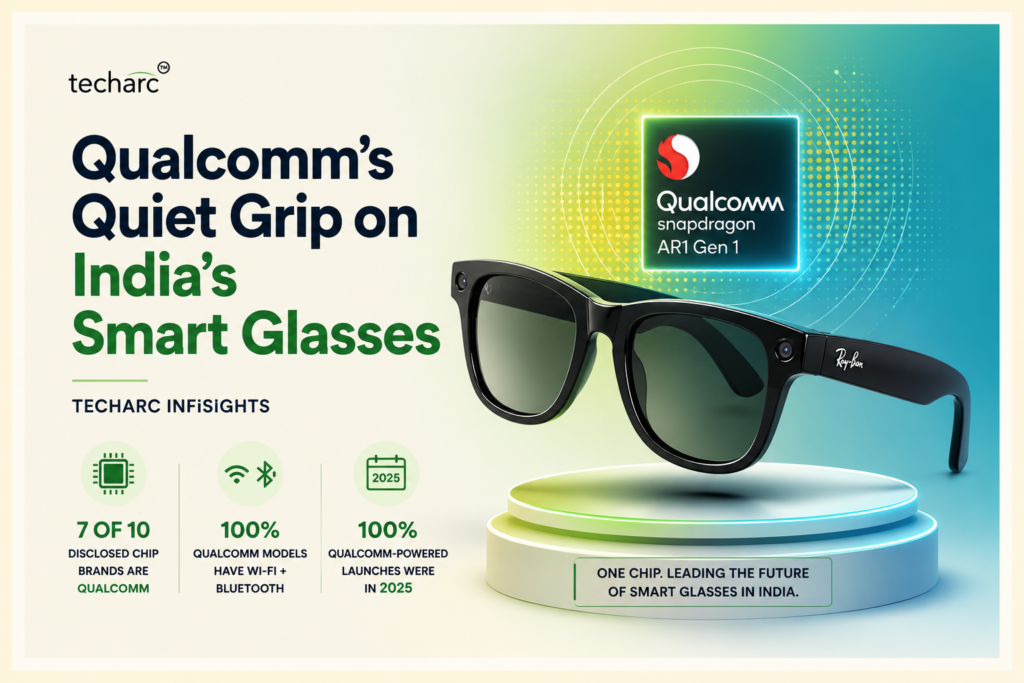
Look at every India-launched smart glass model where the processor brand is actually disclosed, and one name shows up every single time: Qualcomm. Of the 30 XR glasses launches tracked, only 10 name a chipmaker at all, and 7 of those 10 run on Qualcomm silicon. The remaining 20 launches simply don’t disclose a processor, which is its own signal about how undifferentiated the rest of the market still is on compute.
| Metric | Value |
| Launches with a disclosed processor brand | 10 of 30 |
| Of those, running Qualcomm silicon | 7 of 10 |
| Qualcomm-powered launch year | 100% launched in 2025 |
| Wi-Fi + Bluetooth on Qualcomm models | 100% both |
| Average price — Qualcomm models | ₹39,093 |
| Average price — category overall | ₹44,279 |
1. Who’s actually running Qualcomm
The 7 Qualcomm-powered launches aren’t spread across the market; they’re all Meta and Oakley-branded Ray-Ban-style glasses: the Ray-Ban Meta Wayfarer (Gen 1 and Gen 2), Skyler (Gen 1 and Gen 2), Headliner Gen 2, and the Oakley Meta HSTN and Vanguard. Each one of them launched in 2025, and each one carries Wi-Fi and Bluetooth as standard. They’re priced at an average of ₹39,093, actually a shade below the category’s overall average of ₹44,279, despite representing the most feature-complete cluster in the data.
That’s the real story: Qualcomm isn’t just present in India’s smart glasses market; it’s present exactly where the market is most mature. Every brand currently shipping a genuinely AI-and-camera-first glasses product in India has converged on the same chip family.
2. Why one chip family, and why now
That convergence isn’t a coincidence; it’s a platform. Qualcomm’s Snapdragon AR1 Gen 1 was built specifically for the smart-glasses form factor rather than repurposed from a phone SoC, and reviewers consistently point to it as the piece of engineering that finally made all-day smart glasses wearable.
3. What users actually feel
The tradeoffs are real and well documented. The Ray-Ban Meta’s battery is a 154 mAh cell, roughly 3% the size of a typical smartphone battery, which is why battery life still tops out at 4–8 hours of glasses-only use before the charging case takes over. Reviewers describe the fit as noticeably present on the face compared to regular sunglasses, and Meta’s own AI features have drawn half-baked criticism even from generally positive reviews, alongside recurring privacy concerns about the tiny recording indicator light. But the consistent verdict is that the chip itself isn’t the bottleneck; physics (battery volume in a temple arm) is. Reviewers consistently frame the Snapdragon AR1 as the thing that made this generation of glasses finally viable, not the thing holding it back.
4. The Takeaway
India’s smart glasses market is still mostly a black box on compute; two-thirds of tracked launches don’t say what’s inside. But wherever the silicon is disclosed, it’s Qualcomm, and it’s disclosed precisely because the brands running it (Meta, Oakley) are the ones treating the chip as a selling point rather than a commodity. For now, the ceiling on what a smart glasses launch in India can actually do- AI assistant, camera, all-day audio- is set less by any Indian or Chinese brand and more by Qualcomm’s own product roadmap.
Write us for an InfiSights Demo at: Info@techarc.net
The weekly read on where technology is heading — 75,000+ subscribers across the industry.
Questions about our reports, dashboards, InsightsPro or a custom engagement? Send a note and the team will get back to you.